Band 17
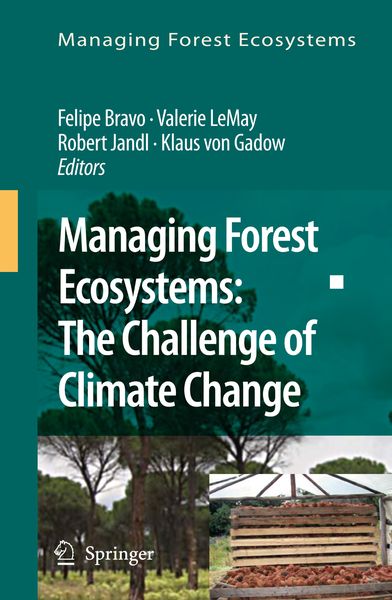
Managing Forest Ecosystems: The Challenge of Climate Change
Aus der Reihe
Managing Forest Ecosystems
-
- Hardcover
- Taschenbuch ausgewählt
- eBook
-
Sprache:Englisch
-
Verlag:Springer Netherland
Fr. 192.00
inkl. gesetzl. MwSt.,
Beschreibung
Produktdetails
Einband
Taschenbuch
Erscheinungsdatum
28.10.2010
Abbildungen
X, 340 p.
Herausgeber
Felipe Bravo + weitereVerlag
Springer NetherlandSeitenzahl
340
Maße (L/B/H)
23.5/15.5/2 cm
Gewicht
534 g
Auflage
1. Auflage
Sprache
Englisch
ISBN
978-90-481-7850-6
Climate changes, particularly warming trends, have been recorded around the globe. For many countries, these changes in climate have become evident through insect epidemics (e.g., Mountain Pine Beetle epidemic in Western Canada, bark beetle in secondary spruce forests in Central Europe), water shortages and intense forest fires in the Mediterranean countries (e.g., 2005 droughts in Spain), and unusual storm activities (e.g., the 2004 South-East Asia Tsunami). Climate changes are expected to impact vegetation as manifested by changes in vegetation extent, migration of species, tree species composition, growth rates, and mortality. The International Panel on Climate Change (IPCC) has included discussions on how forests may be impacted, and how they may be used to mitigate the impacts of changes in climate, to possibly slow the rate of change. This book provides current scientific information on the biological and economical impacts of climate changes in forest environments, as well as information on how forest management activities might mitigate these impacts, particularly through carbon sequestration. Case studies from a wide geographic range are presented. This information is beneficial to managers and researchers interested in climate change and impacts upon forest environments and economic activities. This volume, which forms part of Springer’s book series Managing Forest Ecosystems, presents state-of-the-art research results, visions and theories, as well as specific methods for sustainable forest management in changing climatic conditions.
Noch keine Bewertungen vorhanden
Verfassen Sie die erste Bewertung zu diesem Artikel
Helfen Sie anderen Kundinnen und Kunden durch Ihre Meinung.