
KI-Beratung Beta

  • Produktbild: Automated Deduction - A Basis for Applications Volume I Foundations - Calculi and Methods Volume II Systems and Implementation Techniques Volume III Applications
  • Produktbild: Automated Deduction - A Basis for Applications Volume I Foundations - Calculi and Methods Volume II Systems and Implementation Techniques Volume III Applications
Band 9

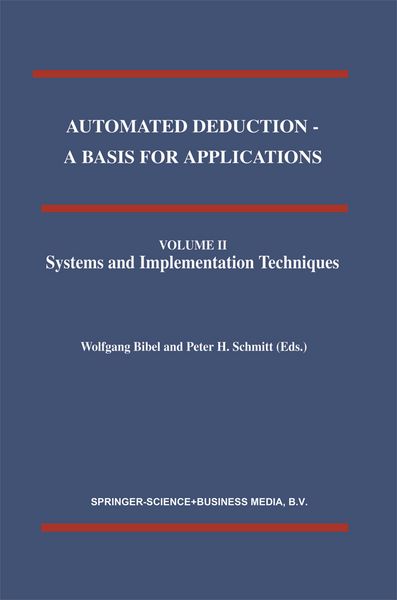
Automated Deduction - A Basis for Applications Volume I Foundations - Calculi and Methods Volume II Systems and Implementation Techniques Volume III Applications

Aus der Reihe Applied Logic Series

Fr. 241.00

inkl. gesetzl. MwSt., Versandkostenfrei


Beschreibung

1. BASIC CONCEPTS OF INTERACTIVE THEOREM PROVING Interactive Theorem Proving ultimately aims at the construction of powerful reasoning tools that let us (computer scientists) prove things we cannot prove without the tools, and the tools cannot prove without us. Interaction typi cally is needed, for example,...

Beschreibung

1. BASIC CONCEPTS OF INTERACTIVE THEOREM PROVING Interactive Theorem Proving ultimately aims at the construction of powerful reasoning tools that let us (computer scientists) prove things we cannot prove without the tools, and the tools cannot prove without us. Interaction typi cally is needed, for example, to direct and control the reasoning, to speculate or generalize strategic lemmas, and sometimes simply because the conjec ture to be proved does not hold. In software verification, for example, correct versions of specifications and programs typically are obtained only after a number of failed proof attempts and subsequent error corrections. Different interactive theorem provers may actually look quite different: They may support different logics (first-or higher-order, logics of programs, type theory etc.), may be generic or special-purpose tools, or may be tar geted to different applications. Nevertheless, they share common concepts and paradigms (e.g. architectural design, tactics, tactical reasoning etc.). The aim of this chapter is to describe the common concepts, design principles, and basic requirements of interactive theorem provers, and to explore the band width of variations. Having a 'person in the loop', strongly influences the design of the proof tool: proofs must remain comprehensible, - proof rules must be high-level and human-oriented, - persistent proof presentation and visualization becomes very important.

Portrait

Prof. Dr. Wolfgang Bibel lehrt das Fachgebiet Intellektik am Fachbereich Informatik der TH Darmstadt.

Produktdetails

Einband

Taschenbuch

Erscheinungsdatum

06.12.2010

Abbildungen

XIV, 434 p.

Herausgeber Wolfgang Bibel + weitere

Produktdetails

Einband

Taschenbuch

Erscheinungsdatum

06.12.2010

Abbildungen

XIV, 434 p.

Herausgeber
Verlag Springer Netherland
Seitenzahl

434

Maße (L/B/H)

23.5/15.5/2.5 cm

Gewicht

674 g

Auflage

1. Auflage

Sprache

Englisch

ISBN

978-90-481-5051-9

Herstelleradresse

Springer-Verlag KG
Sachsenplatz 4-6
1201 Wien
AT

Email: ProductSafety@springernature.com

Noch keine Bewertungen vorhanden

Verfassen Sie die erste Bewertung zu diesem Artikel

Helfen Sie anderen Kundinnen und Kunden durch Ihre Meinung.

Kundinnen und Kunden meinen

Bewertungen (0)

  • Produktbild: Automated Deduction - A Basis for Applications Volume I Foundations - Calculi and Methods Volume II Systems and Implementation Techniques Volume III Applications
  • Produktbild: Automated Deduction - A Basis for Applications Volume I Foundations - Calculi and Methods Volume II Systems and Implementation Techniques Volume III Applications
  • One Interactive Theorem Proving.- 1. Structured Specifications and Interactive Proofs with KIV.- 2. Proof Theory at Work: Program Development in the Minlog System.- 3. Interactive and automated proof construction in type theory.- 4. Integrating Automated and Interactive Theorem Proving.- Two Representation and Optimization Techniques.- 5. Term Indexing.- 6. Developing Deduction Systems: The Toolbox Style.- 7. Specifications of Inference Rules: Extensions of the PTTP Technique.- 8. Proof Analysis, Generalization and Reuse.- Three Parallel Inference Systems.- 9. Parallel Term Rewriting with PaReDuX.- 10. Parallel Theorem Provers Based on SETHEO.- 11. Massively Parallel Reasoning.- Four Comparision and Cooperation of Theorem Provers.- 12. Extension Methods in Automated Deduction.- 13. A Comparison of Equality Reasoning Heuristics.- 14. Cooperating Theorem Provers.