
Band 99
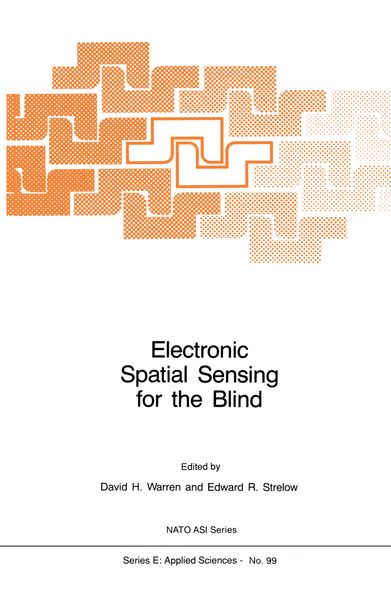
Electronic Spatial Sensing for the Blind Contributions from Perception, Rehabilitation, and Computer Vision
Aus der Reihe
NATO Science Series E:
-
- Hardcover
- Taschenbuch ausgewählt
- eBook
-
Sprache:Englisch
Fr. 360.00
inkl. gesetzl. MwSt.,
Beschreibung
Produktdetails
Einband
Taschenbuch
Erscheinungsdatum
25.12.2010
Abbildungen
XVI, 521 p.
Herausgeber
D.H. Warren + weitereVerlag
Springer NetherlandSeitenzahl
521
Maße (L/B/H)
23.5/15.5/2.9 cm
Gewicht
809 g
Auflage
Softcover reprint of hardcover 1st edition 1985
Sprache
Englisch
ISBN
978-90-481-8293-0
During September 10-14, 1984, we held a Research Workshop at the Lake Arrowhead Conference Center, California, bringing togeth er leaders in the field of electronic spatial sensors for the blind from the psychology, engineering, and rehabilitation areas. Our goal was to engage these groups in discussion with one another about prospects for the future of electronic spatial sensing, in the light of emerging technologies and the increasing sophistica tion of behavioral research related to this field. The papers in this book give an update on several of the key research traditions in thi s fi e 1 d. Broader overvi ews are provi ded in the paper by Brabyn, and in our Historical Overview, Final Commentary and the Introductions to each section. In a field as complex as this, some overlap of discussion is desirable and the reader with a serious interest in this field is advised to sample several opinions. This volume, and the conference on which it is based, received assistance from many people and organizations. The Scientific Affai rs Divi sion of the North Atl antic Treaty Organization sup ported the conference as part of their program of Advanced Research Workshops, and the Science and Technology to Aid the Handicapped Program of the National Science Foundation provided additional major financial support. The Center for Social and Behavioral Sciences Research of the University of California, Riverside provided financial as well as major logistical support.
Noch keine Bewertungen vorhanden
Verfassen Sie die erste Bewertung zu diesem Artikel
Helfen Sie anderen Kundinnen und Kunden durch Ihre Meinung.