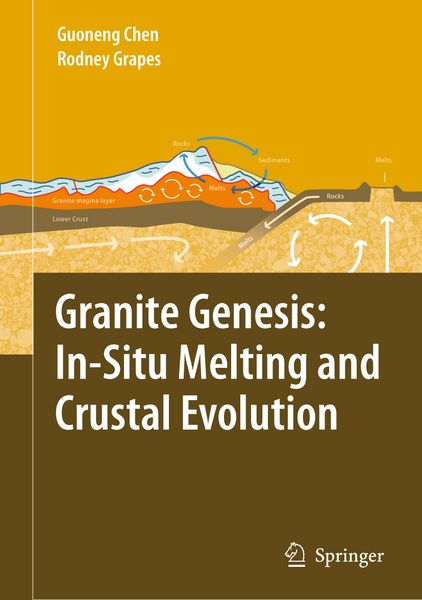
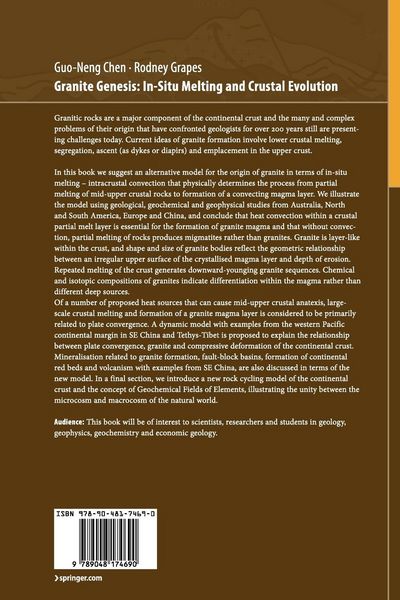
• Produktbild: Granite Genesis: In-Situ Melting and Crustal Evolution
  • Produktbild: Granite Genesis: In-Situ Melting and Crustal Evolution

Granite Genesis: In-Situ Melting and Crustal Evolution

Fr. 192.00

inkl. gesetzl. MwSt., Versandkostenfrei


Beschreibung

Produktdetails

Einband

Taschenbuch

Erscheinungsdatum

19.10.2010

Abbildungen

XI, 218 illus., 1 illus. in color., farbige Illustrationen, schwarz-weiss Illustrationen

Verlag

Springer Netherland

Seitenzahl

278

Maße (L/B/H)

24/16/1.6 cm

Gewicht

447 g

Auflage

Softcover reprint of hardcover 1st ed. 2007

Sprache

Englisch

ISBN

978-90-481-7469-0

Beschreibung

Rezension

From the reviews:


"Granite Genesis: In-Situ Melting and Crustal Evolution is a timely, well-structured, and enjoyable read. The authors provide a useful introduction to granite terminology and the ‘granite debate’ … The book benefits in continuity and style from having only two authors and is easy to read. … this book provides a valuable synthesis and is a great reference for all graduate students and professionals interested in granitic rocks, from their petrogenesis to emplacement mechanisms." (Victoria Pease, Geological Magazine, Vol. 146 (3), 2009)

Produktdetails

Einband

Taschenbuch

Erscheinungsdatum

19.10.2010

Abbildungen

XI, 218 illus., 1 illus. in color., farbige Illustrationen, schwarz-weiss Illustrationen

Verlag

Springer Netherland

Seitenzahl

278

Maße (L/B/H)

24/16/1.6 cm

Gewicht

447 g

Auflage

Softcover reprint of hardcover 1st ed. 2007

Sprache

Englisch

ISBN

978-90-481-7469-0

Herstelleradresse

Springer-Verlag GmbH
Tiergartenstr. 17
69121 Heidelberg
DE

Email: ProductSafety@springernature.com

Kundinnen und Kunden meinen

0 Bewertungen

Informationen zu Bewertungen

Zur Abgabe einer Bewertung ist eine Anmeldung im Konto notwendig. Die Authentizität der Bewertungen wird von uns nicht überprüft. Wir behalten uns vor, Bewertungstexte, die unseren Richtlinien widersprechen, entsprechend zu kürzen oder zu löschen.

Die Bewertungen sind nach Format, Anzahl Sterne und Datum sortiert.

Verfassen Sie die erste Bewertung zu diesem Artikel

Helfen Sie anderen Kund*innen durch Ihre Meinung

Kundinnen und Kunden meinen

0 Bewertungen filtern

  • Produktbild: Granite Genesis: In-Situ Melting and Crustal Evolution
  • Produktbild: Granite Genesis: In-Situ Melting and Crustal Evolution
  • Preface

    Acknowledgements

    1 Introduction

    1.1 Rock genesis and its relationship to geosystems

    1.1.1 Sedimentary rocks and continental geology

    1.1.2 Basaltic rocks and plate tectonics

    1.1.3 "Whence the granites"

    1.2 Granites, migmatites and granite problems

    1.2.1 Definitions

    1.2.1.1 Granite

    1.2.1.2 Migmatite: terminology and classification

    1.2.2 Granite magma intrusion and its problems

    2 Crustal melting: experiments and conditions

    2.1 Introduction

    2.2 Mineral melting

    2.2.1 Topology of melting

    2.2.2 Muscovite dehydration melting

    2.2.3 Biotite dehydration melting

    2.2.4 Hornblende dehydration melting

    2.2.5 Biotite and hornblende melting in granitic rocks

    2.2.6 Other hydrous minerals

    2.2.7 Suprasolidus decompression dehydration reactions

    2.3 Rock melting – experimental evidence

    2.3.1 Melt compositions

    2.3.2 Restite compositions

    2.3.3 Rock solidi

    2.3.4 Melt fraction

    2.3.5 Conclusion

    2.4 Structure and composition of the crust

    2.5 Water in the crust

    2.6 Crustal heat and partial melting

    2.6.1 Introduction

    2.6.2 Thickened crust

    2.6.3 Burial of high radiogenic rocks

    2.6.4 Shear heating

    2.6.5 Extension and removal of lithospheric mantle

    2.6.6 Intrusion of mafic magma

    2.6.7 Crustal thinning and "diapiric" decompression

    3. In-situ melting and intracrustal convection: granite magma layers

    3.1 Introduction

    3.1.1 Geophysical evidence for crustal melting

    3.1.1.1 Himalayas and Tibetan plateau

    3.1.1.2 The Andes

    3.1.2 P-T conditions of granite, migmatite and granulite formation

    3.2 Crustal melting I: Initial melting and partial melt layer

    3.2.1 Formation of a partial melt layer

    3.2.2 Development of a partial melt layer in heterogeneous crust

    3.3 Crustal melting II: Convection and formation of magma layer

    3.3.1 Gravitational separation and formation of magma layer 3.3.2 Convection and development of magma layer

    3.3.3 Upward thickening of magma layer

    3.4 Compositional variation within magma layer

    3.5 Magma layer, granite layer and granite bodies

    3.6 MI fluctuation (remelting) and granite sequence

    3.7 Conclusion

    4. Geological evidence for in-situ melting origin of granite layers

    4.1 Migmatite to granite

    4.1.1 Thor-Odin dome, Canada

    4.1.2 Broken Hill, Australia

    4.1.3 Mt. Stafford, Australia

    4.1.4 Trois Seigneurs massif, Pyrenees

    4.1.5 Velay Dome, France

    4.1.6 Coastal migmatite-granite zone, SE China

    4.1.7 Cooma and Murrumbidgee, Australia

    4.1.8 Optica grey gneiss, Canada

    4.2 Contact metamorphism

    4.3 Xenoliths and mafic enclaves

    4.4 Granite layer and granite exposures

    4.5 Fluctuation of MI and downward younging granite sequence

    5. Differentiation of magma layer: geochemical considerations

    5.1 Introduction

    5.2 Compositional variation

    5.3 Strontium isotopes

    5.4 Oxygen isotopes

    5.5 Rare earth elements

    5.6 Summary

    6. Mineralisation related to in-situ granite formation

    6.1 Introduction

    6.2 Source of ore-forming elements

    6.3 Formation and evolution of ore-bearing fluid

    6.4 Types of mineral deposits

    6.4.1 Vein mineralisation

    6.4.2 Disseminated mineralisation

    6.5 Age relationships

    6.6 Temperature distribution

    6.7 Formation and distribution of hydrothermal mineral deposits

    6.7.1 Precipitation of ore-forming elements

    6.7.2 Oxygen isotope evidence

    6.8 Mineralised depth horizons

    6.9 Mineralisation during elevated crustal temperatures

    6.10 Mineralisation during granite remelting

    6.10.1 Oxidation

    6.10.2 Uranium mineralisation

    6.11 Patterns of element redistribution and element fields

    6.12 Summary

     7. Heat source for crustal magma layers: tectonic models

    7.1 Introduction

    7.2 Crustal temperature disturbance related to plate convergence

    7.3 Subduction and granite formation: western Pacific continental margin

    7.3.1 Introduction

    7.3.2 Tectonic framework of SE China and granite formation

    7.3.3 Tectonic model

    7.3.4 Multiple melting (remelting) and granite belts

    7.3.5 Summary

    7.4 Continental collision and granite formation: Tethys Belt

    7.4.1 Tectonic framework and granite distribution of Tibet plateau

    7.4.2 Tectonic phases in relation to subduction and collision

    7.4.3 Magma layers and plate convergence

    7.5 Concluding statement

    8. Geological effects of crystallisation of a crustal granite magma layer: SE China

    8.1 Fault-block basins

    8.1.1. Characteristics and distribution of Mesozoic basins 8.1.2. Basin formation

    8.1.3. Origin of red beds

    8.1.4. Summary

    8.2. Volcanism

    9. Material and element cycling of the continental crust and summary

    9.1. Rock cycling of continental material

    9.2. Element cycling of the continental crust

    9.3. Overview

    References

    Appendix 1 Map showing provinces of SE China

    Appendix 2 Results of experimental rock melting