Band 216
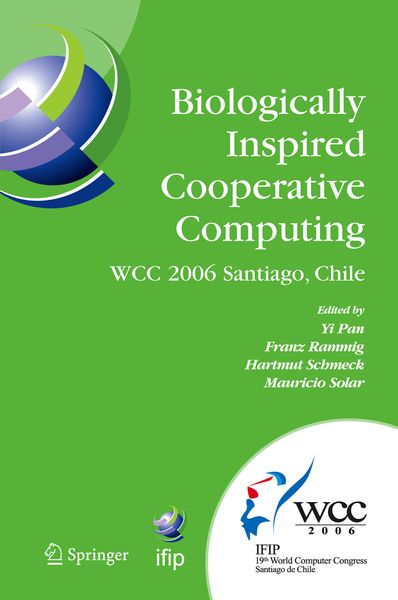
Biologically Inspired Cooperative Computing IFIP 19th World Computer Congress, TC 10: 1st IFIP International Conference on Biologically Inspired Cooperative Computing, August 21-24, 2006, Santiago, Chile
-
- Hardcover
- Taschenbuch ausgewählt
-
Sprache:Englisch
Fr. 138.00
inkl. gesetzl. MwSt.,
Beschreibung
Produktdetails
Einband
Taschenbuch
Erscheinungsdatum
29.11.2010
Abbildungen
X, 212 p.
Herausgeber
Yi Pan + weitereVerlag
Springer UsSeitenzahl
212
Maße (L/B/H)
23.5/15.5/1.3 cm
Gewicht
341 g
Sprache
Englisch
ISBN
978-1-4419-4184-8
In the world of information technology, it is no longer the computer in the classical sense where the majority of IT applications is executed; computing is everywhere. More than 20 billion processors have already been fabricated and the majority of them can be assumed to still be operational. At the same time, virtually every PC worldwide is connected via the Internet. This combination of traditional and embedded computing creates an artifact of a complexity, heterogeneity, and volatility unmanageable by classical means. Each of our technical artifacts with a built-in processor can be seen as a ''Thing that Thinks", a term introduced by MIT's Thinglab. It can be expected that in the near future these billions of Things that Think will become an ''Internet of Things", a term originating from ETH Zurich. This means that we will be constantly surrounded by a virtual "organism" of Things that Think. This organism needs novel, adequate design, evolution, and management means which is also one of the core challenges addressed by the recent German priority research program on Organic Computing.
Noch keine Bewertungen vorhanden
Verfassen Sie die erste Bewertung zu diesem Artikel
Helfen Sie anderen Kundinnen und Kunden durch Ihre Meinung.