New-Product Diffusion Models
-
- Hardcover
- Taschenbuch ausgewählt
-
Sprache:Englisch
Fr. 241.00
inkl. gesetzl. MwSt.,
Beschreibung
Produktdetails
Einband
Taschenbuch
Erscheinungsdatum
02.09.2011
Abbildungen
XIII, 355 p.
Herausgeber
Vijay Mahajan + weitereVerlag
Springer UsSeitenzahl
355
Maße (L/B/H)
23.5/15.5/2 cm
Gewicht
557 g
Auflage
2000
Sprache
Englisch
ISBN
978-1-4419-4963-9
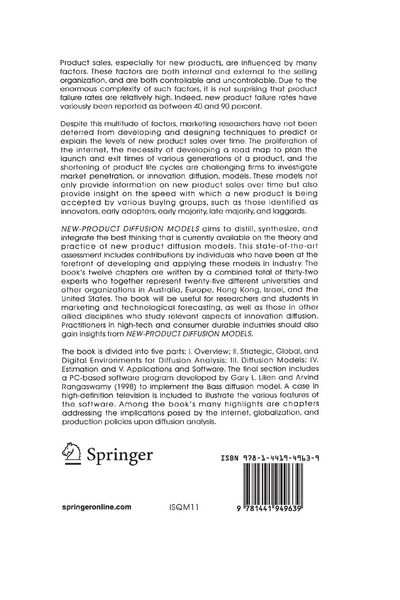
Despite this multitude of factors, marketing researchers have not been deterred from developing and designing techniques to predict or explain the levels of new product sales over time. The proliferation of the internet, the necessity or developing a road map to plan the launch and exit times of various generations of a product, and the shortening of product life cycles are challenging firms to investigate market penetration, or innovation diffusion, models. These models not only provide information on new product sales over time but also provide insight on the speed with which a new product is being accepted by various buying groups, such as those identified as innovators, early adopters, early majority, late majority, and laggards.
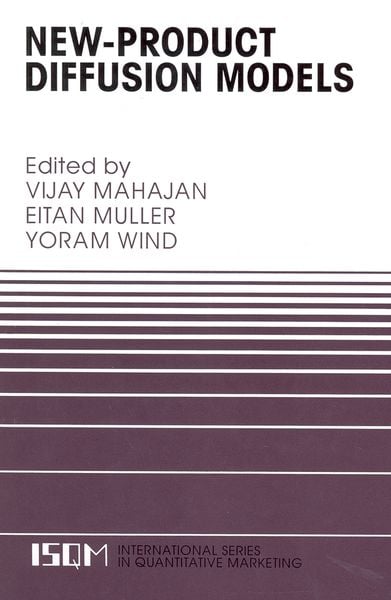
New Product Diffusion Models
aims to distill, synthesize, and integrate the best thinking that is currently available on the theory and practice of new product diffusion models. This state-of-the-art assessment includes contributions by individuals who have been at the forefront of developing and applying these models in industry. The book's twelve chapters are written by a combined total of thirty-two experts who together represent twenty-five different universities and other organizations in Australia, Europe, Hong Kong, Israel, and the United States. The book will be useful for researchers and students in marketing and technological forecasting, as well as those in other allied disciplines who study relevant aspects of innovation diffusion. Practitioners in high-tech and consumer durable industries should also gain newinsights from
New Product Diffusion Models.
The book is divided into five parts: I. Overview; II. Strategic, Global, and Digital Environments for Diffusion Analysis; III. Diffusion Models; IV. Estimation and V. Applications and Software. The final section includes a PC-based software program developed by Gary L. Lilien and Arvind Rangaswamy (1998) to implement the Bass diffusion model. A case on high-definition television is included to illustrate the various features of the software. Among the book's many highlights are chapters addressing the implications posed by the internet, globalization, and production policies upon diffusion of new products and technologies in the population.
Noch keine Bewertungen vorhanden
Verfassen Sie die erste Bewertung zu diesem Artikel
Helfen Sie anderen Kundinnen und Kunden durch Ihre Meinung.