• Produktbild: Reading Complex Words
  • Produktbild: Reading Complex Words
Band 22

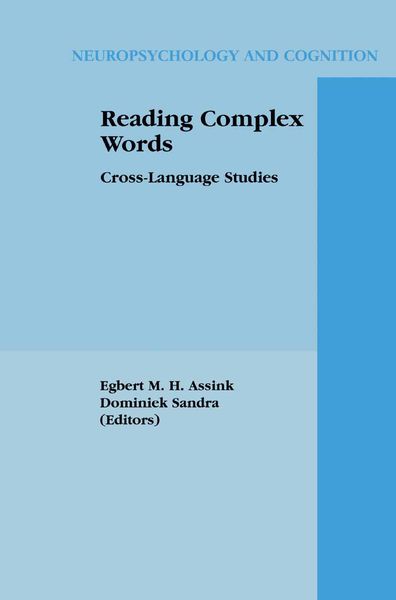
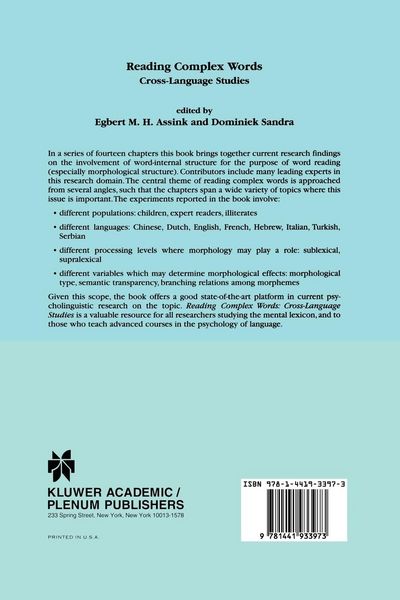
Reading Complex Words Cross-Language Studies

Fr. 192.00

inkl. gesetzl. MwSt., Versandkostenfrei


Beschreibung

Produktdetails

Einband

Taschenbuch

Erscheinungsdatum

06.12.2010

Abbildungen

XXII, 36 illus., schwarz-weiss Illustrationen

Herausgeber

Egbert M.H. Assink + weitere

Verlag

Springer Us

Seitenzahl

339

Maße (L/B/H)

23.5/15.5/2 cm

Gewicht

552 g

Auflage

Softcover reprint of hardcover 1st edition 2003

Sprache

Englisch

ISBN

978-1-4419-3397-3

Beschreibung

Rezension

"Overall, the book is quite comprehensive and adds substantive information to the pool of data regarding sublexical processes and reading."

(Jaumeiko J.C. Brown, Ph.D.)

Produktdetails

Einband

Taschenbuch

Erscheinungsdatum

06.12.2010

Abbildungen

XXII, 36 illus., schwarz-weiss Illustrationen

Herausgeber

Verlag

Springer Us

Seitenzahl

339

Maße (L/B/H)

23.5/15.5/2 cm

Gewicht

552 g

Auflage

Softcover reprint of hardcover 1st edition 2003

Sprache

Englisch

ISBN

978-1-4419-3397-3

Herstelleradresse

Springer-Verlag GmbH
Tiergartenstr. 17
69121 Heidelberg
DE

Email: GPSR Kontakt

Noch keine Bewertungen vorhanden

Verfassen Sie die erste Bewertung zu diesem Artikel

Helfen Sie anderen Kundinnen und Kunden durch Ihre Meinung.

Kundinnen und Kunden meinen

Bewertungen (0)

  • Produktbild: Reading Complex Words
  • Produktbild: Reading Complex Words
  • 1. Linking morphological knowledge to English decoding ability: Large effects of little suffixes.- 2. The effects of morphological structure on children’s reading of derived words in English.- 3. Morphological and phonological analysis by beginning readers: Evidence from Serbian and Turkish.- 4. Recognizing morphologically complex words in Turkish.- 5. Word decomposition in Hebrew as a Semitic language.- 6. Morphological representation as a correlation between form and meaning.- 7. A supralexical model for French derivational morphology.- 8. Parsing and semantic opacity.- 9. Effects of sublexical frequency and meaning in prefixed words.- 10. Morphological parsing and morphological structure.- 11. Morpheme-based lexical reading: Evidence from pseudoword naming.- 12. Word reading processes in adult learners.- 13. Reading aloud polysyllabic words.- 14. Homophonous regular verb forms with a morphographic spelling: Spelling errors as a window on the mental lexicon and working memory.