Band 682
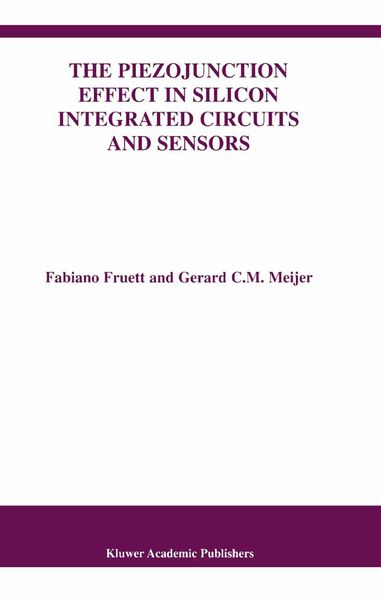
The Piezojunction Effect in Silicon Integrated Circuits and Sensors
-
- Hardcover
- Taschenbuch ausgewählt
- eBook
-
Sprache:Englisch
Fr. 138.00
inkl. gesetzl. MwSt.,
Beschreibung
Produktdetails
Einband
Taschenbuch
Erscheinungsdatum
09.12.2010
Verlag
Springer UsSeitenzahl
162
Maße (L/B/H)
23.5/15.5/1 cm
Gewicht
278 g
Auflage
Softcover reprint of the original 1st ed. 2002
Sprache
Englisch
ISBN
978-1-4419-5282-0
Mechanical stress affects the magnitude of base-emitter voltages of forward biased bipolar transistors. This phenomenon is called the piezojunction effect. The piezojunction effect is the main cause of inaccuracy and drift in integrated temperature sensors and bandgap voltage references. The aim of The Piezojunction Effect in Silicon Integrated Circuits and Sensors is twofold. Firstly, to describe techniques that can reduce the mechanical-stress-induced inaccuracy and long-term instability. Secondly, to show, that the piezojunction effect can be applied for new types of mechanical-sensor structures. During IC fabrication and packaging thermo-mechanical stress is induced, when the packaged chips cool down to the temperature of application.
The piezojunction effect is caused by a stress-induced change in the conductivity of the minority-charge carriers, while the piezoresistive effect is caused by a similar effect for the majority-charge carriers. To characterise the anisotropic piezojunction effect, the authors performed systematic investigations over wide ranges of mechanical stress and temperature. The experiments have been performed for various crystal and stress orientations. The experimental results have been used to extract the first- and second-order piezojunction (FOPJ and SOPJ) coefficients for bipolar transistors.
It is shown how the knowledge of the piezojunction and piezoresistive coefficients can used to minimize the undesirable mechanical-stress effects on the electrical characteristics of transistors and resistors, respectively. Devices with lower mechanical-stress sensitivity can be found by comparing their piezo-coefficients. The layout of the device can also be optimized to reduce the mechanical-stress sensitivity.
As a next step it is shown, how the knowledge of the piezo-effects on device level can be used to predict and to reduce their negative influence on circuit level. This is demonstrated for a number of important basic circuits, including translinear circuits, temperature transducers and bandgap references.
Finally, it is shown how the piezojunction effect can be used to fabricate stress-sensing elements. It appears that, in comparison with resistive stress-sensing elements, the piezojunction sensors have the advantage of a smaller size and very low power dissipation.
The piezojunction effect is caused by a stress-induced change in the conductivity of the minority-charge carriers, while the piezoresistive effect is caused by a similar effect for the majority-charge carriers. To characterise the anisotropic piezojunction effect, the authors performed systematic investigations over wide ranges of mechanical stress and temperature. The experiments have been performed for various crystal and stress orientations. The experimental results have been used to extract the first- and second-order piezojunction (FOPJ and SOPJ) coefficients for bipolar transistors.
It is shown how the knowledge of the piezojunction and piezoresistive coefficients can used to minimize the undesirable mechanical-stress effects on the electrical characteristics of transistors and resistors, respectively. Devices with lower mechanical-stress sensitivity can be found by comparing their piezo-coefficients. The layout of the device can also be optimized to reduce the mechanical-stress sensitivity.
As a next step it is shown, how the knowledge of the piezo-effects on device level can be used to predict and to reduce their negative influence on circuit level. This is demonstrated for a number of important basic circuits, including translinear circuits, temperature transducers and bandgap references.
Finally, it is shown how the piezojunction effect can be used to fabricate stress-sensing elements. It appears that, in comparison with resistive stress-sensing elements, the piezojunction sensors have the advantage of a smaller size and very low power dissipation.
Noch keine Bewertungen vorhanden
Verfassen Sie die erste Bewertung zu diesem Artikel
Helfen Sie anderen Kundinnen und Kunden durch Ihre Meinung.