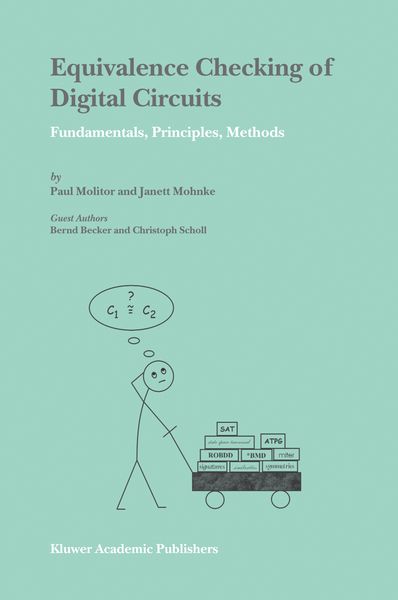
Equivalence Checking of Digital Circuits Fundamentals, Principles, Methods
-
- Hardcover
- Taschenbuch ausgewählt
- eBook
-
Sprache:Englisch
Fr. 192.00
inkl. gesetzl. MwSt.,
Beschreibung
Produktdetails
Einband
Taschenbuch
Erscheinungsdatum
07.12.2010
Abbildungen
XIII, 263 p.
Verlag
Springer UsSeitenzahl
263
Maße (L/B/H)
23.5/15.5/1.6 cm
Gewicht
429 g
Auflage
Softcover reprint of the original 1st ed. 2004
Sprache
Englisch
ISBN
978-1-4419-5423-7
Hardware veri?cation is the process of checking whether a design conforms to its speci?cations of functionality and timing. In today’s design processes it becomes more and more important. Very large scale integrated (VLSI) circuits and the resulting digital systems have conquered a place in almost all areas of our life, even in security sensitive applications. Complex digital systems control airplanes, have been used in banks and on intensive-care units. Hence, the demand for error-free designs is more important than ever. In addition, economic reasons underline this demand as well. The design and production process of present day VLSI-circuits is highly time- and cost-intensive. Mo- over, it is nearly impossible to repair integrated circuits. Thus, it is desirable to detect design errors early in the design process and not just after producing the prototype chip. All these facts are re?ected by developing and prod- tion statistics of present day companies. For example, In?neon Technologies [118] assumed that about 60% to 80% of the overall design time was spent for veri?cation in 2000. Other sources cite the 3-to-1 head count ratio between veri?cation engineers and logic designers. This shows that verifying logical correctness of the design of hardware systems is a major gate to the problem of time-to-market (cf. [113]). With the chip complexity constantly increasing, the dif?culty as well as the - portance of functional veri?cation of new product designs has been increased. It is not only more important to get error-free designs.
Noch keine Bewertungen vorhanden
Verfassen Sie die erste Bewertung zu diesem Artikel
Helfen Sie anderen Kundinnen und Kunden durch Ihre Meinung.