
KI-Beratung Beta

  • Produktbild: Law, Order and Freedom
  • Produktbild: Law, Order and Freedom
Band 94

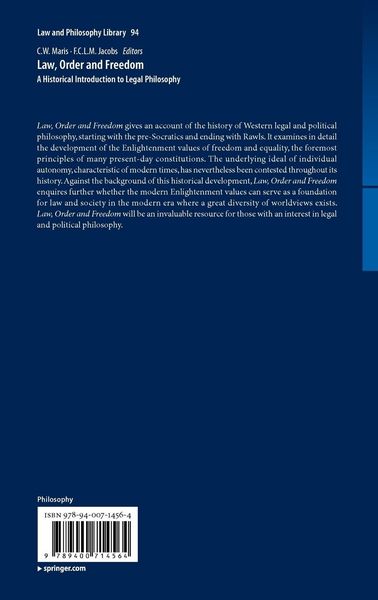
Law, Order and Freedom A Historical Introduction to Legal Philosophy

Fr. 161.00

inkl. gesetzl. MwSt., Versandkostenfrei


Beschreibung

The central question in legal philosophy is the relationship between law and morality. The legal systems of many countries around the world have been influenced by the principles of the Enlightenment: freedom, equality and fraternity. The position is similar in relation to the accompanying state ideal...

Beschreibung

The central question in legal philosophy is the relationship between law and morality. The legal systems of many countries around the world have been influenced by the principles of the Enlightenment: freedom, equality and fraternity. The position is similar in relation to the accompanying state ideal of the democratic constitutional state as well as the notion of a welfare state. The foundation of these principles lies in the ideal of individual autonomy. The law must in this view guarantee a social order which secures the equal freedom of all. This freedom is moreover fundamental because in modern pluralistic societies a great diversity of views exist concerning the appropriate way of life. This freedom ideal is however also strongly contested. In Law, Order and Freedom, a historical overview is given pertaining to the question of the extent to which the modern Enlightenment values can serve as the universal foundation of law and society.

Portrait


Cees Maris is professor of legal philosophy at the University of Amsterdam. He is the editor of several journals in the fields of jurisprudence and philosophy. His main fields of research are the concept of liberty and its practical applications, multiculturalism, love, art, law and literature, and epistemology. Among his publications are
A Critique of the Empiricist Explanation of Morality
;
Letters on Liberty
; and
Twelve Loves
. He also wrote and brought on the stage the philosophical oratorio
Horror Vacui
(in cooperation with the composer José-Luis Greco) and the philosophical dialogue
The Dance of Zarathustra
.
Frans Jacobs is professor (emeritus) of philosophical ethics at the University van Amsterdam. His publications concern philosophers such as Aristotle, Spinoza, Hume, Kant, Schopenhauer, Mill, Habermas, Nozick and Nussbaum, and cover the themes of liberalism, paternalism, egalitarianism and nationalism, as well as toleration, civilized revenge, the meaning of life, the Homeric heroes, the difference between love and war, emotions in general and moral emotions in particular. His most recent book is
A Philosophy of Emotions and Desires
.
Jacques de Ville is professor of law at the University of the Western Cape, South Africa. His main fields of research are constitutional theory, deconstruction, and psychoanalysis. His publications include
Constitutional and Statutory Interpretation
;
Judicial Review of Administrative Action
in South Africa
; and the forthcoming
Jacques Derrida: Law as Absolute Hospitality
.

Produktdetails

Einband

Gebundene Ausgabe

Erscheinungsdatum

10.09.2011

Abbildungen

XIII, 388 p.

Herausgeber C.W. Maris + weitere

Produktdetails

Einband

Gebundene Ausgabe

Erscheinungsdatum

10.09.2011

Abbildungen

XIII, 388 p.

Herausgeber
Verlag Springer Netherland
Seitenzahl

388

Maße (L/B/H)

24.1/16/2.6 cm

Gewicht

718 g

Auflage

1. Auflage

Übersetzt von

J.R. de Ville

Sprache

Englisch

ISBN

978-94-007-1456-4

Herstelleradresse

Springer-Verlag KG
Sachsenplatz 4-6
1201 Wien
AT

Email: ProductSafety@springernature.com

Noch keine Bewertungen vorhanden

Verfassen Sie die erste Bewertung zu diesem Artikel

Helfen Sie anderen Kundinnen und Kunden durch Ihre Meinung.

Kundinnen und Kunden meinen

Bewertungen (0)

  • Produktbild: Law, Order and Freedom
  • Produktbild: Law, Order and Freedom

  • Chapter 1 Legal Philosophy: The Most Important Controversies; Maris.- Chapter 2 Antiquity and the Middle Ages; Van der Vliet (2.1-2.4, with contributions by Maris), Jacobs (2.5-2.8, with contributions by Van der Vliet).- Chapter 3 The Commencement of the Modern Age; Den Hartogh, with an introduction by Maris.- Chapter 4 Hobbes, Locke and Spinoza; Den Hartogh (4.1, 4.2, 4.4), Jacobs (4.3).- Chapter 5 Eighteenth-Century French Enlightenment; Kaptein (5.1-5.7; 5.6 partly by Maris).- Chapter 6 The Synthesis of Kant; Maris (6.1, 6.2, 6.5), Jacobs (6.3, 6.4.3, 6.6), Van der Vliet (6.4.1, 6.4.2).- Chapter 7 Nineteenth Century; Maris (7.1, 7.4.1-7.4.5, 7.4.7, 7.5), Jacobs (7.2, 7.4.6), Van Erp (7.3).- Chapter 8 Twentieth Century; 1900-1945: Maris (8.1, 8.3-8.5), De Ville (8.2).- Chapter 9 Twentieth Century; 1945-2000; Maris (9.1-9.4), De Ville (9.5).- Chapter 10 Conclusion: Law, Order and Freedom; Jacobs (10.1-10.5, 10.9-10.10, with contributions by Maris), Maris (10.6-10.8).- Bibliography.- Index of Names.