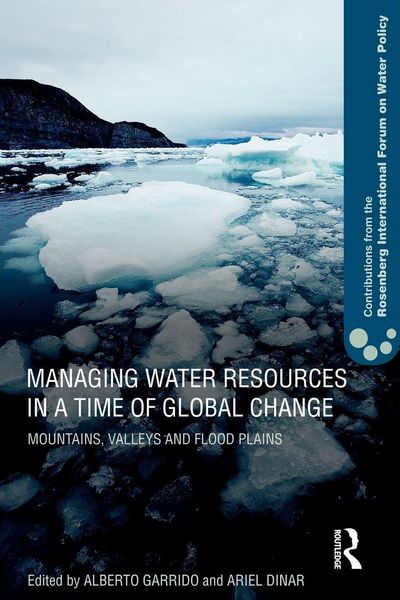
Managing Water Resources in a Time of Global Change Contributions from the Rosenberg International Forum on Water Policy
-
- Hardcover
- Taschenbuch ausgewählt
-
Sprache:Englisch
Fr. 83.90
inkl. gesetzl. MwSt.,
Beschreibung
Produktdetails
Einband
Taschenbuch
Erscheinungsdatum
01.12.2010
Abbildungen
schwarz-weiss Illustrationen, Raster, schwarz-weiss, Zeichnungen, schwarz-weiss, Tabellen, schwarz-weiss
Herausgeber
Garrido Alberto + weitereVerlag
Taylor and FrancisSeitenzahl
288
Maße (L/B/H)
23.4/15.6/1.6 cm
Gewicht
540 g
Sprache
Englisch
ISBN
978-0-415-61977-6
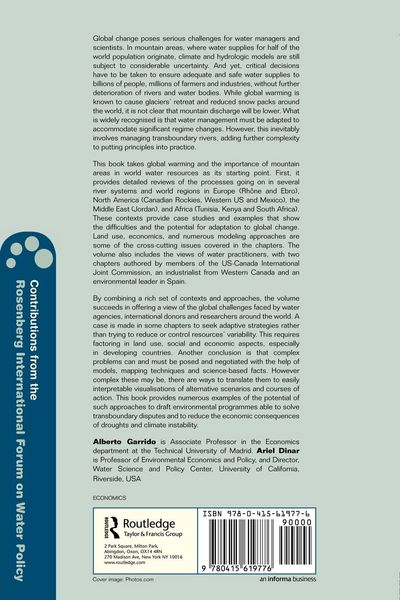
First, it provides detailed reviews of the processes going on in several rivers systems and world regions in Europe (Rhone and Ebro), North America (Canadian Rockies, Western US and Mexico), the Middle East (Jordan), Africa (Tunisia, Kenya and South Africa). These contexts provide case studies and examples that show the difficulties and potential for adaptation to global change. Land-use, economics, numerous modeling approaches are some of the cross-cutting issues covered in the chapters. The volume also includes the views of water practitioners, with two chapters authored by members of the US-Canada International Joint Commission, an industrialist from Western Canada and an environmental leader in Spain. By combining a rich set of contexts and approaches, the volume succeeds in offering a view of the global challenges faced by water agencies, international donors and researchers around the world. A case is made in some chapters to seek adaptive strategies rather than trying to reduce or control resources variability. This requires factoring in land-use, social and economic aspects, especially in developing countries.
Another conclusion is that complex problems can and must be posed and negotiated with the help of models, mapping techniques and science-based facts. However complex these may be, there are ways to translate them to easily interpretable and visualisations of alternative scenarios and courses of action. This book provides numerous examples of the potential of such approaches to draft environmental programmes solve transboundary disputes and reduce the economic consequences of droughts and climate instability.
Kundinnen und Kunden meinen
Verfassen Sie die erste Bewertung zu diesem Artikel
Helfen Sie anderen Kund*innen durch Ihre Meinung