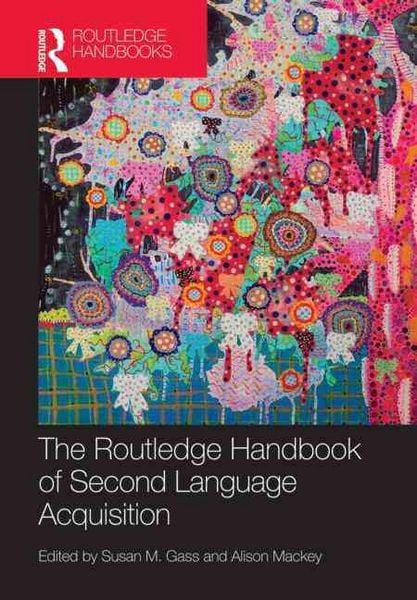
Produktbild: Routledge Handbook of Second Language Acquisition

Routledge Handbook of Second Language Acquisition

Fr. 388.00

inkl. gesetzl. MwSt., Versandkostenfrei


Beschreibung

Produktdetails

Einband

Taschenbuch

Erscheinungsdatum

28.11.2011

Herausgeber

Susan M. Gass + weitere

Verlag

Taylor & Francis

Seitenzahl

628

Maße (L/B/H)

25.6/17.4/3.9 cm

Gewicht

1280 g

Sprache

Englisch

ISBN

978-0-415-47993-6

Beschreibung

Rezension

A 2012 CHOICE Outstanding Academic Title

"This is an excellent collection of writings on traditional and developing areas of study in second-language acquisition learning and teaching. Summing Up: Essential." - CHOICE

"The editors, Susan M. Gass and Alison Mackey, have done a sterling job with this Handbook. The biggest names and rising stars in the fields of second language teaching and language learning have contributed to this "magnum opus". The chapters share a common structure and are highly accessible. I finished most chapters with a sudden ardent desire to plunge into that area and start working on the many unsolved questions in SLA." - Jean-Marc Dewaele, Birkbeck, University of London, UK

"Focusing specifically on second language learning, the 35 chapters that constitute this volume offer fundamental information about both traditional as well as emerging topics in SLA research." - Studies in Second Language Acquisition

"Case studies are presented in each case which further help the reader grasp a better understanding of the theoretical frameworks and claims. Moreover, the importance of this volume lies on the sections which bridge the gap between theory and its application to second language classroom. Possible future research and directions are also of great value." - Alexandra Galani, University of Ioannina

Zitat

A 2012 CHOICE Outstanding Academic Title "The editors, Susan M. Gass and Alison Mackey, have done a sterling job with this Handbook. The biggest names and rising stars in the fields of second language teaching and language learning have contributed to this "magnum opus". The chapters share a common structure and are highly accessible. I finished most chapters with a sudden ardent desire to plunge into that area and start working on the many unsolved questions in SLA." - Jean-Marc Dewaele, Birkbeck, University of London, UK "Focusing specifically on second language learning, the 35 chapters that constitute this volume offer fundamental information about both traditional as well as emerging topics in SLA research." - Studies in Second Language Acquisition

Produktdetails

Einband

Taschenbuch

Erscheinungsdatum

28.11.2011

Herausgeber

Verlag

Taylor & Francis

Seitenzahl

628

Maße (L/B/H)

25.6/17.4/3.9 cm

Gewicht

1280 g

Sprache

Englisch

ISBN

978-0-415-47993-6

Kundinnen und Kunden meinen

0 Bewertungen

Informationen zu Bewertungen

Zur Abgabe einer Bewertung ist eine Anmeldung im Konto notwendig. Die Authentizität der Bewertungen wird von uns nicht überprüft. Wir behalten uns vor, Bewertungstexte, die unseren Richtlinien widersprechen, entsprechend zu kürzen oder zu löschen.

Die Bewertungen sind nach Format, Anzahl Sterne und Datum sortiert.

Verfassen Sie die erste Bewertung zu diesem Artikel

Helfen Sie anderen Kund*innen durch Ihre Meinung

Kundinnen und Kunden meinen

0 Bewertungen filtern

Die Leseprobe wird geladen.
  • Produktbild: Routledge Handbook of Second Language Acquisition
  • Introduction: Introduction Susan M. Gass, Michigan State University Alison Mackey, Georgetown University Section 1: Language in Context Chapter 1 Interactionist approach Alison Mackey, Georgetown University Rebekha Abbuhl, California State University, Long Beach Susan Gass, Michigan State University Chapter 2 The role of Feedback Shawn Loewen, Michigan State University Chapter 3 Variationist perspectives Bob Bayley, University of California, Davis Elaine Tarone, University of Minnesota Chapter 4 Sociocultural theory Jim Lantolf, Penn State University Chapter 5 Complexity theory/emergentism Diane Larsen-Freeman, University of Michigan at Ann Arbor Section 2: Linguistic Perspectives Part One: Language Form Chapter 6 Phonology Fred Eckman, University of Wisconsin, Milwaukee Chapter 7 L2 Morphosyntax/Syntax Donna Lardiere, Georgetown University Part Two: Meaning Chapter 8 Semantics Roumyana Slabakova, University of Iowa Chapter 9 Pragmatics Kathleen Bardovi-Harlig Chapter 10 Vocabulary Batia Laufer - University of Haifa I.S.P. Nation - Victoria University of Wellington Section 3. Psycholinguistic and neurolinguistic perspectives Chapter 11 Processing Norman Segalowitz & Pavel Trofimovich Concordia University, Montreal Chapter 12 Frequency-based accounts Nick Ellis, University of Michigan at Ann Arbor Chapter 13 Competition model Brian MacWhinney, Carnegie Mellon University Chapter 14 Processability theory Manfred Pienemann, Paderborn University, Germany and Newcastle University, UK Jorg-U. Kessler, Ludwigsburg University of Education, Germany Chapter 15 Noticing/attention/awareness Peter Robinson, Aoyama, Japan Richard Schmidt, University of Hawai'i at Manoa Chapter 16 Input processing Bill Van Patten, Texas Tech University Chapter 17 Neurolinguistics Kara Morgan-Short, University of Illinois-Chicago Michael Ullman, Georgetown University Section 4. Skill Learning Chapter 18 L2 reading Keiko Koda, Carnegie Mellon University Chapter 19 L2 writing Charlene Polio, Michigan State University Chapter 20 L2 speech production Lucy Pickering, Georgia State University Chapter 21 L2 speech perception Debra Hardison, Michigan State University Chapter 22 Oral versus written production Folkert Kuiken & Ineke Vedder, University of Amsterdam Section 5. Individual Differences Chapter 23 Aptitude Peter Skehan, The Chinese University of Hong Kong, Hong Kong, China Chapter 24 Motivation Ema Ushioda and Zoltan Dornyei, University of Nottingham, United Kingdom Chapter 25 Issues of identity Patsy Duff, University of British Columbia Chapter 26 Working memory John Williams, University of Cambridge, United Kingdom Chapter 27 Language learning across the lifespan Robert DeKeyser, University of Maryland at College Park Chapter 28 Educational level Martha Bigelow and Jill Watson, University of Minnesota Chapter 29 Attrition/fossilization ZhaoHong Han, Columbia University Chapter 30 Heritage language learners Olga Kagan, University of California at Los Angeles Kathleen Dillon, University of California, Davis Chapter 31 Advanced language proficiency Heidi Byrnes, Georgetown University Section 6. The Setting for Learning Chapter 32: Learning in a second language setting (study abroad) Sally Magnan, University of Wisconsin and Bobbie Lafford, Arizona State University Chapter 33 Classroom research including SL and FL environments Jessica Williams, University of Illinois-Chicago Chapter 34 Learning through technology Trude Heift, Simon Fraser University and Carol Chapelle, Iowa State University Section 7. Conclusion: Assessment of L2 knowledge Chapter 35 Assessing learner knowledge Lourdes Ortega/John Norris, University of Hawai'i at Manoa Glossary Author Index Subject Index