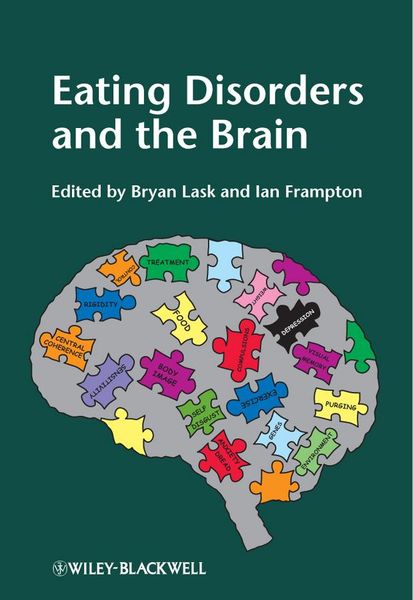
Produktbild: Eating Disorders and the Brain

Eating Disorders and the Brain

Fr. 118.00

inkl. gesetzl. MwSt., Versandkostenfrei


Beschreibung

Produktdetails

Einband

Gebundene Ausgabe

Erscheinungsdatum

26.09.2011

Verlag

John Wiley & Sons Inc

Seitenzahl

272

Maße (L/B/H)

25.5/17.7/1.9 cm

Gewicht

616 g

Auflage

1. Auflage

Sprache

Englisch

ISBN

978-0-470-67003-3

Beschreibung

Rezension

"Congratulation on excellent book: informative, readable, broad in its coverage, and very useful to those of us who are not neuroscientists.I particularly appreciated the several concluding chapters that articulated and evaluated the nature, strengths, and shortcomings of models."
(Dr Michael Levine, Emeritus Professor of Psychology, Kenyon College, Gambier, USA, November 2102)
"This is a very good contribution to the psychiatric literature that will help clinicians, researchers, and neuroscientists in general to understand eating disorders from a biopsychosocial perspective. It gives a very explicit definition of eating disorders as well as treatment options and future overviews." (Doody's, 25 May 2012) "Well written and well edited, nicely balanced between academic reviews and integrative theoretical syntheses, the readable chapters will inform readers who lack deep knowledge about biological aspects of eating disorders as well as those who are better informed. Chapters are scholarly without being stuffy, and contributors summarize pertinent studies in structural and functional neuroimaging, neuropsychology, and the neuroscience of body image.
For serious eating disorders clinicians as well as academicians, there's much in this book to study and ponder." - EATING DISORDERS REVIEW
"There has been an important paradigm shift in thinking about eating disorders in that the brain is receiving more attention. The Academy of Eating Disorders has published a position paper placing the brain more centrally within these highly complex multifaceted disorders. This book is an important addition to the literature: the authors are all expert communicators and are able to make the topic simple, enjoyable and easy to understand." - Janet Treasure, Professor of Psychiatry, Guy's, King's & St Thomas' Medical School, London, U

Produktdetails

Einband

Gebundene Ausgabe

Erscheinungsdatum

26.09.2011

Verlag

John Wiley & Sons Inc

Seitenzahl

272

Maße (L/B/H)

25.5/17.7/1.9 cm

Gewicht

616 g

Auflage

1. Auflage

Sprache

Englisch

ISBN

978-0-470-67003-3

Herstelleradresse

Libri GmbH
Europaallee 1
36244 Bad Hersfeld
DE

Email: gpsr@libri.de

Noch keine Bewertungen vorhanden

Verfassen Sie die erste Bewertung zu diesem Artikel

Helfen Sie anderen Kundinnen und Kunden durch Ihre Meinung.

Kundinnen und Kunden meinen

Bewertungen (0)

Die Leseprobe wird geladen.
  • Produktbild: Eating Disorders and the Brain
  • Preface xi

    List of contributors xiii

    Acknowledgements xv

    1 Why clinicians should love neuroscience: the clinical relevance of contemporary knowledge 1
    David Wood

    1.1 Introduction 1

    1.2 The legacy of mind-body dualism 2

    1.3 Free will and determinism 3

    1.4 Clinical implications 3

    1.5 Restriction of energy intake and increase in energy output 4

    1.6 Non-eating-related concerns 5

    1.7 In-the-beginning questions: the problem of aetiology in eating disorders 6

    1.8 The temporal, 'vertical' aetiological dimension 7

    1.9 The spatial, 'horizontal' aetiological dimension 11

    1.10 The importance of a neuroscientific aetiological framework 13

    1.11 Conclusion 15

    References 16

    2 Eating disorders: an overview 19
    Beth Watkins

    2.1 Introduction 19

    2.2 Clinical descriptions 20

    2.3 Comorbidity 24

    2.4 Epidemiology 25

    2.5 Aetiology and risk factors 27

    2.6 Treatment 35

    2.7 Course and outcome 40

    2.8 Conclusion 41

    References 41

    3 Neuroimaging 56
    Tone Seim Fuglset and Ian Frampton

    3.1 Introduction 56

    3.2 Structural imaging 56

    3.3 Functional imaging 90

    3.4 Conclusion 101

    References 101

    4 Neuropsychology 106
    Joanna E. Steinglass and Deborah R. Glasofer

    4.1 Introduction 106

    4.2 Intellectual functioning 107

    4.3 Attention 108

    4.4 Memory 110

    4.5 Visuospatial processing 111

    4.6 Executive functioning 113

    4.7 Conclusion 116

    References 117

    5 Neurochemistry: the fabric of life and the fabric of eating disorders 122
    Kenneth Nunn

    5.1 Introduction 122

    5.2 Five aims 122

    5.3 Five propositions relating neurochemistry to the field of eating disorders 123

    5.4 Five implications of these propositions 127

    5.5 Five directions for future research 127

    5.6 Conclusion 127

    Acknowledgement 128

    References 128

    6 Body-image disturbance 129
    Maria Øverås

    6.1 Introduction 129

    6.2 What is body image? 130

    6.3 How is body image constructed in the brain? 130

    6.4 Body-image disturbance in eating disorders 133

    6.5 The neuroscience of body-image distortion in anorexia nervosa 134

    6.6 Conclusion 138

    References 139

    7 Conceptual models 142
    Mark Rose and Ian Frampton

    7.1 Introduction 142

    7.2 Conceptual models in anorexia nervosa 143

    7.3 Conclusion 161

    References 163

    8 Towards a comprehensive, causal and explanatory neuroscience model of anorexia nervosa 164
    Kenneth Nunn, Bryan Lask and Ian Frampton

    8.1 Introduction 164

    8.2 The model 164

    8.3 Critical appraisal 173

    8.4 Clinical implications 175

    8.5 Conclusion 177

    Acknowledgements 177

    References 177

    9 Neurobiological models: implications for patients and families 180
    Ilina Singh and Alina Wengaard

    9.1 Introduction 180

    9.2 The emergence of neurobiological models 180

    9.3 Anorexia nervosa and illness representations 181

    9.4 Impact of a neurobiological model on families' understandings of anorexia nervosa 183

    9.5 Conclusion 188

    References 189

    10 Implications for treatment 191
    Camilla Lindvall and Bryan Lask

    10.1 Introduction 191

    10.2 Psychopharmacology 192

    10.3 The educational context 193

    10.4 Psychological treatment 194

    10.5 Conclusion 205

    References 205

    11 Future directions 207
    Ian Frampton and Bryan Lask

    11.1 Introduction 207

    11.2 Cause 207

    11.3 Assessment and diagnosis 208

    11.4 Treatment 210

    11.5 Prevention 211

    11.6 Future directions 212

    11.7 Conclusion 215

    References 216

    Index 219