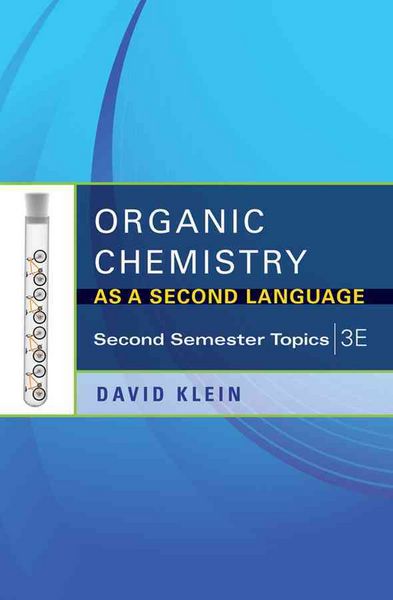
Produktbild: Organic Chemistry As a Second Language

Organic Chemistry As a Second Language Second Semester Topics

Fr. 82.90

inkl. gesetzl. MwSt., Versandkostenfrei


Beschreibung

Produktdetails

Einband

Taschenbuch

Erscheinungsdatum

01.11.2011

Verlag

John Wiley & Sons Inc

Seitenzahl

368

Maße (L/B/H)

24.1/15.9/1.5 cm

Gewicht

426 g

Auflage

3. Auflage

Sprache

Englisch

ISBN

978-1-118-14434-3

Beschreibung

Produktdetails

Einband

Taschenbuch

Erscheinungsdatum

01.11.2011

Verlag

John Wiley & Sons Inc

Seitenzahl

368

Maße (L/B/H)

24.1/15.9/1.5 cm

Gewicht

426 g

Auflage

3. Auflage

Sprache

Englisch

ISBN

978-1-118-14434-3

Kundinnen und Kunden meinen

0 Bewertungen

Informationen zu Bewertungen

Zur Abgabe einer Bewertung ist eine Anmeldung im Konto notwendig. Die Authentizität der Bewertungen wird von uns nicht überprüft. Wir behalten uns vor, Bewertungstexte, die unseren Richtlinien widersprechen, entsprechend zu kürzen oder zu löschen.

Die Bewertungen sind nach Format, Anzahl Sterne und Datum sortiert.

Verfassen Sie die erste Bewertung zu diesem Artikel

Helfen Sie anderen Kund*innen durch Ihre Meinung

Kundinnen und Kunden meinen

0 Bewertungen filtern

  • Produktbild: Organic Chemistry As a Second Language
  • CHAPTER 1 IR SPECTROSCOPY 1

    1.1 Vibrational Excitation 2

    1.2 IR Spectra 3

    1.3 Wavenumber 4

    1.4 Signal Intensity 9

    1.5 Signal Shape 11

    1.6 Analyzing an IR Spectrum 19

    CHAPTER 2 NMR SPECTROSCOPY 26

    2.1 Chemical Equivalence 26

    2.2 Chemical Shift (Benchmark Values) 30

    2.3 Integration 35

    2.4 Multiplicity 39

    2.5 Pattern Recognition 41

    2.6 Complex Splitting 43

    2.7 No Splitting 44

    2.8 Hydrogen Deficiency Index (Degrees of Unsaturation) 46

    2.9 Analyzing a Proton NMR Spectrum 49

    2.10 13C NMR Spectroscopy 53

    CHAPTER 3 ELECTROPHILIC AROMATIC SUBSTITUTION 56

    3.1 Halogenation and the Role of Lewis Acids 57

    3.2 Nitration 61

    3.3 Friedel-Crafts Alkylation and Acylation 64

    3.4 Sulfonation 72

    3.5 Activation and Deactivation 76

    3.6 Directing Effects 78

    3.7 Identifying Activators and Deactivators 88

    3.8 Predicting and Exploiting Steric Effects 98

    3.9 Synthesis Strategies 106

    CHAPTER 4 NUCLEOPHILIC AROMATIC SUBSTITUTION 112

    4.1 Criteria for Nucleophilic Aromatic Substitution 112

    4.2 SNAr Mechanism 115

    4.3 Elimination-Addition 121

    4.4 Mechanism Strategies 126

    CHAPTER 5 KETONES AND ALDEHYDES 129

    5.1 Preparation of Ketones and Aldehydes 129

    5.2 Stability and Reactivity of C¨O Bonds 133

    5.3 H-Nucleophiles 135

    5.4 O-Nucleophiles 140

    5.5 S-Nucleophiles 153

    5.6 N-Nucleophiles 155

    5.7 C-Nucleophiles 165

    5.8 Some Important Exceptions to the Rule 175

    5.9 How to Approach Synthesis Problems 180

    CHAPTER 6 CARBOXYLIC ACID DERIVATIVES 187

    6.1 Reactivity of Carboxylic Acid Derivatives 187

    6.2 General Rules 188

    6.3 Acid Halides 192

    6.4 Acid Anhydrides 201

    6.5 Esters 203

    6.6 Amides and Nitriles 213

    6.7 Synthesis Problems 222

    CHAPTER 7 ENOLS AND ENOLATES 231

    7.1 Alpha Protons 231

    7.2 Keto-Enol Tautomerism 233

    7.3 Reactions Involving Enols 238

    7.4 Making Enolates 241

    7.5 Haloform Reaction 244

    7.6 Alkylation of Enolates 247

    7.7 Aldol Reactions 252

    7.8 Claisen Condensation 259

    7.9 Decarboxylation 266

    7.10 Michael Reactions 273

    CHAPTER 8 AMINES 281

    8.1 Nucleophilicity and Basicity of Amines 281

    8.2 Preparation of Amines through SN2 Reactions 283

    8.3 Preparation of Amines through Reductive Amination 287

    8.4 Acylation of Amines 291

    8.5 Reactions of Amines with Nitrous Acid 295

    8.6 Aromatic Diazonium Salts 298

    Answer Key 301

    Index 345