Zitat
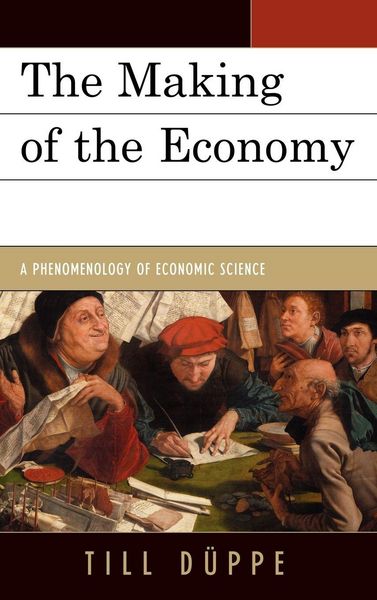
These days, intellectual historians rarely construct their books self-consciously so as to exemplify a pre-existent well-developed philosophy of knowledge. Till Duppe bucks that trend, portraying the history of modern neoclassical economics as an illustration of Husserl's Phenomenology. Continental philosophy meets the history of Arrow-Debreu general equilibrium theory, and is contrasted with Husserl's inquiry into the mathematization of nature by Galileo. It sounds dry, but Duppe's writing style is conversational, and he makes sparks fly. His vision of the future of the economics profession is grave. The shopworn complaint concerning the unrealism of neoclassical mathematical economics has just experienced future shock. -- Philip Mirowski, University of Notre Dame Now more than ever - after the Global Financial Crisis, in the midst of the Second Great Depression - it is necessary to think critically about the relationship between economics and science, to interrogate the epistemic authority of mainstream economics. Till Duppe, in his The Making of the Economy, bravely takes up that challenge; bringing together history and phenomenology, he shows that mainstream economists 'made the economy' by adopting a distanced attitude, a culture of suspicion, toward their object of study. But, along the way - through quantification and formalism, by invoking science as the beginning and end of economic practice, by forgetting about the life-world - the discipline of economics lost its reason for being. But Duppe does not mourn the loss of mainstream economists' scientific authority. It was of no help to them anyway. Instead, he offers the only possible way of moving forward and thus of reviving interest in economic life: "Economists of the World-Disperse." -- David F. Ruccio, University of Notre Dame Any book that concludes with the argument that economic science "must fall for the sake of social responsibility and for the sake of moral integrity in economic discourse" is going to be provocative This book is that, but it is also informed and insightful, which makes it a worthwhile read. -- David Colander, Middlebury College As its subtitle indicates, this book is a reflection on the idea of economics as 'science' from the vantage point of the phenomenological tradition in philosophy. Duppe asks a two sided question: what in the life-world creates the opportunity for the expertise that might go by the name of 'economic science'; and what interests have led would-be economists to respond. The book is very interesting from a number of vantage points within economics itself, giving depth and perspective to themes in the history of economics, to economic theory and methodology, and to contemporary conversations about what 'economics' is (or is not). Erasmus Journal for Philosophy and Economics The intended audience for the book consists of both philosophers and economists, with Duppe aiming to construct the book so as to make phenomenology amenable to economists while the discreetness of economic theory is made more transparent to non-specialists And one of the greatest virtues of this book, from the perspective of a fellow Continental philosopher interested in but by no means trained in economics, is the historical narrative Duppe constructs and which weaves in and out of general assumptions and minute but substantial points of theoretical detail. Duppe's book makes a significant contribution towards a better understanding of the very thing that seems to dominate our lives yet remains furthest from our understanding. Moreover, for any scholar or student wishing to have a competent, critical, and accessible overview of economic history, especially the postneoclassical, this book remains a much-needed resource Philosophy in Review In his illuminating and provocative book The Making of the Economy, Till Duppe examines the economics profession, diagnoses a lack of confidence in its methods and declares the profession to be in crisis. I have only been able to give a sense of the sheer enormity of the ground covered by this highly engaging book: hermeneutics, prescientific economics, the scientific attitude of Gerard Debreu, economics imperialism and much besides. Duppe has performed a valuable service in providing motivation for reflecting on how economists' epistemic authority is actually used, and in providing a structure for organizing these reflections. His book vividly illustrates the benefits of bringing together history and philosophy to evaluate economics, an approach John Davis (2012) has persuasively argued economic methodologists should adopt. It encourages one to pose some hitherto-unasked questions: Would the end of economics restore meaning to our intellectual projects? Would this breakup make it more or less likely that opportunistic uses of epistemic authority would be successfully challenged? Put bluntly, would it liberate or oppress us? Journal Of Economic Methodology