• Produktbild: Security and Game Theory
  • Produktbild: Security and Game Theory

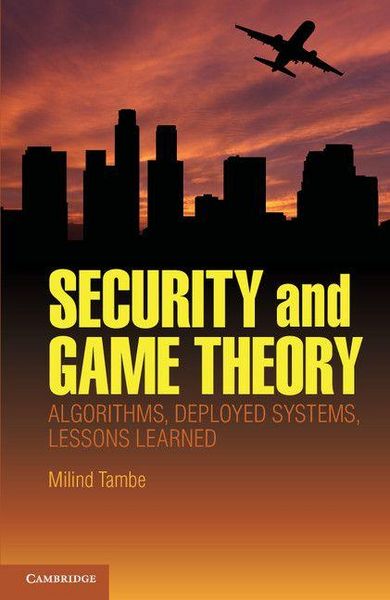
Security and Game Theory Algorithms, Deployed Systems, Lessons Learned

Fr. 142.00

inkl. gesetzl. MwSt., Versandkostenfrei


Beschreibung

Produktdetails

Einband

Gebundene Ausgabe

Erscheinungsdatum

01.12.2011

Verlag

Cambridge University Press

Seitenzahl

336

Maße (L/B/H)

23.5/15.7/2.3 cm

Gewicht

570 g

Sprache

Englisch

ISBN

978-1-107-09642-4

Beschreibung

Rezension

'This exciting book brings together key papers describing important algorithmic advances in computational game theory and the deployed systems for aviation and transportation security that they have enabled. Milind Tambe has been at the forefront of efforts to bring advances in artificial intelligence research to bear on important national security challenges. The lucid presentations he and his co-authors provide of a family of efficient algorithms, which deal with increasingly more complex types of security situations, provide a wonderful and accessible introduction to anyone interested in this important area of research and technology development.' Barbara J. Grosz, Harvard University

Zitat

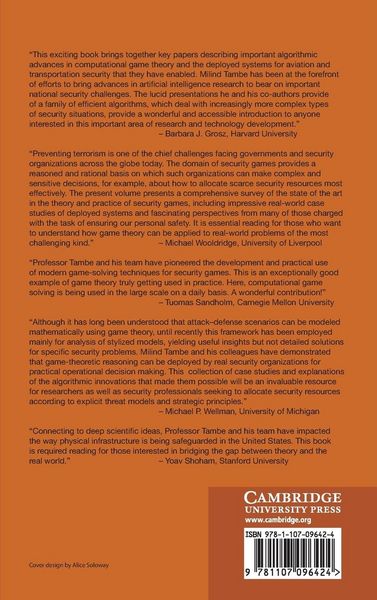
'This exciting book brings together key papers describing important algorithmic advances in computational game theory and the deployed systems for aviation and transportation security that they have enabled. Milind Tambe has been at the forefront of efforts to bring advances in artificial intelligence research to bear on important national security challenges. The lucid presentations he and his co-authors provide of a family of efficient algorithms, which deal with increasingly more complex types of security situations, provide a wonderful and accessible introduction to anyone interested in this important area of research and technology development.' Barbara J. Grosz, Harvard University 'Preventing terrorism is one of the chief challenges facing governments and security organizations across the globe today. The domain of security games provides a reasoned and rational basis on which such organizations can make complex and sensitive decisions, for example about how to allocate scarce security resources most effectively. The present volume presents a comprehensive survey of the state of the art in the theory and practice of security games, including impressive real-world case studies of deployed systems and fascinating perspectives from many of those charged with the task of ensuring our personal safety. It is essential reading for those who want to understand how game theory can be applied to real-world problems of the most challenging kind.' Michael Wooldridge, University of Liverpool 'Professor Tambe and his team have pioneered the development and practical use of modern game-solving techniques for security games. This is an exceptionally good example of game theory truly getting used in practice. Here, computational game solving is being used in the large scale on a daily basis. A wonderful contribution!' Tuomas Sandholm, Carnegie Mellon University 'Although it has long been understood that attack-defense scenarios can be modeled mathematically using game theory, until recently this framework has been employed mainly for analysis of stylized models, yielding useful insights but not detailed solutions for specific security problems. Milind Tambe and his colleagues have demonstrated that game-theoretic reasoning can be deployed by real security organizations for practical, operational decision making. This collection of case studies and explanations of the algorithmic innovations that made them possible will be an invaluable resource for researchers as well as security professionals seeking to allocate security resources according to explicit threat models and strategic principles.' Michael P. Wellman, University of Michigan 'Connecting to deep scientific ideas, Professor Tambe and his team have impacted the way physical infrastructure is being safeguarded in the United States. This book is required reading for those interested in bridging the gap between theory and the real world.' Yoav Shoham, Stanford University

Produktdetails

Einband

Gebundene Ausgabe

Erscheinungsdatum

01.12.2011

Verlag

Cambridge University Press

Seitenzahl

336

Maße (L/B/H)

23.5/15.7/2.3 cm

Gewicht

570 g

Sprache

Englisch

ISBN

978-1-107-09642-4

Herstelleradresse

Libri GmbH
Europaallee 1
36244 Bad Hersfeld
DE

Email: Libri GmbH

Kundinnen und Kunden meinen

0 Bewertungen

Informationen zu Bewertungen

Zur Abgabe einer Bewertung ist eine Anmeldung im Konto notwendig. Die Authentizität der Bewertungen wird von uns nicht überprüft. Wir behalten uns vor, Bewertungstexte, die unseren Richtlinien widersprechen, entsprechend zu kürzen oder zu löschen.

Die Bewertungen sind nach Format, Anzahl Sterne und Datum sortiert.

Verfassen Sie die erste Bewertung zu diesem Artikel

Helfen Sie anderen Kund*innen durch Ihre Meinung

Kundinnen und Kunden meinen

0 Bewertungen filtern

  • Produktbild: Security and Game Theory
  • Produktbild: Security and Game Theory
  • 1. Introduction; Part I. Security Experts' Perspective: 2. LAX - terror target: the history, the reason, the countermeasure Erroll Southers; 3. Maritime transportation system security and the use of game theory: a perfect match to address operational and tactical concerns Joe DiRenzo III, Erik Jensen and Fred Bertsch; Part II. Deployed Applications: 4. Deployed ARMOR protection: the application of a game theoretic model for security at the Los Angeles International Airport James Pita, Manish Jain, Craig Western, Praveen Paruchuri, Janusz Marecki, Milind Tambe, Fernando Ordonez and Sarit Kraus; 5. IRIS: a tool for strategic security allocation in transportation networks Jason Tsai, Shyamsunder Rathi, Christopher Kiekintveld, Milind Tambe and Fernando Ordonez; 6. GUARDS - game theoretic security allocation on a national scale James Pita, Christopher Kiekintveld, Milind Tambe, Shane Cullen and Erin Steigerwald; Part III. Efficient Algorithms for Massive Security Games: 7. Coordinating randomized policies for increasing security of agent systems Praveen Paruchuri, Jonathan Pearce, Janusz Marecki, Milind Tambe, Fernando Ordonez and Sarit Kraus; 8. Computing optimal randomized resource allocations for massive security games Christopher Kiekintveld, James Pita, Manish Jain, Jason Tsai, Milind Tambe and Fernando Ordonez; 9. Security games with arbitrary schedules: a branch and price approach Manish Jain, Christopher Kiekintveld, Erim Kardes, Fernando Ordonez and Milind Tambe; Part IV. Future Research: 10. Effective solutions for real-world Stackelberg games: when agents must deal with human uncertainties James Pita, Manish Jain, Milind Tambe, Fernando Ordonez, Sarit Kraus and Romi Magori-Cohen; 11. Robust Bayesian methods for Stackelberg security games Christopher Kiekintveld, Janusz Marecki and Milind Tambe; 12. Stackelberg vs. Nash in security games: interchangeability, equivalence, and uniqueness Zhengyu Yin, Dmytro Korzhyk, Christopher Kiekintveld, Vincent Conitzer and Milind Tambe; 13. Evaluating deployed decision support systems for security: challenges, arguments, and approaches Matthew E. Taylor, Christopher Kiekintveld and Milind Tambe.