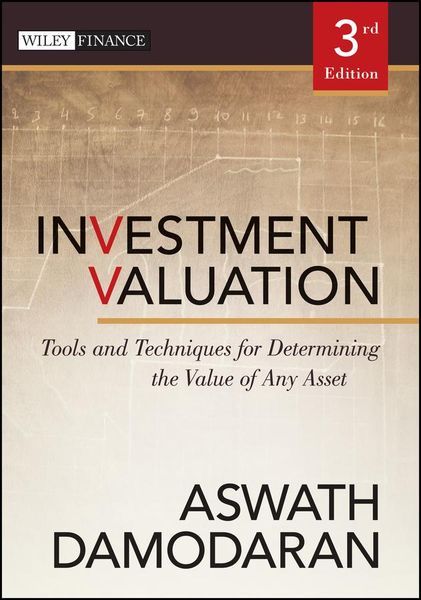
Damodaran, A: Investment Valuation
Aus der Reihe
Wiley Finance Editions
-
- Englisch ausgewählt
-
Verlag:John Wiley & Sons Inc
- Wiley Fr. 162.00
- John Wiley & Sons Inc Fr. 170.00 ausgewählt
Fr. 170.00
inkl. gesetzl. MwSt.,
Beschreibung
Produktdetails
Einband
Gebundene Ausgabe
Erscheinungsdatum
16.05.2012
Abbildungen
Tables: 226 B&W, 0 Color; Graphs: 197 B&W, 0 Color
Verlag
John Wiley & Sons IncSeitenzahl
992
Maße (L/B/H)
25.9/17.7/4.2 cm
Gewicht
1686 g
Auflage
3. Auflage
Sprache
Englisch
ISBN
978-1-118-01152-2
The definitive source of information on all topics related to investment valuation tools and techniques
Valuation is at the heart of any investment decision, whether that decision is buy, sell or hold. But the pricing of many assets has become a more complex task in modern markets, especially after the recent financial crisis. In order to be successful at this endeavor, you must have a firm understanding of the proper valuation techniques. One valuation book stands out as withstanding the test of time among investors and students of financial markets, Aswath Damodaran'sInvestment Valuation.
Now completely revised and updated to reflect changing market conditions, this third edition comprehensively introduces investment professionals and students to the range of valuation models available and how to chose the right model for any given asset valuation scenario. This edition includes valuation techniques for a whole host of real options, start-up firms, unconventional assets, distressed companies and private equity, and real estate. All examples have been updated and new material has been added.
* Fully revised to incorporate valuation lessons learned from the last five years, from the market crisis and emerging markets to new types of equity investments
* Includes valuation practices across the life cycle of companies and emphasizes value enhancement measures, such as EVA and CFROI
* Contains a new chapter on probabilistic valuation techniques such as decision trees and Monte Carlo Simulation
* Author Aswath Damodaran is regarded as one of the best educators and thinkers on the topic of investment valuation
This indispensable guide is a must read for anyone wishing to gain a better understanding of investment valuation and its methods. With it, you can take the insights and advice of a recognized authority on the valuation process and immediately put them to work for you.
Valuation is at the heart of any investment decision, whether that decision is buy, sell or hold. But the pricing of many assets has become a more complex task in modern markets, especially after the recent financial crisis. In order to be successful at this endeavor, you must have a firm understanding of the proper valuation techniques. One valuation book stands out as withstanding the test of time among investors and students of financial markets, Aswath Damodaran'sInvestment Valuation.
Now completely revised and updated to reflect changing market conditions, this third edition comprehensively introduces investment professionals and students to the range of valuation models available and how to chose the right model for any given asset valuation scenario. This edition includes valuation techniques for a whole host of real options, start-up firms, unconventional assets, distressed companies and private equity, and real estate. All examples have been updated and new material has been added.
* Fully revised to incorporate valuation lessons learned from the last five years, from the market crisis and emerging markets to new types of equity investments
* Includes valuation practices across the life cycle of companies and emphasizes value enhancement measures, such as EVA and CFROI
* Contains a new chapter on probabilistic valuation techniques such as decision trees and Monte Carlo Simulation
* Author Aswath Damodaran is regarded as one of the best educators and thinkers on the topic of investment valuation
This indispensable guide is a must read for anyone wishing to gain a better understanding of investment valuation and its methods. With it, you can take the insights and advice of a recognized authority on the valuation process and immediately put them to work for you.
Noch keine Bewertungen vorhanden
Verfassen Sie die erste Bewertung zu diesem Artikel
Helfen Sie anderen Kundinnen und Kunden durch Ihre Meinung.