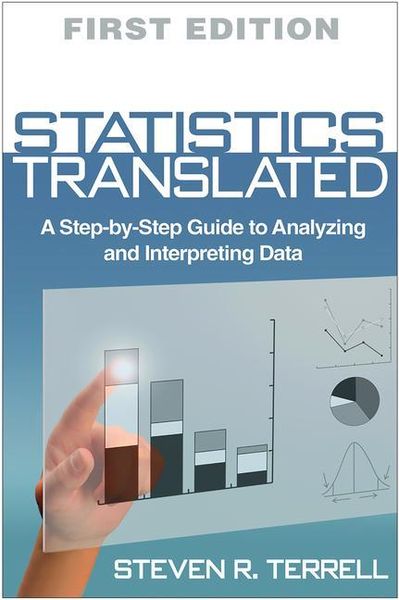
Produktbild: Statistics Translated

Statistics Translated Interpreting Data

Fr. 139.00

inkl. gesetzl. MwSt., Versandkostenfrei


Beschreibung

Produktdetails

Einband

Gebundene Ausgabe

Erscheinungsdatum

01.04.2012

Verlag

GUILF

Seitenzahl

409

Maße (L/B/H)

26.1/18.2/2.7 cm

Gewicht

910 g

Sprache

Englisch

ISBN

978-1-4625-0321-6

Beschreibung

Zitat

"Bravo to Terrell for creating an introduction to statistics that is friendly, conversational, and understandable. His focus on the most frequently used statistical analyses, vocabulary, and methods are absolutely what our students need. Terrell offers hundreds of authentic and timely research examples and case studies, leading readers through the research process in a supportive and interactive manner. I applaud the sections with key words, formulas to know, and self-quizzes. This is an excellent text for beginners in a quantitative research class or general introduction to research, such as a master's-level Introduction to Educational Research course. It is also useful for early-career academics writing their beginning journal articles, or for experienced faculty members to use as a terrific reference source." - Lynne Schrum, George Mason University, Virginia, USA "I applaud the author for linking statistical reasoning to a problem-oriented framework and for including a discussion of how to identify a researchable problem and frame research questions. These are serious omissions in many texts. The book is well situated to inform upper-level undergraduate and graduate students pursuing practitioner-related degrees. It does a good job of laying out a framework for inquiry and aligning statistical reasoning and tools with this framework. It is written for an audience who may do some basic statistical calculations and analysis, but who primarily will be consumers of statistics and quantitative research. I will recommend this text to colleagues who teach statistics or more general research methods courses for this audience." - Tammy Kolbe, University of Connecticut, USA

Produktdetails

Einband

Gebundene Ausgabe

Erscheinungsdatum

01.04.2012

Verlag

GUILF

Seitenzahl

409

Maße (L/B/H)

26.1/18.2/2.7 cm

Gewicht

910 g

Sprache

Englisch

ISBN

978-1-4625-0321-6

Noch keine Bewertungen vorhanden

Verfassen Sie die erste Bewertung zu diesem Artikel

Helfen Sie anderen Kundinnen und Kunden durch Ihre Meinung.

Kundinnen und Kunden meinen

Bewertungen (0)

Weitere Artikel finden Sie in

  • Produktbild: Statistics Translated
  • Introduction: You Do Not Need to be a Statistician to Understand Statistics!A Little BackgroundMany Students Don’t Know What They’re Getting IntoA Few Simple StepsSummaryDo You Understand These Key Words and Phrases?1. Identifying a Research Problem and Stating HypothesesStep 1: Identify a Problem That Can Be Investigated Using Inferential StatisticsStep 2: State a Hypothesis about the Problem You Are InvestigatingDo You Understand These Key Words and Phrases?Quiz Time!2. Identifying the Independent and Dependent Variables in a HypothesisStep 3: Be Able to Identify the Independent Variable(s) and the Levels of the Independent Variable(s) in Your HypothesisStep 4: Be Able to Identify and Statistically Describe the Dependent Variable(s) in Your HypothesisDo You Understand These Key Words and Phrases?Do You Understand These Formulas?Quiz Time!3. Measures of Dispersion and Measures of Relative StandingMeasures of DispersionMeasures of Relative StandingSummary of the Measures of Dispersion and Measures of Relative StandingDo You Understand These Key Words and Phrases?Do You Understand These Formulas?Quiz Time!4. Graphically Describing the Dependent VariableGraphical Descriptive StatisticsThe Normal DistributionDo You Understand These Key Words and Phrases?Quiz Time!5. Choosing the Right Statistical TestThe Very BasicsHow Are We Doing So Far?Estimating Population Parameters Using Confidence IntervalsPredicting a Population Parameter Based on a Sample Statistic Using Confidence IntervalsTesting Hypotheses about a Population Parameter Based on a Sample StatisticTesting a One-Tailed HypothesisTesting a One-Tailed "Less Than" HypothesisSummarizing What We Just SaidBe Careful When Changing Your Alpha ValuesThe Heart of Inferential StatisticsProbability ValuesStep 5 Summary of Choosing the Right Statistical TestDo You Understand These Formulas and Symbols?Quiz Time!6. The One-Sample t-TestWelcome to the Guinness BreweriesThe t DistributionLet’s Look at a Directional HypothesisOne More TimeLet’s Use the Six-Step ModelSummary of the One-Sample t-TestDo You Understand These Key Words and Phrases?Do You Know These Formulas?Quiz Time!7. The Independent-Sample t-TestIf We Have Samples from Two Independent Populations, How Do We Know If They Are Significantly Different from One Another?Putting the Independent-Sample t-Test to WorkSummary of the Independent-Sample t-TestDo You Understand These Key Words and Phrases?Do You Understand These Formulas?Quiz Time!8. The Dependent-Sample t-TestThat’s Great, But How Do We Test Our Hypothesis?Independence versus DependenceTesting a Two-Tailed HypothesisLet’s Move Forward and Use Our Six-Step ModelThe Case of the Unexcused StudentsThe Case of Never Saying NeverSummary of the Dependent Sample t-TestDo You Understand These Key Words and Phrases?Do You Understand These Formulas?Quiz Time!9. The Analysis of VarianceUnderstanding the ANOVAThe Different Types of ANOVAsAssumptions of the ANOVACalculating the ANOVAThe Factorial ANOVAInterpreting the Interaction p ValueSummary of the ANOVADo You Understand These Key Words and Phrases?Do You Understand These Formulas?Quiz Time!10. The Chi-Square TestsThe One-Way Chi-Square TestThe Factorial Chi-Square Test (the Chi-Square Test of Independence)Computing the Chi-Square StatisticThe Chi-Square Test of IndependenceComputing Chi-square for the Test of IndependencePost-Hoc Tests Following the Chi-SquareSummary of the Chi-Square TestsDo You Understand These Key Words and Phrases?Do You Understand These Formulas?Quiz Time!11. The Correlational ProceduresUnderstanding the Idea of CorrelationsInterpreting Pearson’s rA Nonparametric Correlational ProcedureLinear RegressionSummary of the Correlational ProceduresDo You Understand These Key Words and Phrases?Do You Understand These Formulas?Quiz Time!Conclusion. Have We Accomplished What We Set Out to Do?Statistics in a New LightA Limited Set of Statistical TechniquesThe Use of Statistical Software PackagesA Straightforward ApproachAppendix A: Area Under the Normal Curve Table (Critical Values of z)Appendix B. Critical Values of tAppendix C. Critical Values of F When Alpha = .01Appendix D. Critical Values of F When Alpha = .-05Appendix E. Critical Values of Chi-SquareAppendix F. Critical Values of F When Alpha = .10Appendix G. Selecting the Right Statistical TestGlossaryAnswers to Quiz Time