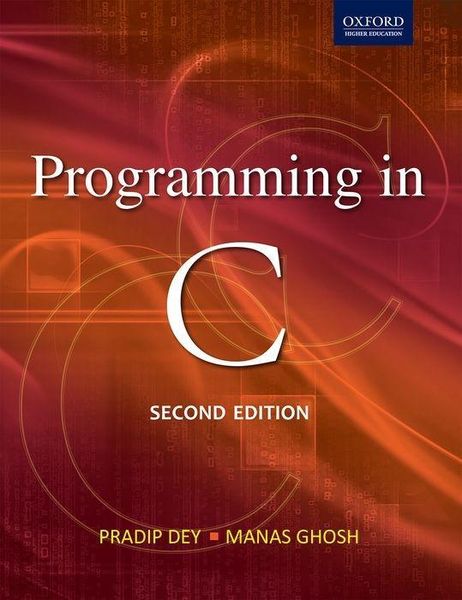
Produktbild: Dey, P: Programming in C 2/E

Dey, P: Programming in C 2/E

Fr. 43.90

inkl. gesetzl. MwSt., Versandkostenfrei


Beschreibung

Produktdetails

Einband

Taschenbuch

Erscheinungsdatum

12.01.2012

Verlag

Oxford Academic

Seitenzahl

528

Maße (L/B/H)

27.7/21.3/2.5 cm

Gewicht

1043 g

Auflage

2nd Revised edition

Sprache

Englisch

ISBN

978-0-19-806528-9

Beschreibung

Produktdetails

Einband

Taschenbuch

Erscheinungsdatum

12.01.2012

Verlag

Oxford Academic

Seitenzahl

528

Maße (L/B/H)

27.7/21.3/2.5 cm

Gewicht

1043 g

Auflage

2nd Revised edition

Sprache

Englisch

ISBN

978-0-19-806528-9

Noch keine Bewertungen vorhanden

Verfassen Sie die erste Bewertung zu diesem Artikel

Helfen Sie anderen Kundinnen und Kunden durch Ihre Meinung.

Kundinnen und Kunden meinen

Bewertungen (0)

  • Produktbild: Dey, P: Programming in C 2/E

    • 1.1 Programs and Programming

    • 1.1.1 System Software

    • 1.1.2 Application Software

    • 1.2 Programming Languages

    • 1.2.1 System Programming Languages

    • 1.2.2 Application Programming Languages

    • 1.2.3 Low-level Languages

    • 1.2.4 High-level Languages

    • 1.3 Compiler, Interpreter, Loader, and Linker

    • 1.3.1 Compiling and Executing High-level Language Programs

    • 1.3.2 Linker

    • 1.3.3 Loader

    • 1.3.4 Linking Loader and Linkage Editor

    • 1.4 Program Execution

    • 1.5 Fourth Generation Languages

    • 1.6 Fifth Generation Languages

    • 1.7 Classification of Programming Languages

    • 1.7.1 Procedural Languages

    • 1.7.2 Problem-oriented Languages

    • 1.7.3 Non-procedural Languages

    • 1.8 Structured Programming Concept

    • 1.8.1 Top-Down Analysis

    • 1.8.2 Modular Programming

    • 1.8.3 Structured Code

    • 1.8.4 The Process of Programming

    • 1.9 Algorithms

    • 1.9.1 What is an Algorithm?

    • 1.9.2 Different Ways of Stating Algorithms

    • 1.9.3 The Key Features of an Algorithm and the Step Form

    • 1.9.4 What are Variables?

    • 1.9.5 Subroutines

    • 1.9.6 A Strategy for Designing Algorithms

    • 1.9.7 Tracing an algorithm to Depict Logic

    • 1.9.8 Specification for converting algorithms into programs


    • 2.1. Introduction

    • 2.1.1. Why Learn C?

    • 2.1.2 The Future of C

    • 2.2. Standardizations of C Language

    • 2.3. Developing Programs In C

    • 2.4. A Simple C Program

    • 2.5. Parts Of C Program Revisited

    • 2.6. Structure Of A C Program

    • 2.7. Concept Of A Variable

    • 2.8. Datatypes In C

    • 2.9. Program Statement

    • 2.10. Declaration

    • 2.11. How does the computer store things in memory?

    • 2.11.1. How Integers Are Stored?

    • 2.11.2. How Floats And Doubles Are Stored?

    • 2.12. Token

    • 2.12. 1. Identifier

    • 2.12.2. Keywords

    • 2.12.3. Constant

    • 2.12.3. Assignment

    • 2.12.4. Initialization

    • 2.12.5. Operators and Expressions

    • 2.12.6. Expression Evaluation - Precedence and Associativity

    • 2.13. Expressions Revisited

    • 2.14. Lvalues And Rvalues

    • 2.15. Type Conversion In C

    • 2.16 Working With Complex Numbers


    • 3.1 Introduction

    • 3.2 Basic Screen and keyboard I/O in C

    • 3.3 Non-formatted Input and Output

    • 3.3.1 Single Character Input and Output

    • 3.3.2 Single Character Input

    • 3.3.3 Single Character Output

    • 3.3.4 Additional Single Character Input and Output Functions

    • 3.3.5 Worked-out Programs with getchar ( ) and putchar ( )

    • 3.4 Formatted Input and Output Functions

    • 3.4.1 Output Function printf ( )

    • 3.4.2 Input Function scanf ( )

    • 3.5 Worked-out Examples using scanf ( ) and printf ( )


    • 4.1 Introduction

    • 4.2 Specifying Test Condition for Selection and Iteration

    • 4.3 Writing Test Expression

    • 4.3.1 Understanding How True and False is Represented in C

    • 4.4 Conditional Execution and Selection

    • 4.4.1 Selection Statements

    • 4.4.2 The Conditional Operator

    • 4.4.3 The switch Statement

    • 4.5 Iteration and Repetitive Execution

    • 4.5.1 while Construct

    • 4.5.2 for Construct

    • 4.5.3 do-while Construct

    • 4.6 Which Loop Should be Used?

    • 4.6.1 Using Sentinel Values

    • 4.6.2 Using Prime Read

    • 4.6.3 Using Counter

    • 4.7 goto Statement

    • 4.8 Special Control Statements

    • 4.9 Nested Loops


    • 5.1 Introduction

    • 5.2 One-dimensional Array

    • 5.2.1 Declaration of a One-dimensional Array

    • 5.2.2 Initializing Integer Arrays

    • 5.2.3 Accessing Array Elements

    • 5.2.4 Other Allowed Operations

    • 5.2.5 Internal Representation of Arrays in C

    • 5.2.6 Variable Length Arrays and the C99 changes

    • 5.2.7 Working with a One-dimensional Array

    • 5.3 Strings: One-dimensional Character Arrays

    • 5.3.1 Declaration of a String

    • 5.3.2 String Initialization

    • 5.3.3 Printing Strings

    • 5.3.4 String Input

    • 5.3.5 Character Manipulation in the String

    • 5.3.6 String Manipulation

    • 5.4 Multidimensional Arrays

    • 5.4.1 Declaration of a Two-dimensional Array

    • 5.4.2 Declaration of a Three-dimensional Array

    • 5.4.3 Initialization of Multidimensional Arrays

    • 5.4.4 Unsized Array Initializations

    • 5.4.5 Accessing Multidimensional Arrays

    • 5.5 Arrays of Strings: Two-dimensional Character Array

    • 5.5.1 Initialization

    • 5.5.2 Manipulating String Arrays


    • 6.1 Introduction

    • 6.2 Concept of Function

    • 6.2.1 Why are functions needed?

    • 6.3 Using Functions

    • 6.3.1 Function prototype declaration

    • 6.3.2 Function definition

    • 6.3.3 Function calling

    • 6.4 Call by Value Mechanism

    • 6.5 Working with Functions

    • 6.6 Passing Arrays to Functions

    • 6.7 Scope and Extent

    • 6.7.1 Concept of Global and Local Variables

    • 6.7.2 Scope Rules

    • 6.8 Storage Classes

    • 6.8.1 Storage class specifiers for variables

    • 6.8.2 Storage class specifiers for functions

    • 6.8.3 Linkage

    • 6.9 The Inline Function

    • 6.10 Recursion

    • 6.10.1 What is needed for implementing recursion?

    • 6.10.2 How is Recursion implemented?

    • 6.10.3 Comparing Recursion and Iteration

    • 6.11 Searching and Sorting

    • 6.11.1 Searching Algorithms

    • 6.11.2. Sorting Algorithms

    • 6.12. Analysis of Algorithms

    • 6.12.1 Asymptotic Notation

    • 6.12.2 Efficiency of Linear Search

    • 6.12.3 Binary Search Analysis

    • 6.12.4 Analysis of Bubble Sort

    • 6.12.5 Analysis of Quick Sort

    • 6.12.6 Disadvantages of Complexity Analysis


    • 7.1 Introduction

    • 7.2 Understanding Memory Addresses

    • 7.3 Address Operator (and)

    • 7.4 Pointers

    • 7.4.1 Declaring a Pointer

    • 7.4.2 Initializing Pointers

    • 7.4.3 Indirection Operator and Dereferencing

    • 7.5 void Pointer

    • 7.6 Null Pointer

    • 7.7 Use of Pointers

    • 7.8 Arrays and Pointers

    • 7.8.1 One-dimensional Arrays and Pointers

    • 7.8.2 Passing an Array to a Function

    • 7.8.3 Differences between Array Name and Pointer

    • 7.9 Pointer and String

    • 7.10 Pointer Arithmetic

    • 7.10.1 Assignment

    • 7.10.2 Addition or Subtraction on Integer

    • 7.10.3 Subtraction of Pointers

    • 7.10.4 Comparing Pointers

    • 7.11 Pointers to Pointers

    • 7.12 Array of Pointers

    • 7.13 Pointers to an Array

    • 7.14 Two-dimensional Arrays and Pointers

    • 7.14.1 Passing Two-dimensional Array to a Function

    • 7.15 Three-dimensional Arrays

    • 7.16 Pointers to Functions

    • 7.16.1 Declaration of a Pointer to a Function

    • 7.16.2 Initialization of Function Pointers

    • 7.16.3 Calling a Function using a Function Pointer

    • 7.16.4 Passing a Function to Another Function

    • 7.16.5 How to Return a Function Pointer

    • 7.16.6 Arrays of Function Pointers

    • 7.17 Dynamic Memory Allocation

    • 7.17.1 Dynamic Allocation of Arrays

    • 7.17.2 Freeing Memory

    • 7.17.3 Reallocating Memory Blocks

    • 7.17.4 Implementing Multidimensional Arrays using Pointers

    • 7.18 Offsetting a Pointer

    • 7.19 Memory Leak and Memory Corruption

    • 7.20 Pointer and Const Qualifier

    • 7.20.1 Pointer to Constant

    • 7.20.2 Constant Pointers

    • 7.20.3 Constant Parameters


    • 8.1 Introduction

    • 8.2 Structures

    • 8.2.1 Declaring Structures and Structure Variables

    • 8.2.2 Accessing the Members of a Structure

    • 8.2.3 Initialization of Structures

    • 8.2.4 Copying and Comparing Structures

    • 8.2.5 typedef and its Use in Structure Declarations

    • 8.2.6 Nesting of Structures

    • 8.2.7 Arrays of Structures

    • 8.2.8 Initializing Arrays of Structures

    • 8.2.9 Arrays within the Structure

    • 8.2.10 Structures and Pointers

    • 8.2.11 Structures and Functions

    • 8.3 Union

    • 8.3.1 Declaring a Union and its Members

    • 8.3.2 Accessing and Initializing Members of a Union

    • 8.3.3 Structure Versus Union

    • 8.4 Enumeration Types

    • 8.5 Bitfields


    • 9.1 Introduction

    • 9.2 Using Files in C

    • 9.2.1 Declaration of a File Pointer

    • 9.2.2 Opening a File

    • 9.2.3 Closing and Flushing Files

    • 9.3 Working with Text Files

    • 9.3.1 Character Input and Output

    • 9.3.2 End of File (EOF)

    • 9.3.3 Detecting the End of a File using feof() Function

    • 9.4 Working with Binary Files

    • 9.5 Direct File Input and Output

    • 9.5.1 Sequential Versus Random File Access

    • 9.6 Files of Records

    • 9.6.1 Working with Files of Records

    • 9.7 Random Access to Files of Records

    • 9.8 Other File Management Functions

    • 9.8.1 Deleting a File

    • 9.8.2 Renaming a File

    • 9.9 Low-Level I/O


    • 10.1 Introduction

    • 10.2 Singly Linked Lists

    • 10.2.1 Insertion of a Node in a Singly Linked List

    • 10.2.2 Deletion of a Node from a Singly Linked List

    • 10.2.3 Sorting a Singly Linked List

    • 10.2.4 Destroying a Singly Linked List

    • 10.2.5 More Complex Operations on Singly Linked Lists

    • 10.3 Circular Linked Lists

    • 10.3.1 Appending a Node

    • 10.3.2 Displaying a Circular Linked List

    • 10.3.3 Inserting a Node after a Specified Node

    • 10.3.4 Inserting a Node before a Particular Node

    • 10.3.5 Deleting a Node

    • 10.3.6 Sorting a Circular Linked List

    • 10.4 Doubly Linked Lists

    • 10.4.1 Operations on Doubly Linked Lists

    • 10.4.2 Advantages/Disadvantages of Doubly Linked Lists

    • 10.5 Introduction to Circular Doubly Linked Lists

    • 10.6 Applications of Linked Lists

    • 10.6.1 Dynamic Storage Management

    • 10.6.2 Garbage Collection and Compaction

    • 10.7 Disadvantages of Linked Lists

    • 10.8 Array versus Linked List Revisited


    • 11.1 Introduction

    • 11.2 Bitwise Operator

    • 11.2.1 Bitwise AND

    • 11.2.2 Bitwise OR

    • 11.2.3 Bitwise Exclusive-OR

    • 11.2.4 Bitwise NOT

    • 11.2.5 Bitwise Shift Operator

    • 11.3 Command-line Arguments

    • 11.4 The C Preprocessor

    • 11.4.1 The C Preprocessor Directives

    • 11.4.2 Predefined Identifiers

    • 11.5 Type Qualifier

    • 11.5.1 const Qualifier

    • 11.5.2 volatile Qualifier

    • 11.5.3 restrict Qualifier

    • 11.6 Variable Length Argument List

    • 11.7 Memory Models and Pointers


    • 12.1. Introduction

    • 12.2. Stack

    • 12.2.1 Implementation Of Stack

    • 12.2.2 Application Of Stack

    • 12.3. Queue

    • 12.3.1 Implementation of a queue

    • 12.3.2 Other variations of queue

    • 12.3.3 Applications of queue

    • 12.4. Tree

    • 12.4.1 Some basic tree terminology

    • 12.4.2 Binary tree

    • 12.4.3 Traversals of a binary tree

    • 12.4.4 Kinds of binary trees

    • 12.4.5 Binary search tree

    • 12.4.6 Application of tree

    • Appendices

    • Index