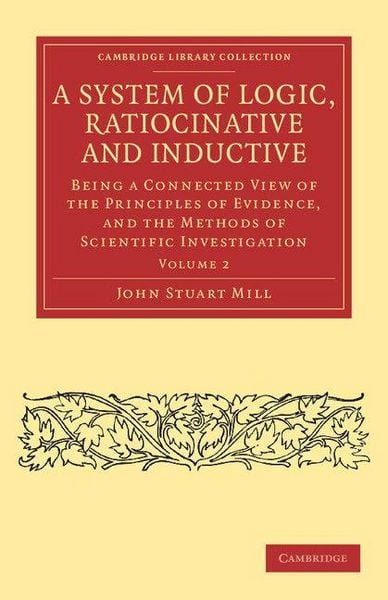
A System of Logic, Ratiocinative and Inductive - Volume 2 Being a Connected View of the Principles of Evidence, and the Methods of Scientific Investigation
-
- Hardcover
- Taschenbuch ausgewählt
- eBook
-
Sprache:Englisch
-
Verlag:Cambridge Academic
- University Press Of The Pacific Fr. 54.90
- Creative Media Partners, LLC Fr. 41.90
- Cambridge Scholars Publishing Fr. 44.90
- Outlook Fr. 68.90
- Cosimo Classics Fr. 55.90
- Cambridge Academic Fr. 82.90 ausgewählt
- Benediction Classics Fr. 61.90
- Double9 Books Fr. 54.90
- Hansebooks Fr. 51.90
- Kessinger Publishing, LLC Fr. 54.90
- Liberty Fund Inc Fr. 44.90
Fr. 82.90
inkl. gesetzl. MwSt.,
Beschreibung
Produktdetails
Einband
Taschenbuch
Erscheinungsdatum
18.11.2011
Verlag
Cambridge AcademicSeitenzahl
642
Maße (L/B/H)
21.6/14/3.7 cm
Gewicht
810 g
Sprache
Englisch
ISBN
978-1-108-04089-1
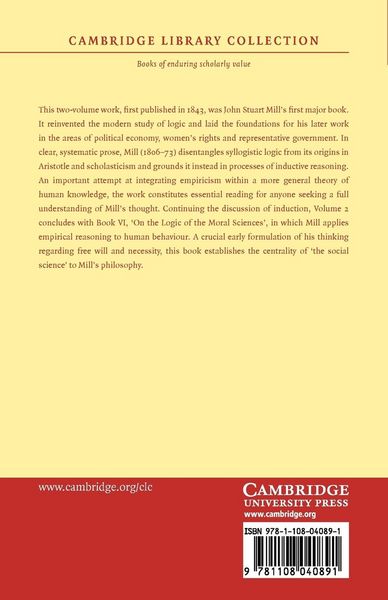
This two-volume work, first published in 1843, was John Stuart Mill's first major book. It reinvented the modern study of logic and laid the foundations for his later work in the areas of political economy, women's rights and representative government. In clear, systematic prose, Mill (1806-73) disentangles syllogistic logic from its origins in Aristotle and scholasticism and grounds it instead in processes of inductive reasoning. An important attempt at integrating empiricism within a more general theory of human knowledge, the work constitutes essential reading for anyone seeking a full understanding of Mill's thought. Continuing the discussion of induction, Volume 2 concludes with Book VI, 'On the Logic of the Moral Sciences', in which Mill applies empirical reasoning to human behaviour. A crucial early formulation of his thinking regarding free will and necessity, this book establishes the centrality of 'the social science' to Mill's philosophy.
Kundinnen und Kunden meinen
Verfassen Sie die erste Bewertung zu diesem Artikel
Helfen Sie anderen Kund*innen durch Ihre Meinung