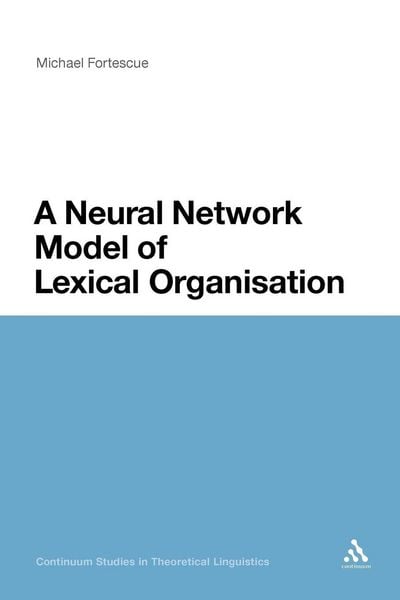
A Neural Network Model of Lexical Organization
-
- Hardcover
- Taschenbuch ausgewählt
- eBook
-
Sprache:Englisch
Fr. 76.90
inkl. gesetzl. MwSt.,
Beschreibung
Produktdetails
Einband
Taschenbuch
Erscheinungsdatum
27.10.2011
Verlag
Bloomsbury AcademicSeitenzahl
246
Maße (L/B/H)
23.4/15.6/1.3 cm
Gewicht
380 g
Sprache
Englisch
ISBN
978-1-4411-1791-5
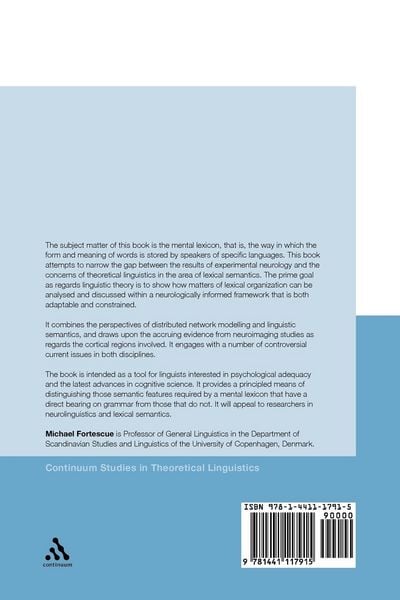
This is an engaging study of the mental lexicon: the way in which the form and meaning of words is stored by speakers of specific languages. Fortescue attempts to narrow the gap between the results of experimental neurology and the concerns of theoretical linguistics in the area of lexical semantics. The prime goal as regards linguistic theory is to show how matters of lexical organization can be analysed and discussed within a neurologically informed framework that is both adaptable and constrained.
It combines the perspectives of distributed network modelling and linguistic semantics, and draws upon the accruing evidence from neuroimaging studies as regards the cortical regions involved. It engages with a number of controversial current issues in both disciplines. This text is intended as a tool for linguists interested in psychological adequacy and the latest advances in Cognitive Science. It provides a principled means of distinguishing those semantic features required by a mental lexicon that have a direct bearing on grammar from those that do not.
A Neural Network Model of Lexical Organisation is essential reading for researchers in neurolinguistics and lexical semantics.
Noch keine Bewertungen vorhanden
Verfassen Sie die erste Bewertung zu diesem Artikel
Helfen Sie anderen Kundinnen und Kunden durch Ihre Meinung.