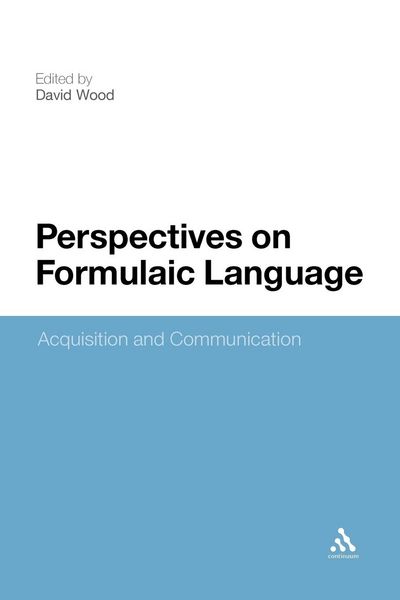
Perspectives on Formulaic Language Acquisition and Communication
-
- Hardcover
- Taschenbuch ausgewählt
- eBook
-
Sprache:Englisch
Fr. 76.90
inkl. gesetzl. MwSt.,
Beschreibung
Produktdetails
Einband
Taschenbuch
Erscheinungsdatum
03.11.2011
Herausgeber
David WoodVerlag
BloomsburySeitenzahl
298
Maße (L/B/H)
23.4/15.6/1.6 cm
Gewicht
456 g
Sprache
Englisch
ISBN
978-1-4411-4841-4
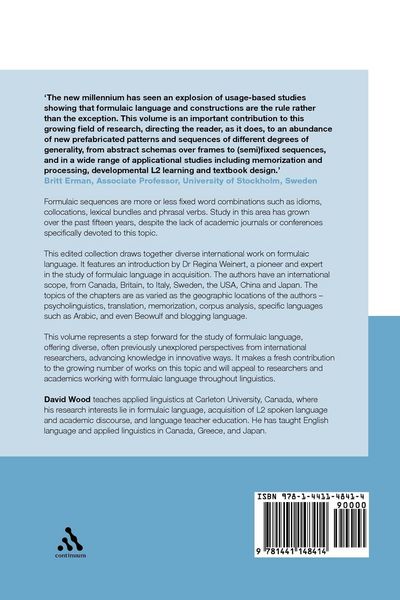
Formulaic sequences are more or less fixed word combinations such as idioms, collocations, lexical bundles, phrasal verbs and so on. Study in this area has grown over the past fifteen years, despite the fact that there are no academic journals or conferences devoted to this topic.
This edited collection is an attempt to draw together the diverse international work on formulaic language. It features an introduction by Dr. Regina Weinert, a pioneer and expert in the study of formulaic language in acquisition. The authors have an international scope, from China and Italy to Armenia, Canada and Britain. The book is divided into three sections: Formulaic Language in Acquisition and Pedagogy; Identification and Psycholinguistic Processing of Formulaic Language; Communicative Functions of Formulaic Language. The topics of the papers are as varied as the geographic locations of the authors - critical discourse analysis, psycholinguistics, memorization, corpus analysis, specific languages such as Arabic, and even Beowulf and blogging language. This volume represents a step forward for the study of formulaic language, offering diverse, often previously unexplored perspectives from international researchers, advancing knowledge in innovative ways.
It makes a fresh contribution the growing number of works on this topic and will appeal to researchers and academics working with formulaic language throughout linguistics.
This edited collection is an attempt to draw together the diverse international work on formulaic language. It features an introduction by Dr. Regina Weinert, a pioneer and expert in the study of formulaic language in acquisition. The authors have an international scope, from China and Italy to Armenia, Canada and Britain. The book is divided into three sections: Formulaic Language in Acquisition and Pedagogy; Identification and Psycholinguistic Processing of Formulaic Language; Communicative Functions of Formulaic Language. The topics of the papers are as varied as the geographic locations of the authors - critical discourse analysis, psycholinguistics, memorization, corpus analysis, specific languages such as Arabic, and even Beowulf and blogging language. This volume represents a step forward for the study of formulaic language, offering diverse, often previously unexplored perspectives from international researchers, advancing knowledge in innovative ways.
It makes a fresh contribution the growing number of works on this topic and will appeal to researchers and academics working with formulaic language throughout linguistics.
Kundinnen und Kunden meinen
Verfassen Sie die erste Bewertung zu diesem Artikel
Helfen Sie anderen Kund*innen durch Ihre Meinung