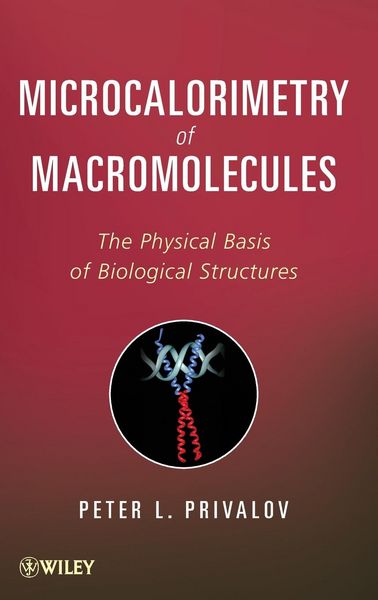
Microcalorimetry of Macromolecules
Fr. 219.00
inkl. gesetzl. MwSt.,
Beschreibung
Produktdetails
Einband
Gebundene Ausgabe
Erscheinungsdatum
16.07.2012
Verlag
John Wiley & SonsSeitenzahl
420
Maße (L/B/H)
24/16.1/2.7 cm
Gewicht
795 g
Auflage
1. Auflage
Sprache
Englisch
ISBN
978-1-118-10451-4
Examining the physical basis of the structure of macromolecules--proteins, nucleic acids, and their complexes--using calorimetric techniques
Many scientists working in biology are unfamiliar with the basics of thermodynamics and its role in determining molecular structures. Yet measuring the heat of structural change a molecule undergoes under various conditions yields information on the energies involved and, thus, on the physical bases of the considered structures. Microcalorimetry of Macromolecules offers protein scientists unique access to this important information.
Divided into thirteen chapters, the book introduces readers to the basics of thermodynamics as it applies to calorimetry, the evolution of the calorimetric technique, as well as how calorimetric techniques are used in the thermodynamic studies of macromolecules, detailing instruments for measuring the heat effects of various processes. Also provided is general information on the structure of biological macromolecules, proteins, and nucleic acids, focusing on the key thermodynamic problems relating to their structure. The book covers:
* The use of supersensitive calorimetric instruments, including micro and nano-calorimeters for measuring the heat of isothermal reactions (Isothermal Titration Nano-Calorimeter), the heat capacities over a broad temperature range (Scanning Nano-Calorimeter), and pressure effects (Pressure Perturbation Nano-Calorimeter)
* Two of the simplest but key structural elements: the alpha and polyproline helices and their complexes, the alpha-helical coiled-coil, and the pyroline coiled-coils
* Complicated macromolecular formations, including small globular proteins, multidomain proteins and their complexes, and nucleic acids
* Numerous examples of measuring the ground state of protein energetics, as well as changes seen when proteins interact
The book also reveals how intertwined structure and thermodynamics are in terms of a macromolecule's organization, mechanism of formation, the stabilization of its three-dimensional structure, and ultimately, its function. The first book to describe microcalorimetric technique in detail, enough for graduate students and research scientists to successfully plumb the structural mysteries of proteins and the double helix, Microcalorimetry of Macromolecules is an essential introduction to using a microcalorimeter in biological studies.
Many scientists working in biology are unfamiliar with the basics of thermodynamics and its role in determining molecular structures. Yet measuring the heat of structural change a molecule undergoes under various conditions yields information on the energies involved and, thus, on the physical bases of the considered structures. Microcalorimetry of Macromolecules offers protein scientists unique access to this important information.
Divided into thirteen chapters, the book introduces readers to the basics of thermodynamics as it applies to calorimetry, the evolution of the calorimetric technique, as well as how calorimetric techniques are used in the thermodynamic studies of macromolecules, detailing instruments for measuring the heat effects of various processes. Also provided is general information on the structure of biological macromolecules, proteins, and nucleic acids, focusing on the key thermodynamic problems relating to their structure. The book covers:
* The use of supersensitive calorimetric instruments, including micro and nano-calorimeters for measuring the heat of isothermal reactions (Isothermal Titration Nano-Calorimeter), the heat capacities over a broad temperature range (Scanning Nano-Calorimeter), and pressure effects (Pressure Perturbation Nano-Calorimeter)
* Two of the simplest but key structural elements: the alpha and polyproline helices and their complexes, the alpha-helical coiled-coil, and the pyroline coiled-coils
* Complicated macromolecular formations, including small globular proteins, multidomain proteins and their complexes, and nucleic acids
* Numerous examples of measuring the ground state of protein energetics, as well as changes seen when proteins interact
The book also reveals how intertwined structure and thermodynamics are in terms of a macromolecule's organization, mechanism of formation, the stabilization of its three-dimensional structure, and ultimately, its function. The first book to describe microcalorimetric technique in detail, enough for graduate students and research scientists to successfully plumb the structural mysteries of proteins and the double helix, Microcalorimetry of Macromolecules is an essential introduction to using a microcalorimeter in biological studies.
Noch keine Bewertungen vorhanden
Verfassen Sie die erste Bewertung zu diesem Artikel
Helfen Sie anderen Kundinnen und Kunden durch Ihre Meinung.