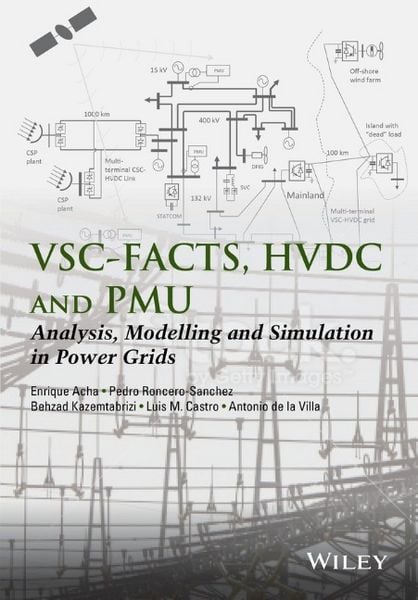
VSC-FACTS-HVDC Analysis, Modelling and Simulation in Power Grids
Fr. 169.00
inkl. gesetzl. MwSt.,
Beschreibung
Produktdetails
Einband
Gebundene Ausgabe
Erscheinungsdatum
12.04.2019
Verlag
John Wiley & SonsSeitenzahl
414
Maße (L/B/H)
25.1/17.2/3 cm
Gewicht
878 g
Auflage
1. Auflage
Sprache
Englisch
ISBN
978-1-119-97398-0
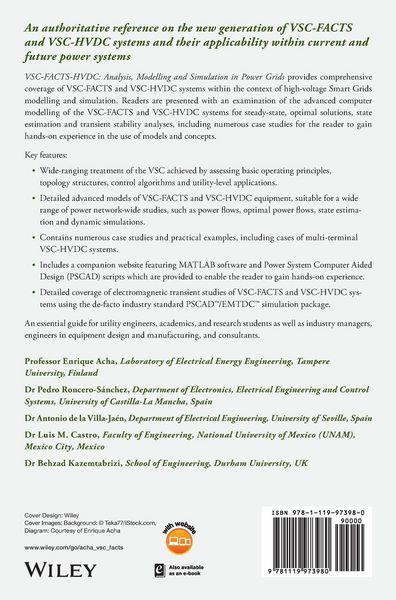
An authoritative reference on the new generation of VSC-FACTS and VSC-HVDC systems and their applicability within current and future power systems
VSC-FACTS-HVDC and PMU: Analysis, Modelling and Simulation in Power Grids provides comprehensive coverage of VSC-FACTS and VSC-HVDC systems within the context of high-voltage Smart Grids modelling and simulation. Readers are presented with an examination of the advanced computer modelling of the VSC-FACTS and VSC-HVDC systems for steady-state, optimal solutions, state estimation and transient stability analyses, including numerous case studies for the reader to gain hands-on experience in the use of models and concepts.
Key features:
* Wide-ranging treatment of the VSC achieved by assessing basic operating principles, topology structures, control algorithms and utility-level applications.
* Detailed advanced models of VSC-FACTS and VSC-HVDC equipment, suitable for a wide range of power network-wide studies, such as power flows, optimal power flows, state estimation and dynamic simulations.
* Contains numerous case studies and practical examples, including cases of multi-terminal VSC-HVDC systems.
* Includes a companion website featuring MATLAB software and Power System Computer Aided Design (PSCAD) scripts which are provided to enable the reader to gain hands-on experience.
* Detailed coverage of electromagnetic transient studies of VSC-FACTS and VSC-HVDC systems using the de-facto industry standard PSCAD?/EMTDC? simulation package.
An essential guide for utility engineers, academics, and research students as well as industry managers, engineers in equipment design and manufacturing, and consultants.
VSC-FACTS-HVDC and PMU: Analysis, Modelling and Simulation in Power Grids provides comprehensive coverage of VSC-FACTS and VSC-HVDC systems within the context of high-voltage Smart Grids modelling and simulation. Readers are presented with an examination of the advanced computer modelling of the VSC-FACTS and VSC-HVDC systems for steady-state, optimal solutions, state estimation and transient stability analyses, including numerous case studies for the reader to gain hands-on experience in the use of models and concepts.
Key features:
* Wide-ranging treatment of the VSC achieved by assessing basic operating principles, topology structures, control algorithms and utility-level applications.
* Detailed advanced models of VSC-FACTS and VSC-HVDC equipment, suitable for a wide range of power network-wide studies, such as power flows, optimal power flows, state estimation and dynamic simulations.
* Contains numerous case studies and practical examples, including cases of multi-terminal VSC-HVDC systems.
* Includes a companion website featuring MATLAB software and Power System Computer Aided Design (PSCAD) scripts which are provided to enable the reader to gain hands-on experience.
* Detailed coverage of electromagnetic transient studies of VSC-FACTS and VSC-HVDC systems using the de-facto industry standard PSCAD?/EMTDC? simulation package.
An essential guide for utility engineers, academics, and research students as well as industry managers, engineers in equipment design and manufacturing, and consultants.
Noch keine Bewertungen vorhanden
Verfassen Sie die erste Bewertung zu diesem Artikel
Helfen Sie anderen Kundinnen und Kunden durch Ihre Meinung.