Dialogic Learning Shifting Perspectives to Learning, Instruction, and Teaching
-
- Hardcover ausgewählt
- Taschenbuch
- eBook
-
Sprache:Englisch
Fr. 138.00
inkl. gesetzl. MwSt.,
Beschreibung
Produktdetails
Einband
Gebundene Ausgabe
Erscheinungsdatum
29.02.2004
Herausgeber
Jos van den Linden + weitereVerlag
Springer NetherlandSeitenzahl
263
Maße (L/B/H)
24.1/16/2 cm
Gewicht
584 g
Auflage
2004
Sprache
Englisch
ISBN
978-1-4020-1930-2
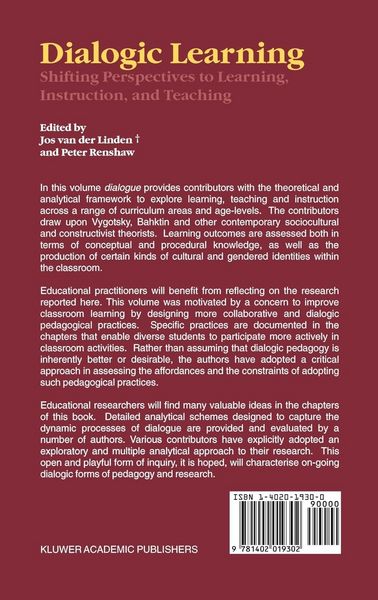
Contemporary researchers have analysed dialogue primarily in terms of instruction, conversation or inquiry. There is an irreducible tension when the terms ‘dialogue’ and ‘instruction’ are brought together, because the former implies an emergent process of give-and-take, whereas the latter implies a sequence of predetermined moves. It is argued that effective teachers have learned how to perform in this contradictory space to both follow and lead, to be both responsive and directive, to require both independence and receptiveness from learners. Instructional dialogue, therefore, is an artful performance rather than a prescribed technique. Dialogues also may be structured as conversations which function to build consensus, conformity to everyday ritualistic practices, and a sense of community. The dark side of the dialogic ‘we’ and the community formed around ‘our’ and ‘us’ is the inevitable boundary that excludes ‘them’ and ‘theirs’. When dialogues are structured to build consensus and community, critical reflection on the bases of that consensus is required and vigilance to ensure that difference and diversity are not being excluded or assimilated (see Renshaw, 2002). Again it is argued that there is an irreducible tension here because understanding and appreciating diversity can be achieved only through engagement and living together in communities. Teachers who work to create such communities in their classrooms need to balance the need for common practices with the space to be different, resistant or challenging – again an artful performance that is difficult to articulate in terms of specific teaching techniques.
Noch keine Bewertungen vorhanden
Verfassen Sie die erste Bewertung zu diesem Artikel
Helfen Sie anderen Kundinnen und Kunden durch Ihre Meinung.