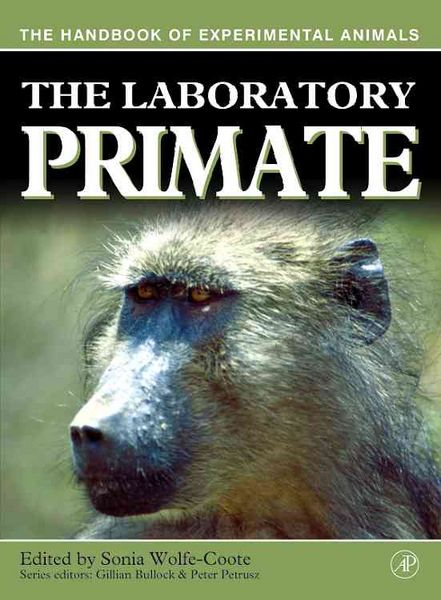
Produktbild: The Laboratory Primate

The Laboratory Primate =Handbook of Experimental Animal Series

Fr. 334.00

inkl. gesetzl. MwSt., Versandkostenfrei


Beschreibung

Produktdetails

Einband

Gebundene Ausgabe

Erscheinungsdatum

01.10.2005

Herausgeber

Sonia Wolfe-Coote

Verlag

Academic Press

Seitenzahl

650

Maße (L/B/H)

28/21.5/3.7 cm

Gewicht

1928 g

Sprache

Englisch

ISBN

978-0-12-080261-6

Beschreibung

Rezension

"...provides research scientists in academia and industry with comprehensive, practical information on laboratory animals...a welcome and necessary addition to the series of handbooks...this book is recommended to all researchers and students in biological, pharmaceutical, veterinary and medical sciences." -- M. Schmidt, in JZS

Produktdetails

Einband

Gebundene Ausgabe

Erscheinungsdatum

01.10.2005

Herausgeber

Sonia Wolfe-Coote

Verlag

Academic Press

Seitenzahl

650

Maße (L/B/H)

28/21.5/3.7 cm

Gewicht

1928 g

Sprache

Englisch

ISBN

978-0-12-080261-6

Herstelleradresse

Libri GmbH
Europaallee 1
36244 Bad Hersfeld
DE

Email: gpsr@libri.de

Noch keine Bewertungen vorhanden

Verfassen Sie die erste Bewertung zu diesem Artikel

Helfen Sie anderen Kundinnen und Kunden durch Ihre Meinung.

Kundinnen und Kunden meinen

Bewertungen (0)

  • Produktbild: The Laboratory Primate
  • Part 1: Definition of the Primate Model

    1.1 The Taxonomy of Primates in the Laboratory Context
    1.2 Similarities of Non Human Primates to Humans
    1.3 General Anatomy
    1.4 Pathology
    1.4.1 Non infectious diseases
    1.4.2 Common Viral Infections
    1.4.3 Modelling Parasitic diseases in Non Human
    Primates: Malaria, Chagas Disease and Filariasis
    1.5 Reproduction: Definition of a Primate Model of Female Fertility
    1.6 Male Reproduction and Fertilization
    1.7 Primate Natural History and Social Behaviour: Implications for Laboratory Housing

    Part 2: Primate Management

    2.1 New World Primates
    2.1.1 Husbandry and Management: Marmosets and
    Tamarins
    2.2 Old World Primates
    2.2.1 Practical Care & Management of Macaques
    2.2.2 Vervet Monkey Breeding
    2.3 Nutrition and Nutritional Diseases
    2.4 Environmental Enrichment & Refinement of Handling Procedures
    2.5 Development of Specific Pathogen Free (SPF)
    Non Human Primate Colonies
    2.6 Medical Care

    Part 3: Current Uses in Biomedical Research

    3.1 Factors affecting the choice of species
    3.2 Techniques & Procedures
    3.2.1 Anaesthesia
    3.2.2 Rigid Endoscopy
    3.2.3 Ultrasound Imaging in Rhesus (Macaca mulatta)and Long-tailed (Macaca fascicularis) Macaques: Reproductive & Research Applications
    3.2.4 Functional Magnetic Resonances Imaging in Conscious Marmoset Monkeys : Methods and Applications in Neuroscience Research
    3.2.5 Radiographic Imaging of Non Human Primates
    3.2.6 Imaging: Positron Emission Tomography (PET)
    3.3 Current Uses in Biomedical Research
    3.3.1 The Use of the Primate Model in Research
    3.3.2 Chronic Diseases
    3.3.3 Practical approaches to Pharmacological
    3.3.4 Non Human Primate Models of Human Aging
    3.3.5 Primate Models of Neurological Disease
    3.3.6 Genetics: A survey of Non Human Primate
    Genetics, Genetic Management and Applications
    to Biomedical Research
    3.3.7 The Respiratory System & its use in research
    3.3.8 Reproduction - Male
    3.3.9 Reproduction - Female
    3.3.10 The Baboon as an Appropriate Model for Study
    3.3.11 Virology Research
    3.3.12 Parasitic Diseases of Non Human Primates