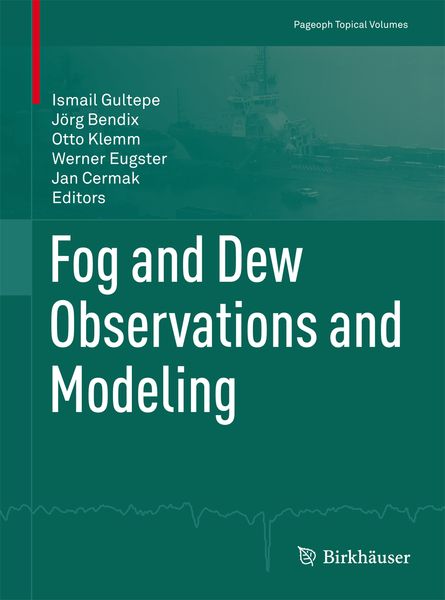
Fog and Dew Observations and Modeling
Aus der Reihe
Pageoph Topical Volumes
-
- Englisch ausgewählt
Fr. 72.90
inkl. gesetzl. MwSt.,
Beschreibung
Produktdetails
Einband
Taschenbuch
Erscheinungsdatum
21.07.2012
Abbildungen
VI, 408 p.
Herausgeber
Ismail Gultepe + weitereVerlag
Springer BaselSeitenzahl
408
Maße (L/B/H)
26/19.3/2.3 cm
Gewicht
864 g
Auflage
2012
Sprache
Englisch
ISBN
978-3-0348-0456-1
This topical issue of the Journal of Pure and Applied Geophysics focuses on research related to dew and various types of fog occurring around the globe which was presented on July 25-30, 2010, at the 5th International Conference on Fog, Fog Collection, and Dew in Münster, Germany. The areas of knowledge in this field include surface in-situ and remote sensing observations of fog, dew, fog collection, applications of the various fog models (such as 1D, 2D, and 3D fog and forecasting models), microphysical parameterizations, and climatology.
This volume gives a very good review of the existing knowledge and highlights the remaining difficulties in predicting and measuring fog at various scales of time and space. It also represents an important step in the direction of addressing new scientific challenges in fog and dew related research, teaching, and operational applications. Students as well as researchers, who are interested either in fog, in association with cloud physics, physical meteorology, aviation meteorology, climatology, weather forecasting and nowcasting, or in other adjacent disciplines like hydrometeorology, environment, and agriculture, will benefit from consulting and reading this topical issue.
This publication was significantly supported by the Canadian National Search And Rescue (SAR) Secretariat by funding the Fog Remote Sensing and Modeling (FRAM) Project led by Dr. Ismail Gultepe since 2005.
This volume gives a very good review of the existing knowledge and highlights the remaining difficulties in predicting and measuring fog at various scales of time and space. It also represents an important step in the direction of addressing new scientific challenges in fog and dew related research, teaching, and operational applications. Students as well as researchers, who are interested either in fog, in association with cloud physics, physical meteorology, aviation meteorology, climatology, weather forecasting and nowcasting, or in other adjacent disciplines like hydrometeorology, environment, and agriculture, will benefit from consulting and reading this topical issue.
This publication was significantly supported by the Canadian National Search And Rescue (SAR) Secretariat by funding the Fog Remote Sensing and Modeling (FRAM) Project led by Dr. Ismail Gultepe since 2005.
Noch keine Bewertungen vorhanden
Verfassen Sie die erste Bewertung zu diesem Artikel
Helfen Sie anderen Kundinnen und Kunden durch Ihre Meinung.