
• Produktbild: Globalization and Austerity Politics in Latin America
  • Produktbild: Globalization and Austerity Politics in Latin America

Globalization and Austerity Politics in Latin America

Fr. 51.90

inkl. gesetzl. MwSt., Versandkostenfrei


Beschreibung

Produktdetails

Einband

Taschenbuch

Erscheinungsdatum

01.02.2013

Verlag

Cambridge Academic

Seitenzahl

360

Maße (L/B/H)

22.9/15.2/2.1 cm

Gewicht

480 g

Sprache

Englisch

ISBN

978-1-107-67076-1

Beschreibung

Zitat

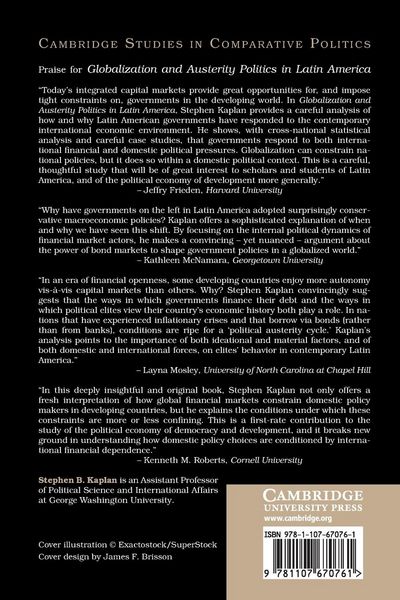
Advance praise: 'Today's integrated capital markets provide great opportunities for, and impose tight constraints on, governments in the developing world. In Globalization and Austerity Politics in Latin America, Stephen Kaplan provides a careful analysis of how and why Latin American governments have responded to the contemporary international economic environment. He shows, with cross-national statistical analysis and careful case studies, that governments respond to both international financial and domestic political pressures. Globalization can constrain national policies, but it does so within a domestic political context. This is a careful, thoughtful study that will be of great interest to scholars and students of Latin America, and of the political economy of development more generally.' Jeffry Frieden, Harvard University Advance praise: 'Why have governments on the left in Latin America adopted surprisingly conservative macroeconomic policies? Kaplan offers a sophisticated explanation of when and why we have seen this shift. By focusing on the internal political dynamics of financial market actors, he makes a convincing - yet nuanced - argument about the power of bond markets to shape government policies in a globalized world.' Kathleen McNamara, Georgetown University Advance praise: 'In an era of financial openness, some developing countries enjoy more autonomy vis-...-vis capital markets than others. Why? Stephen Kaplan convincingly suggests that the ways in which governments finance their debt and the ways in which political elites view their country's economic history both play a role. In nations that have experienced inflationary crises and that borrow via bonds (rather than from banks), conditions are ripe for a 'political austerity cycle'. Kaplan's analysis points to the importance of both ideational and material factors, and of both domestic and international forces, on elites' behavior in contemporary Latin America.' Layna Mosley, University of North Carolina, Chapel Hill Advance praise: 'In this deeply insightful and original book, Stephen Kaplan not only offers a fresh interpretation of how global financial markets constrain domestic policy makers in developing countries, but he explains the conditions under which these constraints are more or less confining. This is a first-rate contribution to the study of the political economy of democracy and development, and it breaks new ground in understanding how domestic policy choices are conditioned by international financial dependence.' Kenneth M. Roberts, Cornell University

Produktdetails

Einband

Taschenbuch

Erscheinungsdatum

01.02.2013

Verlag

Cambridge Academic

Seitenzahl

360

Maße (L/B/H)

22.9/15.2/2.1 cm

Gewicht

480 g

Sprache

Englisch

ISBN

978-1-107-67076-1

Herstelleradresse

Libri GmbH
Europaallee 1
36244 Bad Hersfeld
DE

Email: gpsr@libri.de

Kundinnen und Kunden meinen

0 Bewertungen

Informationen zu Bewertungen

Zur Abgabe einer Bewertung ist eine Anmeldung im Konto notwendig. Die Authentizität der Bewertungen wird von uns nicht überprüft. Wir behalten uns vor, Bewertungstexte, die unseren Richtlinien widersprechen, entsprechend zu kürzen oder zu löschen.

Die Bewertungen sind nach Format, Anzahl Sterne und Datum sortiert.

Verfassen Sie die erste Bewertung zu diesem Artikel

Helfen Sie anderen Kund*innen durch Ihre Meinung

Kundinnen und Kunden meinen

0 Bewertungen filtern

Die Leseprobe wird geladen.
  • Produktbild: Globalization and Austerity Politics in Latin America
  • Produktbild: Globalization and Austerity Politics in Latin America
  • 1. Introduction; 2. Globalization and austerity politics; 3. The political economy of elections; 4. The electoral boom-bust cycle; 5. From gunboat to trading-floor diplomacy; 6. When Latin American grasshoppers become ants; 7. The political austerity cycle; 8. Conclusion; Appendix: field research interviews.