Gutscheinbedingungen

*Gültig bis 04.08.2026 auf (fast) alles. Ausgeschlossen sind Smartboxen, Zeitschriften, Tickets, Lebensmittel, Gaming-Elektroartikel, Tinte/Toner, Gutscheine, Geschenkkarten, Blumen und Abos | Einlösbar in allen Buchhandlungen von Orell Füssli, Barth Bücher, Buchladen Rapunzel, Papeterie Köhler, Schuler Orell Füssli, Stauffacher und ZAP unter Vorweisung des Gutscheins, auf www.orellfüssli.ch durch Eingabe des Gutscheincodes. Beim Service „eBooks verschenken“ und bei eBook-Käufen via eReader nicht einlösbar | Mindesteinkaufswert: Fr. 30.- | Nicht mit anderen Rabatten kumulierbar.

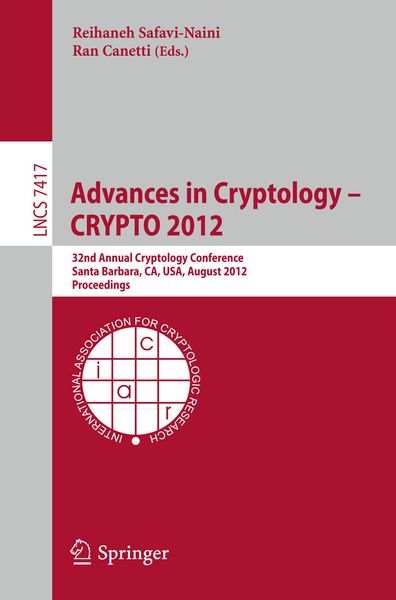
  • Produktbild: Advances in Cryptology -- CRYPTO 2012
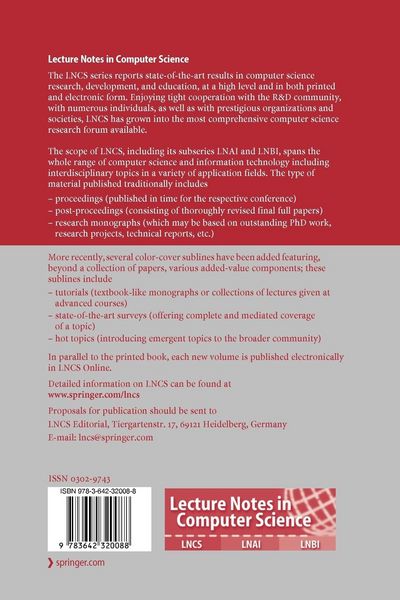
  • Produktbild: Advances in Cryptology -- CRYPTO 2012

Advances in Cryptology -- CRYPTO 2012 32nd Annual Cryptology Conference, Santa Barbara, CA, USA, August 19-23, 2012, Proceedings

Fr. 73.90

inkl. gesetzl. MwSt., Versandkostenfrei


Beschreibung

Produktdetails

Einband

Taschenbuch

Erscheinungsdatum

05.07.2012

Abbildungen

XV, 103 illus., schwarz-weiss Illustrationen

Herausgeber

Reihaneh Safavi-Naini + weitere

Verlag

Springer Berlin

Seitenzahl

888

Maße (L/B/H)

23.5/15.5/4.9 cm

Gewicht

1359 g

Auflage

2012

Sprache

Englisch

ISBN

978-3-642-32008-8

Beschreibung

Produktdetails

Einband

Taschenbuch

Erscheinungsdatum

05.07.2012

Abbildungen

XV, 103 illus., schwarz-weiss Illustrationen

Herausgeber

Verlag

Springer Berlin

Seitenzahl

888

Maße (L/B/H)

23.5/15.5/4.9 cm

Gewicht

1359 g

Auflage

2012

Sprache

Englisch

ISBN

978-3-642-32008-8

Herstelleradresse

Springer-Verlag GmbH
Tiergartenstr. 17
69121 Heidelberg
DE

Email: GPSR Kontakt

Noch keine Bewertungen vorhanden

Verfassen Sie die erste Bewertung zu diesem Artikel

Helfen Sie anderen Kundinnen und Kunden durch Ihre Meinung.

Kundinnen und Kunden meinen

Bewertungen (0)

  • Produktbild: Advances in Cryptology -- CRYPTO 2012
  • Produktbild: Advances in Cryptology -- CRYPTO 2012
  • Symmetric Cryptosystems.- An Enciphering Scheme Based on a Card Shuffle.- Tweakable Blockciphers with Beyond Birthday-Bound Security.- Breaking and Repairing GCM Security Proofs.- On the Distribution of Linear Biases: Three Instructive Examples.- Substitution-Permutation Networks, Pseudorandom Functions, and Natural Proofs.- Invited Talk.- The End of Crypto.- Secure Computation I.- Adaptively Secure Multi-Party Computation with Dishonest Majority.- Collusion-Preserving Computation.- Secret Sharing Schemes for Very Dense Graphs.- Attribute-Based and Functional Encryption.- Functional Encryption with Bounded Collusions via Multi-party Computation.- New Proof Methods for Attribute-Based Encryption: Achieving Full Security through Selective Techniques.- Dynamic Credentials and Ciphertext Delegation for Attribute-Based Encryption.- Functional Encryption for Regular Languages.- Proof Systems.- Database Commitments and Universal Arguments of Quasi Knowledge.- Succinct Arguments from Multi-prover Interactive Proofs and Their Efficiency Benefits.- Protocols.- On the Security of TLS-DHE in the Standard Model.- Semantic Security for the Wiretap Channel.- Multi-instance Security and Its Application to Password-Based Cryptography.- Hash Functions.- Hash Functions Based on Three Permutations: A Generic Security Analysis.-  Hash or Not to Hash Again? (In)Differentiability Results for H 2 and HMAC.- New Preimage Attacks against Reduced SHA-1.- Stam’s Conjecture and Threshold Phenomena in Collision Resistance.- Composable Security.- Universal Composability from Essentially Any Trusted Setup.- Impossibility Results for Static Input Secure Computation.- New Impossibility Results for Concurrent Composition and a Non-interactive Completeness Theorem for SecureComputation.- Black-Box Constructions of Composable Protocols without Set-Up.- Privacy.- Crowd-Blending Privacy.- Differential Privacy with Imperfect Randomness.- Leakage and Side-Channels.- Tamper and Leakage Resilience in the Split-State Model.- Securing Circuits against Constant-Rate Tampering.- How to Compute under AC 0 Leakage without Secure Hardware.- Invited Talk.- Recent Advances and Existing Research Questions in Platform Security.- Signatures.- Group Signatures with Almost-for-Free Revocation.- Tightly Secure Signatures and Public-Key Encryption.- Implementation Analysis.- Efficient Padding Oracle Attacks on Cryptographic Hardware.- Public Keys.- Secure Computation II.- Multiparty Computation from Somewhat Homomorphic Encryption.-Near-Linear Unconditionally-Secure Multiparty Computation with a Dishonest Minority.- A New Approach to Practical Active-Secure Two-Party Computation.- Black-Box Separation.- The Curious Case of Non-Interactive Commitments – On the Power of Black-Box vs. Non-Black-Box Use of Primitive.- Cryptanalysis.- Efficient Dissection of Composite Problems, with Applications to Cryptanalysis, Knapsacks, and Combinatorial Search Problems.- Resistance against Iterated Attacks by Decorrelation Revisited .- Quantum Cryptography.- Secure Identity-Based Encryption in the Quantum Random Oracle Model .- Quantum to Classical Randomness Extractors.- Actively Secure Two-Party Evaluation of Any Quantum Operation.- Key Encapsulation and One-Way functions.- On the Impossibility of Constructing Efficient Key Encapsulation and Programmable Hash Functions in Prime Order Groups .- Hardness of Computing Individual Bits for One-Way Functions on Elliptic Curves.-Homomorphic Evaluation of the AES Circuit.- Fully Homomorphic Encryption without Modulus Switching from Classical GapSVP.

    An Enciphering Scheme Based on a Card Shuffle.- Tweakable Blockciphers with Beyond Birthday-Bound Security.- Breaking and Repairing GCM Security Proofs.- On the Distribution of Linear Biases: Three Instructive Examples.- Substitution-Permutation Networks, Pseudorandom Functions, and Natural Proofs.- Invited Talk.- The End of Crypto.- Secure Computation I.- Adaptively Secure Multi-Party Computation with Dishonest Majority.- Collusion-Preserving Computation.- Secret Sharing Schemes for Very Dense Graphs.- Attribute-Based and Functional Encryption.- Functional Encryption with Bounded Collusions via Multi-party Computation.- New Proof Methods for Attribute-Based Encryption: Achieving Full Security through Selective Techniques.- Dynamic Credentials and Ciphertext Delegation forAttribute-Based Encryption.- Functional Encryption for Regular Languages.- Proof Systems.- Database Commitments and Universal Arguments of Quasi Knowledge.- Succinct Arguments from Multi-prover Interactive Proofs and Their Efficiency Benefits.- Protocols.- On the Security of TLS-DHE in the Standard Model.- Semantic Security for the Wiretap Channel.- Multi-instance Security and Its Application to Password-Based Cryptography.- Hash Functions.- Hash Functions Based on Three Permutations: A Generic Security Analysis.-  Hash or Not to Hash Again? (In)Differentiability Results for H 2 and HMAC.- New Preimage Attacks against Reduced SHA-1.- Stam’s Conjecture and Threshold Phenomena in Collision Resistance.- Composable Security.- Universal Composability from Essentially Any Trusted Setup.- Impossibility Results forStatic Input Secure Computation.- New Impossibility Results for Concurrent Composition and a Non-interactive Completeness Theorem for Secure Computation.- Black-Box Constructions of Composable Protocols without Set-Up.- Privacy.- Crowd-Blending Privacy.- Differential Privacy with Imperfect Randomness.- Leakage and Side-Channels.- Tamper and Leakage Resilience in the Split-State Model.- Securing Circuits against Constant-Rate Tampering.- How to Compute under AC 0 Leakage without Secure Hardware.- Invited Talk.- Recent Advances and Existing Research Questions in Platform Security.- Signatures.- Group Signatures with Almost-for-Free Revocation.- Tightly Secure Signatures and Public-Key Encryption.- Implementation Analysis.- Efficient Padding Oracle Attacks on Cryptographic Hardware.- Public Keys.- Secure Computation II.- Multiparty Computation from Somewhat Homomorphic Encryption.- Near-Linear Unconditionally-Secure Multiparty Computation with a Dishonest Minority.- A New Approach to Practical Active-Secure Two-Party Computation.- Black-Box Separation.- The Curious Case of Non-Interactive Commitments – On the Power of Black-Box vs. Non-Black-Box Use of Primitive.- Cryptanalysis.- Efficient Dissection of Composite Problems, with Applications to Cryptanalysis, Knapsacks, and Combinatorial Search Problems.- Resistance against Iterated Attacks by Decorrelation Revisited .- Quantum Cryptography.- Secure Identity-Based Encryption in the Quantum Random Oracle Model .- Quantum to Classical Randomness Extractors.- Actively Secure Two-Party Evaluation of Any Quantum Operation.- Key Encapsulation and One-Way functions.- On the Impossibility of Constructing Efficient Key Encapsulation and Programmable Hash Functions in Prime Order Groups .- Hardness of Computing Individual Bits for One-Way Functions on Elliptic Curves.- Homomorphic Evaluation of the AES Circuit.- Fully Homomorphic Encryption without Modulus Switching from Classical GapSVP.