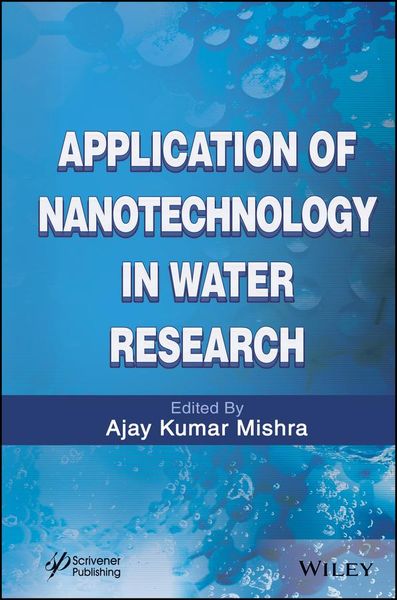
Application of Nanotechnology in Water Research
Fr. 293.00
inkl. gesetzl. MwSt.,
Beschreibung
Produktdetails
Einband
Gebundene Ausgabe
Erscheinungsdatum
23.06.2014
Herausgeber
Ajay Kumar MishraVerlag
John Wiley & SonsSeitenzahl
560
Maße (L/B/H)
23.6/15.5/3.3 cm
Gewicht
880 g
Sprache
Englisch
ISBN
978-1-118-49630-5
Details the water research applications of nanotechnology in various areas including environmental science, remediation, membranes, nanomaterials, and water treatment
At the nano size, materials often take on unique and sometimes unexpected properties that result in them being 'tuned' to build faster, lighter, stronger, and more efficient devices and systems, as well as creating new classes of materials. In water research, nanotechnology is applied to develop more cost-effective and high-performance water treatment systems, as well as to provide instant and continuous ways to monitor water quality.
This volume presents an array of cutting-edge nanotechnology research in water applications including treatment, remediation, sensing, and pollution prevention. Nanotechnology applications for waste water research have significant impact in maintaining the long-term quality, availability, and viability of water. Regardless of the origin, such as municipal or industrial waste water, its remediation utilizing nanotechnology can not only be recycled and desalinized, but it can simultaneously detect biological and chemical contamination.
Application of Nanotechnology in Water Research describes a broad area of nanotechnology and water research where membrane processes (nanofiltration, ultrafiltration, reverse osmosis, and nanoreactive membranes) are considered key components of advanced water purification and desalination technologies that remove, reduce, or neutralize water contaminants that threaten human health and/or ecosystem productivity and integrity. Various nanoparticles and nanomaterials that could be used in water remediation (zeolites, carbon nanotubes, self-assembled monolayer on mesoporous supports, biopolymers, single-enzyme nanoparticles, zero-valent iron nanoparticles, bimetallic iron nanoparticles, and nanoscale semiconductor photocatalysts) are discussed. The book also covers water-borne infectious diseases as well as water-borne pathogens, microbes, and toxicity approach.
Readership
Engineers and scientists conducting research in water treatment and remediation, materials science, nanotechnology, and pollution control will find this book to be especially useful. Its interdisciplinary nature will appeal to scientists in the broader areas of chemistry, physics, materials science, polymer science, engineering, and nanotechnology.
Noch keine Bewertungen vorhanden
Verfassen Sie die erste Bewertung zu diesem Artikel
Helfen Sie anderen Kundinnen und Kunden durch Ihre Meinung.