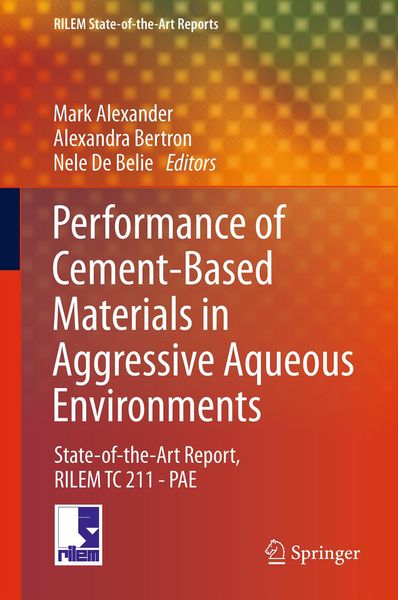
Performance of Cement-Based Materials in Aggressive Aqueous Environments State-of-the-Art Report, RILEM TC 211 - PAE
-
- Hardcover ausgewählt
- Taschenbuch
- eBook
-
Sprache:Englisch
Fr. 192.00
inkl. gesetzl. MwSt.,
Beschreibung
Produktdetails
Einband
Gebundene Ausgabe
Erscheinungsdatum
18.12.2012
Herausgeber
Mark Alexander + weitereVerlag
Springer NetherlandSeitenzahl
464
Maße (L/B/H)
24.1/16/3.2 cm
Gewicht
881 g
Auflage
1. Auflage
Sprache
Englisch
ISBN
978-94-007-5412-6
Concrete and cement-based materials must operate in increasingly aggressive aqueous environments, which may be either natural or industrial. These materials may suffer degradation in which ion addition and/or ion exchange reactions occur, leading to a breakdown of the matrix microstructure and consequent weakening. Sometimes this degradation can be extremely rapid and serious such as in acidic environments, while in other cases degradation occurs over long periods. Consequences of material failure are usually severe – adversely affecting the health and well-being of human communities and disturbing ecological balances. There are also large direct costs of maintaining and replacing deteriorated infrastructure and indirect costs from loss of production during maintenance work, which place a great burden on society.
The focus of this book is on addressing issues concerning performance of cement-based materials in aggressive aqueous environments , by way of this State-of-the-Art Report. The book represents the work of many well-known and respected authors who contributed chapters or parts of chapters. Four main themes were addressed: I. Nature and kinetics of degradation and deterioration mechanisms of cement-based materials in aggressive aqueous environments, II. Modelling of deterioration in such environments, III. Test methods to assess performance of cement-based materials in such environments, and which can be used to characterise and rate relative performance and inform long term predictions, IV. Engineering implications and consequences of deterioration in aggressive aqueous environments, and engineering approaches to the problem.
Noch keine Bewertungen vorhanden
Verfassen Sie die erste Bewertung zu diesem Artikel
Helfen Sie anderen Kundinnen und Kunden durch Ihre Meinung.