Gutscheinbedingungen

*Gültig bis 07.09.2026 auf alle Bücher. Ausgeschlossen sind Zeitschriften, Prozentbücher und Abos | Einlösbar in allen Buchhandlungen von Orell Füssli, Barth Bücher, Buchladen Rapunzel, Schuler Orell Füssli, Stauffacher und ZAP unter Vorweisung des Gutscheins, auf www.orellfüssli.ch durch Eingabe des Gutscheincodes. Beim Service „eBooks verschenken“ und bei eBook-Käufen via eReader nicht einlösbar | Mindesteinkaufswert: Fr. 30.- | Nicht mit anderen Rabatten kumulierbar.

  • Produktbild: Thrombolytic Therapy in Acute Ischemic Stroke II
  • Produktbild: Thrombolytic Therapy in Acute Ischemic Stroke II

Thrombolytic Therapy in Acute Ischemic Stroke II

Fr. 137.00

inkl. gesetzl. MwSt., Versandkostenfrei


Beschreibung

Produktdetails

Einband

Taschenbuch

Erscheinungsdatum

03.06.1993

Abbildungen

XIV, 334 p. 36 illus.

Herausgeber

Gregory J. DelZoppo + weitere

Verlag

Springer Berlin

Seitenzahl

334

Maße (L/B/H)

23.5/15.5/2 cm

Gewicht

534 g

Sprache

Englisch

ISBN

978-3-540-56442-3

Beschreibung

Produktdetails

Einband

Taschenbuch

Erscheinungsdatum

03.06.1993

Abbildungen

XIV, 334 p. 36 illus.

Herausgeber

Verlag

Springer Berlin

Seitenzahl

334

Maße (L/B/H)

23.5/15.5/2 cm

Gewicht

534 g

Sprache

Englisch

ISBN

978-3-540-56442-3

Herstelleradresse

Springer-Verlag KG
Sachsenplatz 4-6
1201 Wien
AT

Email: ProductSafety@springernature.com

Noch keine Bewertungen vorhanden

Verfassen Sie die erste Bewertung zu diesem Artikel

Helfen Sie anderen Kundinnen und Kunden durch Ihre Meinung.

Kundinnen und Kunden meinen

Bewertungen (0)

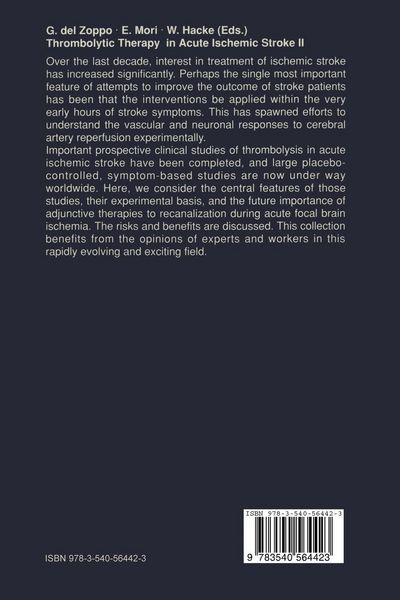
  • Produktbild: Thrombolytic Therapy in Acute Ischemic Stroke II
  • Produktbild: Thrombolytic Therapy in Acute Ischemic Stroke II
  • Background to Thrombolytic Therapy in Acute Ischemic Stroke.- Therapy for Acute Ischemic Stroke: Clinical Needs and Statistical Burdens.- Clinical Outcome of Acute Ischemic Stroke: Prospective Angiographic Studies.- The Ischemic Penumbra: Usefulness of PET.- Thrombolytic Agents: Lessons for Their Use in Acute Stroke from Myocardial Infarction Experience.- Pathogenesis of Secondary Brain Hemorrhage After Ischemia: Lessons from Animal Models … and a few from man, too!.- Clinical Trials of Fibrinolytic Agents in Carotid Territory Cerebral Ischemia.- Symptom-Based Trials of Intravenous rt-PA in Acute Stroke.- A Safety and Efficacy Study of Intravenous rt-PA in Patients with Acute Stroke.- Recanalization, Infarct Volume, Cerebral Hemorrhage, and Clinical Outcome After Intravenous Recombinant Tissue Plasminogen Activator and Heparin in Acute Carotid Territory Stroke.- Intravenous Tissue Plasminogen Activator in Acute Thromboembolic Stroke: A Placebo-Controlled, Double-Blind Trial.- The European Cooperative Acute Stroke Study (ECASS).- On the Estimation of the Sample Size for the ECASS Study.- Australian Streptokinase Trial (ASK).- Thrombolytic and Antithrombotic Therapy in Acute Ischemic Stroke. Multicenter Acute Stroke Trial — Italy (MAST-I).- Discussion Summary: Clinical Trials in Progress.- Other Applications of Fibrinolytic Agents in the Central Nervous System.- Acute Central Retinal Artery Occlusion and the Role of Thrombolysis.- Current Status of Fibrinolysis for the Rapid Dissolution of Subarachnoid and Intraventricular Clot.- Discussion Summary: Other Applications of Fibrinolytic Agents in the Central Nervous System.- Insights into the Pathogenesis of Cerebral Ischemia Relevant to Fibrinolysis.- Deterioration of Acute Stroke.- Early Spontaneous Recanalization ofThromboembolic Stroke.- Spectacular Shrinking Deficits in Acute Ischemic Stroke.- The Significance of Various Factors Associated with Hemorrhagic Transformation in Patients Treated with Recombinant Tissue Plasminogen Activator for Acute Stroke.- Thrombolysis: Stroke Subtype and Embolus Type.- The Prognostic Value of Collateral Blood Flow in Acute Middle Cerebral Artery Occlusion.- Morphological Evidence of Progressive Microvascular Impairment in Middle Cerebral Artery Occlusion-Reperfusion.- Discussion Summary: Insights into the Pathogenesis of Cerebral Ischemia Relevant to Fibrinolysis.- Diagnosis and Assessment of Outcomes in Acute Cerebral Ischemia.- The Relevance of CT Scanning and Angiography for Patients with Acute Stroke Treated with Recombinant Tissue Plasminogen Activator.- Recanalization of the Embolically Occluded Middle Cerebral Artery in Acute Stroke Patients: Noninvasive Assessment and Outcome.- Potential Role of Magnetic Resonance Imaging in Selecting Patients for Thrombolytic Therapy.- The Role of SPECT in Acute Stroke Thrombolysis.- Clinical and Brain Hemodynamic Evaluations of Thrombolytic Therapy in Acute Ischemic Stroke: SPECT Study.- The Relevance of Neurological and Functional Outcome Scales for Acute Stroke Trials.- Discussion Summary: Diagnosis and Assessment of Outcomes in Acute Cerebral Ischemia.- Ancillary Therapy for Cerebrovascular Reperfusion.- Neuronal Protection and Recanalization Strategies: Is More Better?.- Strategies Which Decrease Post-Reperfusion Lipid Peroxidation.- Anti-PMN Leukocyte Strategies and Their Application to Focal Cerebral Ischemia.- Von Willebrand Factor as a Target for Antithrombotic Intervention.- Neuronal Protection: Is There a Role for Gangliosides or Ca2+-Channel Blockers?.- Discussion Summary: Ancillary Therapyfor Cerebrovascular Reperfusion.- Open Communications.- A Meta-Analysis of All Published Data on the Use of Thrombolytic Therapy to Treat Acute Ischemic Stroke.- Causes of Delayed Treatment of Stroke Patients Enrolled in t-PA Protocols.- A Demming Approach to Recruiting: The National Institute of Neurological Disease and Stroke (NINDS) t-PA Stroke Trial Experience.- Local Intra-arterial Fibrinolytic Therapy Within the Cerebral Arteries: Effectiveness of rt-PA Concerning Recanalization Rate and Time.- Relation of Thrombolytic Reperfusion and of Collateral Circulation to Outcome in Patients Suffering Cerebral Main Artery Occlusion.- Factors Related to Intracranial Hematoma Formation in Patients Receiving t-PA for Acute Ischemic Stroke.- Transcranial Doppler Sonographic (TCD) Monitoring of Basilar Artery Thrombolysis.- HMPAO SPECT Measures Reperfusion After Thrombolytic Therapy in Acute Stroke.- A Cell Culture Model of Reperfusion Injury: Neutrophil-Mediated Brain Endothelial Cytotoxicity.- Modification of Brain Ischemia Due to Embolic Stroke by Tissue-Type Plasminogen Activator With and Without Heparin in a Rabbit Model.- Reduction of Infarct Volume and Mortality by Thrombolysis with rt-PA in an Embolic Stroke Model.- Discussion Summary: Open Communications.- Clinical Trial Development.- Clinical Trials Sponsored by Companies Versus the NIH.- Blindness and Thrombolysis.