• Produktbild: Stochastic Models for Spike Trains of Single Neurons
  • Produktbild: Stochastic Models for Spike Trains of Single Neurons
Band 16

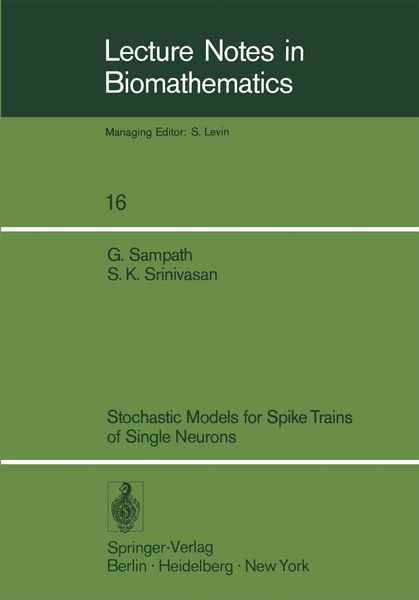
Stochastic Models for Spike Trains of Single Neurons

Fr. 72.90

inkl. gesetzl. MwSt., Versandkostenfrei


Beschreibung

Produktdetails

Einband

Taschenbuch

Erscheinungsdatum

01.08.1977

Verlag

Springer Berlin

Seitenzahl

190

Maße (L/B/H)

24.4/17/1.2 cm

Gewicht

375 g

Auflage

Softcover reprint of the original 1st ed. 1977

Sprache

Englisch

ISBN

978-3-540-08257-6

Beschreibung

Produktdetails

Einband

Taschenbuch

Erscheinungsdatum

01.08.1977

Verlag

Springer Berlin

Seitenzahl

190

Maße (L/B/H)

24.4/17/1.2 cm

Gewicht

375 g

Auflage

Softcover reprint of the original 1st ed. 1977

Sprache

Englisch

ISBN

978-3-540-08257-6

Herstelleradresse

Springer-Verlag GmbH
Tiergartenstr. 17
69121 Heidelberg
DE

Email: ProductSafety@springernature.com

Kundinnen und Kunden meinen

0 Bewertungen

Informationen zu Bewertungen

Zur Abgabe einer Bewertung ist eine Anmeldung im Konto notwendig. Die Authentizität der Bewertungen wird von uns nicht überprüft. Wir behalten uns vor, Bewertungstexte, die unseren Richtlinien widersprechen, entsprechend zu kürzen oder zu löschen.

Die Bewertungen sind nach Format, Anzahl Sterne und Datum sortiert.

Verfassen Sie die erste Bewertung zu diesem Artikel

Helfen Sie anderen Kund*innen durch Ihre Meinung

Kundinnen und Kunden meinen

0 Bewertungen filtern

  • Produktbild: Stochastic Models for Spike Trains of Single Neurons
  • Produktbild: Stochastic Models for Spike Trains of Single Neurons
  • 1 Some basic neurophysiology.- 1.1 The neuron.- 1.1.1 The axon.- 1.1.2 The synapse.- 1.1.3 The soma.- 1.1.4 The dendrites.- 1.2 Types of neurons.- 2 Signals in the nervous system.- 2.1 Action potentials as point events — point processes in the nervous system.- 2.2 Spontaneous activity in neurons.- 3 Stochastic modelling of single neuron spike trains.- 3.1 Characteristics of a neuron spike train.- 3.2 The mathematical neuron.- 4 Superposition models.- 4.1 Superposition of renewal processes.- 4.2 Superposition of stationary point processes — limiting behaviour.- 4.2.1 Palm functions.- 4.2.2 Asymptotic behaviour of n stationary point processes superposed.- 4.3 Superposition models of neuron spike trains.- 4.3.1 Model 4.1.- 4.3.2 Model 4.2 — A superposition model with two input channels.- 4.3.3 Model 4.3.- 4.4 Discussion.- 5 Deletion models.- 5.1 Deletion models with independent interaction of excitatory and inhibitory sequences.- 5.1.1 Model 5.1 The basic deletion model.- 5.1.2 Higher-order properties of the sequence of r-events.- 5.1.3 Extended version of Model 5.1 — Model 5.2.- 5.2 Models with dependent interaction of excitatory and inhibitory sequences — Models 5.3 and 5.4.- 5.3 Discussion.- 6 Diffusion models.- 6.1 The diffusion equation.- 6.1.1 The diffusion process as the limit of a random walk.- 6.1.2 General theory of diffusion processes.- 6.2 Diffusion models for neuron firing sequences.- 6.2.1 Model 6.1.- 6.2.2 Model 6.2 — Refractoriness in a diffusion model.- 6.3 Discussion.- 7 Counter models.- 7.1 Theory of counters.- 7.2 Counter model extensions of deletion models with independent interaction of e-and i-events.- 7.2.1 Model 7.1.- 7.2.2 Model 7.2.- 7.2.3 Model 7.3.- 7.3 Counter model extensions of deletion models with dependent interaction of e-and i-events.- 7.3.1 Model 7.4.- 7.3.2 Model 7.5.- 7.4 Counter models with threshold behaviour 100 7.4.1 Model 7.6.- 7.5 Discussion.- 8 Discrete state models.- 8.1 Birth and death processes.- 8.2 Models with excitatoiy inputs only.- 8.2.1 Model 8.1.- 8.2.2 Model 8.2.- 8.3 Models with independent interaction of e-events and i-events.- 8.3.1 Model 8.3.- 8.3.2 Model 8.4.- 8.3.3 Model 8.5.- 8.4 Models with dependent interaction of input sequaices.- 8.4.1 Model 8.6.- 8.5 Discussion.- 9 Continuous state models.- 9.1 Cumulative processes.- 9.1.1 The distribution of X(t).- 9.1.2 The first passage time problem in a cumulative process.- 9.2 Models with only one input sequence.- 9.2.1 Model 9.1.- 9.2.2 Model 9.2.- 9.3 Models with independent interaction of e-and i-events.- 9.3.1 Model 9.3.- 9.3.2 Model 9.4.- 9.4 Models with dependent interaction of e- and i-events.- 9.4.1 Model 9.5.- 9.5 Discussion.- 10 Real neurons and mathematical models.- 10.1 Decay of the membrane potential.- 10.2 Hyperpolarisation of the membrane.- 10.3 Refractoriness and threshold.- 10.4 Spatial summation.- 10.5 Other properties of neurons.- 10.6 The neuron as a black box.- 10.7 Spike trains and renewal processes.- 10.8 Conclusion.- References.