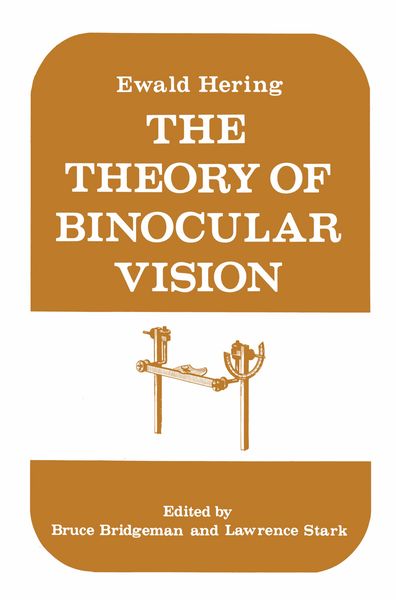
The Theory of Binocular Vision Ewald Hering (1868)
-
- Taschenbuch ausgewählt
- eBook
-
Sprache:Englisch
Fr. 137.00
inkl. gesetzl. MwSt.,
Beschreibung
Produktdetails
Einband
Taschenbuch
Erscheinungsdatum
13.10.2011
Abbildungen
VI, 218 p.
Verlag
Springer UsSeitenzahl
218
Maße (L/B/H)
23.5/15.5/1.3 cm
Gewicht
353 g
Auflage
Softcover reprint of the original 1st ed. 1997
Sprache
Englisch
ISBN
978-1-4613-4150-5
The Theory of Binocular Vision is a book about neurological control theory. In this sense it was far ahead of its time, for the formal development of control theory was many decades in the future when this book appeared in 1868. Hering's principal concept is that the control of eye movements is greatly simplified if there is only one neurological control system commanding the 'double-eye' as a single organ. This idea leads directly to the first thorough exposition of what is now known as Hering's law, that the corresponding muscles of the two eyes are always equally innervated. As Hering eloquently states it, "one and the same impulse of will directs both eyes simultaneously as one can direct a pair of horses with single reins" (Ch. 2). The 19th Century The book was written during an exciting era for physiological research. Before the mid-19th century the study of physiology had been limited to isolated efforts by great men who worked largely without colleagues or organized laboratories. Now for the first time of inquiry, with many sensory physiology was becoming a living field groups working simultaneously on fundamental problems. Like the classical Greeks before them in philosophy, the physiologists of the 19th century were defining in a burst of creative energy the problems 1 2 Introduction which would shape subsequent inquiry; and like the Greeks, they produced a splendid period of science.
Noch keine Bewertungen vorhanden
Verfassen Sie die erste Bewertung zu diesem Artikel
Helfen Sie anderen Kundinnen und Kunden durch Ihre Meinung.