Gutscheinbedingungen

*Gültig bis 21.06.2026 auf (fast) alles. Ausgeschlossen sind Smartboxen, Zeitschriften, Tickets, Lebensmittel, Gaming-Elektroartikel, Tinte/Toner, Gutscheine, Geschenkkarten, Blumen und Abos | Einlösbar in allen Buchhandlungen von Orell Füssli, Barth Bücher, Buchladen Rapunzel, Schuler Orell Füssli, Stauffacher und ZAP unter Vorweisung des Gutscheins, auf www.orellfüssli.ch durch Eingabe des Gutscheincodes. Beim Service „eBooks verschenken“ und bei eBook-Käufen via eReader nicht einlösbar | Mindesteinkaufswert: Fr. 30.- | Nicht mit anderen Rabatten kumulierbar.

Produktbild: Telecommunications and Energy in Systemic Transformation

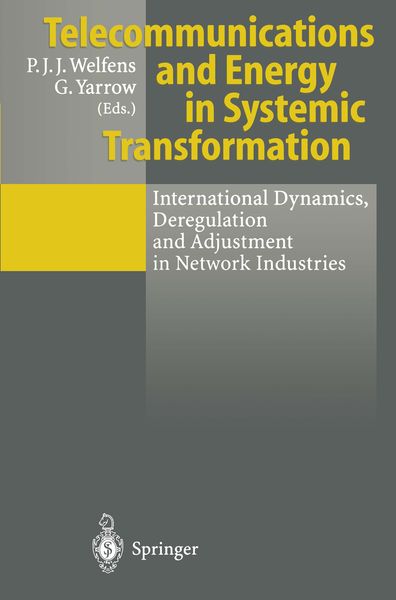
Telecommunications and Energy in Systemic Transformation International Dynamics, Deregulation and Adjustment in Network Industries

Fr. 72.90

inkl. gesetzl. MwSt., Versandkostenfrei


Beschreibung

Produktdetails

Einband

Taschenbuch

Erscheinungsdatum

16.09.2011

Herausgeber

Paul J.J. Welfens + weitere

Verlag

Springer Berlin

Seitenzahl

501

Maße (L/B/H)

23.5/15.5/2.8 cm

Gewicht

778 g

Auflage

Softcover reprint of the original 1st ed. 1997

Sprache

Englisch

ISBN

978-3-642-64441-2

Beschreibung

Portrait

Paul J. J. Welfens, geb. 1957 in Düren, Studium der Volkswirtschaftslehre in Wuppertal, Duisburg und Paris, Promotion 1985, Habilitation1989. Inhaber des Lehrstuhls für Volkswirtschaftslehre - Schwerpunkt Makroökonomische Theorie und Politik an der Bergischen Universität Wuppertal; Präsident des Europäischen Instituts für Internationale Wirtschaftsbeziehungen (EIIW); Jean-Monnet-Professor für Europäische Wirtschaftsintegration; zuvor Distinguished Research Fellow am AICGS/The Johns Hopkins University, Professor an der Universität Münster bzw. Potsdam, Visiting Alfred Grosser Professor Sciences Po, Paris.

Produktdetails

Einband

Taschenbuch

Erscheinungsdatum

16.09.2011

Herausgeber

Verlag

Springer Berlin

Seitenzahl

501

Maße (L/B/H)

23.5/15.5/2.8 cm

Gewicht

778 g

Auflage

Softcover reprint of the original 1st ed. 1997

Sprache

Englisch

ISBN

978-3-642-64441-2

Herstelleradresse

Springer-Verlag GmbH
Tiergartenstr. 17
69121 Heidelberg
DE

Email: ProductSafety@springernature.com

Kundinnen und Kunden meinen

0 Bewertungen

Informationen zu Bewertungen

Zur Abgabe einer Bewertung ist eine Anmeldung im Konto notwendig. Die Authentizität der Bewertungen wird von uns nicht überprüft. Wir behalten uns vor, Bewertungstexte, die unseren Richtlinien widersprechen, entsprechend zu kürzen oder zu löschen.

Die Bewertungen sind nach Format, Anzahl Sterne und Datum sortiert.

Verfassen Sie die erste Bewertung zu diesem Artikel

Helfen Sie anderen Kund*innen durch Ihre Meinung

Kundinnen und Kunden meinen

0 Bewertungen filtern

  • Produktbild: Telecommunications and Energy in Systemic Transformation
  • A. Telecommunications in Western Europe: Liberalization, Technological Dynamics and Regulatory Developments.- 1. Introduction.- 2. Liberalization and Market Expansion in Telecommunications.- 2.1 Global Forces in Telecoms Liberalization.- 2.2 Privatization and Deregulation in Western Europe.- 2.3 Politico-economic Deregulation Pressures.- 3. Technological Dynamics.- 3.1 Digitization.- 3.2 Integrated Services Digital Network.- 3.3 Fibre Optics, Fibre to the Home and Optical Networks.- 3.4 Mobile Communications.- 4. Regulatory Developments.- 4.1 Regulatory Developments on the EC Level.- 4.2 National Regulatory Frameworks: Developments and Experiences.- 4.2.1 Telecommunications Equipment.- 4.2.2 Value-added Services.- 4.2.3 Infrastructure.- 5. Prospects and Consequences for Central and Eastern Europe.- B. Telecommunications in Systemic Transformation: Theoretical Issues and Policy Options.- 1. Introduction.- 2. Points of Departure in Eastern Europe.- 2.1 Structure of the Telecoms Industry in an East-West Perspective.- 2.2 Telecoms Industry as a Strategic Industry for Systemic Transition.- 3. Theoretical Aspects of the Telecoms Industry.- 3.1 Some Problems of Uniform Subscriber Pricing.- 3.2 Competition, Natural Monopoly and Economies of Scope.- 3.3 External Effects of Telecoms Network Expansion.- 3.4 Oligopolistic Telecoms Industries.- 3.5 Regulation of the Telecoms Industry.- 4. Policy Options for a Modern Telecoms Policy.- 4.1 Privatization of the Telecoms Industry.- 4.2 How to Accelerate Telephone Penetration.- 4.3 Special Aspects of Mobile Telecommunications.- 4.4 Innovative Use of Telecoms.- 4.5 Capital Market Aspects.- 4.6 Social Problems.- 4.7 Principles of Efficient Regulatory Policy.- 4.8 Perspectives for Poland.- C. Modernization of Telecommunications in the Former GDR.- 1. Former GDR Telecommunications System.- 2. German Unification and Telecoms Modernization.- D. Recent Evolution of Telecommunications in the Region of Central Europe.- 1. Introduction.- 2. Telecommunication Administration.- 3. Legislative Framework.- 4. Development Strategy.- 5. Network Development.- 6. Private Local Operators.- 7. Privatization of National Operators.- 8. Tariffs.- 9. Cellular Telephony.- 10. Conclusions.- E. Modernizing Telecommunications in Central and Eastern Europe: A Business Perspective.- 1. Structural Reasons for the Current Eastern Demand for Telecommunications.- 2. Pumping Fresh Money into Old Structures is Not Enough.- 3. How to Attract Investors’ Interest.- 4. Special Networks (Overlay, Mobile, Wireless Local Loop).- 5. Regulators’ Possibilities and Contradictions.- 6. Siemens’s Role as Supplier and Local Manufacturer.- F. Telecommunications Reform in the United States: Promises and Pitfalls.- 1. Need for Pro-competitive Regulatory Reform, and the 1996 Telecommunications Act.- 1.1 Reassessing Government Intervention in So-called Natural Monopolies.- 1.2 Challenges to Regulatory Reform.- 2. Increasing the Reliance on Competition and Markets.- 2.1 Relaxing Legal Entry Barriers.- 2.2 Liberalizing Restrictions on Foreign Investment.- 2.3 Making Better Use of the Radio Spectrum.- 3. Role for Government: Media Cross-ownership, Cable Rate Decontrol, Telephone-cable Consolidations.- 3.1 Media Cross-ownership.- 3.2 Cable Rate Decontrol.- 3.3 Cable-telephone Consolidations.- 4. Role for Government: Telephone Competition.- 4.1 Background.- 4.1.1 Local and Long-distance Service.- 4.1.2 Why the 1984 AT&T Breakup: Regulatory Evasion via Favoring Unregulated Affiliates Distorts Competition and is Inefficient.- 4.1.3 Unbundling Regulated Bottleneck Monopolies from Potentially Competitive Segments: Alternative Approaches.- 4.2 Bell Companies’ Entry into Long-distance Service.- 4.2.1 Arguments for Bell’s Entry: Costs of Structural Separation.- 4.2.2 Arguments against Bell’s Entry: Preventing Access Discrimination.- 4.2.3 Competitive Safeguards in the 1996 Act.- 4.3 Promoting Local Competition.- 4.3.1 Local Telephone Networks and Types of Entrants.- 4.3.2 Benefits of Resale or Partial-facilities Entry.- 4.3.3 Requirements of the 1996 Act: Interconnection and Unbundling.- 5. Reducing Cross-subsidies and Revamping Universal Service.- 5.1 Cross-subsidies, Common Costs, and Economic Efficiency.- 5.2 Distortions in Current System and Tension with Competition.- 5.3 Reforming Universal Service.- 5.4 The 1996 Act.- 6. Conclusion.- G. Regulation and Tariff Policies in the Energy and Telecommunications Sectors in the Transition Countries: The Case of the Czech Republic.- 1. Introduction.- 2. Features of the Energy Sector.- 3. Price Regulation and Tariffs in the Energy Sector.- 4. Telecommunications Sector Features.- 5. Regulation and Tariffs in the Telecommunications Sector.- 6. Situation and Approaches in CEC and EU.- 7. Conclusions.- H. The Process of Systemic Transformation and Reforms in the Energy Sector: The Regulatory Issues of the Reforms.- 1. Introduction.- 2. Systemic Transformation and Reforms in the Energy Industry.- 3. The Model of an Independent Regulation.- 3.1 The Concept of Reforms in the Energy Sector.- 3.2. The Justification for Independent Regulation.- 4. Controversies Surrounding the Model of Independent Regulation.- 5. Regulatory Authority and Antimonopoly Office.- I. Restructuring and Regulatory Reform in the Polish Energy Sector: an Assessment.- 1. Introduction.- 2. The Energy Sector in Poland.- 3. Policy during the Initial Phase of Economic Transition.- 4. Industrial Restructuring.- 4.1 Restructuring in Gas.- 4.2 Restructuring in Electricity.- 4.3 Conclusions on Structural Decisions.- 5. Regulation.- 5.1 The Problem of Delegation.- 5.2 The Trade-offs.- 5.3 The Consequences of Delay.- 6. Conclusions.- J. Energy Law Developments in the European Union and Poland.- 1. Introduction.- 2. Energy Policy Developments.- 2.1 European Union.- 2.2 Poland.- 3. New Legislation.- 3.1 European Union.- 3.1.1 Primary EU Law.- 3.1.2 Secondary Legislation.- 4. Poland.- Conclusion.- K. Institutional Choice or Muddling Through — Problems of Transformation in the Electricity Supply Industry in Russia.- 1. Institutional Choice in the Phase of Transformation.- 2. Models for Network-oriented Energy Sectors in the West.- 2.1 Special Characteristics of the ESI.- 2.2 Elements of Competition.- 2.3 Transformation in Different Political Systems.- 2.3.1 Germany.- 2.3.2 USA.- 2.3.3 European Union.- 2.3.4 Great Britain.- 3. The ESI in Russia.- 3.1 Basic Energy Situation.- 3.2 State of the ESI.- 3.3 State of the Institutional Reform of the Sector.- 4. Analysis of the Reform Process.- 4.1 General Problems of the Present Reform.- 4.2 Regional Interests — Siberia.- 4.3 The Concept of Privatisation in the Discussion.- 5. Cooperation with Western Europe.- L. Co-operation in Energy Policies: European Union (EU) — Eastern Europe.- 1. Introduction.- 2. East-West Co-operation in the Electricity and Gas Sector.- 2.1 The Electricity Sector.- 2.2 The Gas Sector.- 2.2.1 Natural Gas from the Former Soviet Union for Western Europe.- 2.2.2 The Outlook: Natural Gas from the CIS in the Context of Meeting Future Requirements.- 2.2.3 New Areas of Co-operation.- 2.2.4 Stable Framework Conditions as a Prerequisite for East-West-Co-operation.- 2.2.5 Examples of Co-operation in the Gas Sector.- 3. Transeuropean Networks (TEN).- 3.1 Short Overview.- 3.2 Gas Pipeline between Russia and the EU.- 3.3 The East-West High Power Transmission System as an Essential Part of the Baltic Ring.- 3.3.1 Introduction.- 3.3.2 Rough Investment Evaluation for the Baltic Ring.- 3.3.3 East-West High Power Transmission System.- 3.3.4 Conclusions.- 4. Summary.- M. Regulation and Systemic Transformation.- 1. Introduction.- 2. The Process of Systemic Transformation and its Constitutive Characteristics.- 3. Regulation in Market Economies.- 3.1 The Rule of Law and the Law of Contract as Regulation: an Institutional Approach.- 3.2 Regulation and Competition.- 4.Regulation in the Strict Sense of the Word.- 4.1 Regulation as an Institution of Market Economies.- 4.1.1 Regulation as an Actually Existing Institution in Market Economies.- 4.1.2 Why Regulation? Regulation and Economic Efficiency.- 4.2 Regulation of Public Utilities.- 4.2.1 Public Ownership as Regulation.- 4.2.2 Regulation and Private Sector.- 4.2.2.1 Regulation of Private Public Utilities (Network Industries).- 4.2.2.2 Regulation and Privatisation.- 4.2.2.2.1 Procompetitive Restructuring.- 4.2.2.2.2 Regulatory Agencies and Procompetitive Regulation.- 5. Regulation on the Way Back towards Capitalism.- 5.1 The Rule of Law and Competition.- 5.2 Public Utilities and Systemic Transformation.- 5.2.1 Regulation within the Public Sector: Institutional Reform and Restructuring.- 5.2.2 Regulation and Privatisation.- 6. Regulation as an Element of the System Being Created: Some Normative Remarks and Suggestions.- List of Tables.- List of Figures.- List of Contributors.