
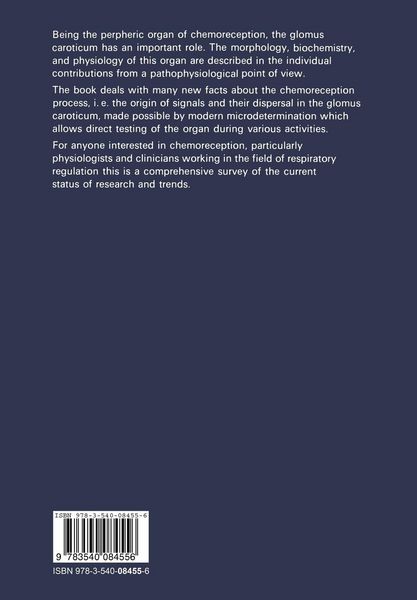
• Produktbild: Chemoreception in the Carotid Body
  • Produktbild: Chemoreception in the Carotid Body

Chemoreception in the Carotid Body

Fr. 138.00

inkl. gesetzl. MwSt., Versandkostenfrei


Beschreibung

Produktdetails

Einband

Taschenbuch

Erscheinungsdatum

01.11.1977

Abbildungen

XIV, 32 illus., schwarz-weiss Illustrationen

Herausgeber

H. Acker + weitere

Verlag

Springer Berlin

Seitenzahl

296

Maße (L/B/H)

24.4/17/1.8 cm

Gewicht

595 g

Sprache

Englisch

ISBN

978-3-540-08455-6

Beschreibung

Produktdetails

Einband

Taschenbuch

Erscheinungsdatum

01.11.1977

Abbildungen

XIV, 32 illus., schwarz-weiss Illustrationen

Herausgeber

Verlag

Springer Berlin

Seitenzahl

296

Maße (L/B/H)

24.4/17/1.8 cm

Gewicht

595 g

Sprache

Englisch

ISBN

978-3-540-08455-6

Herstelleradresse

Springer-Verlag KG
Sachsenplatz 4-6
1201 Wien
AT

Email: GPSR Kontakt

Noch keine Bewertungen vorhanden

Verfassen Sie die erste Bewertung zu diesem Artikel

Helfen Sie anderen Kundinnen und Kunden durch Ihre Meinung.

Kundinnen und Kunden meinen

Bewertungen (0)

  • Produktbild: Chemoreception in the Carotid Body
  • Produktbild: Chemoreception in the Carotid Body
  • Session I: Morphometric and Histologic Analysis of the Cell Elements in the Carotid Body Tissue.- Light-Microscopic and Electron-Microscopic Studies on the Morphology of Cat Carotid Body.- Origin of Nerve Terminals on Glomus Cells in Cat Carotid Body: A Study of Axoplasmic Movement of Labeled Material Along Sensory Neurons of the Petrosal Ganglion.- Identification of Sensory Axon Terminations in the Carotid Body by Autoradiography.- Degenerative Changes in Rabbit Carotid Body Following Systematic Denervation and Preliminary Results about the Morphology of Sinus Nerve Neuromas.- Regeneration of Nerves and Nerve Terminals in Rabbit Carotid Body Following Carotid Nerve Sectioning and Suturing.- Chemoreceptor Activity in the Rabbit Carotid Sinus Nerve During Regeneration.- Recovery of Chemosensory Function of Regenerating Carotid Nerve Fibers.- Studies of Normal and Wobbler Mutant Carotid Bodies.- Fine Structure of Pressoreceptor Terminals in the Carotid Body (Mouse, Cat, Rat).- Capillary Distances and Oxygen Supply to the Specific Tissue of the Carotid Body.- Session II: Electrophysiological Characteristics of the Cell Elements in the Carotid Body.- Effects of Temperature and Stimulating Agents on Carotid Body Cells.- Are the Conventional Electrophysiological Criteria Sufficient to Give Evidence of an Electrogenic Sodium Transport Across Neuronal Membranes?.- Reaction of Cultured Carotid Body Cells to Different Concentrations of Oxygen and Carbon Dioxide.- Meaning of the Type I Cell for the Chemoreceptive Process - An Electrophysiological Study on Cultured Type I Cells of the Carotid Body.- Session III: Histochemical and Biochemical Investigation of the Transmitters in the Carotid Body.- Dopamine Beta-Hydroxylase Activity in the Cat Carotid Body.- Endogenous Acetylcholine Levels in Cat Carotid Body and the Autoradiographic Localization of a High Affinity Component of Choline Uptake.- Molecular Biology of Chemoreceptor Function: Induction of Tyrosine Hydroxylase in the Rat Carotid Body Elicited by Hypoxia.- Effects of Hypoxia on Carotid Body Type I Cells and Their Catecholamines. A Biochemical and Morphologic Study.- Loss of Histochemically Demonstrable Catecholamines in the Glomus Cells of the Carotid Body After a-Methylparatyrosine Treatment.- Enzymes and Inhibitors of the Catecholamine Metabolism in the Cat Carotid Body.- Session IV: The Afferent and Efferent Chemoreceptive Pathway of the Carotid Body.- A Pharmacologic Study on a Possible Inhibitory Role of Dopamine in the Cat Carotid Body Chemoreceptor.- Blockade of Carotid Body Chemosensory Inhibition.- Variable Influences of the Sympathetic Nervous System Upon Carotid Body Chemoreceptor Activity.- Mechanism of Inhibition of Chemoreceptor Activity by Sinus Nerve Efferents.- Further Studies on the Fluctuation of Chemoreceptor Discharge in the Cat.- Carotid Body Chemoreceptor Afferent Neurons in the Solitary Tract Nucleus Area of the Cat.- Multifactor Influences on the Functional Relationship Between Ventilation and Arterial Oxygen Pressure.- Session V: Morphometric Analysis of Ultrastructural Changes in the Carotid Body Tissue.- Histofluorescent and Ultrastructural Studies on the Effects of Reserpine and Calcium on Dense-Cored Vesicles in Glomus Cells of the Rat Carotid Body.- Ultrastructural Changes in Sensory Nerve Endings Accompanying Increased Chemoreceptor Activity: A Morphometric Study of the Rat Carotid Body.- Dense-Cored Vesicles and Cell Types in the Rabbit Carotid Body.- The Carotid Body Chief Cell as a Paraneuron.- Session VI: Environmental Conditions for the Chemoreceptive Process in the Carotid Body.- Factors Affecting O2 Consumption of the Cat Carotid Body.- Mathematical Analysis of Oxygen Partial Pressure Distribution of the Carotid Body Tissue.- Comparative Measurements of Tissue PO2 in the Carotid Body.- A Functional Estimate of the Local PO2 at Aortic Chemoreceptors.- Role of Calcium Ions in the Mechanism of Arterial Chemoreceptor Excitation.- Tissue P02 in the Cat Carotid Body During Respiratory Arrest After Breathing Pure Oxygen.- Relationship Between Local Flow, Tissue P02, and Total Flow of the Cat Carotid Body.- Effects of Temperature on Steady-State Activity and Dynamic Responses of Carotid Baroand Chemoreceptors.- Manipulation of Bicarbonate in the Carotid Body.