
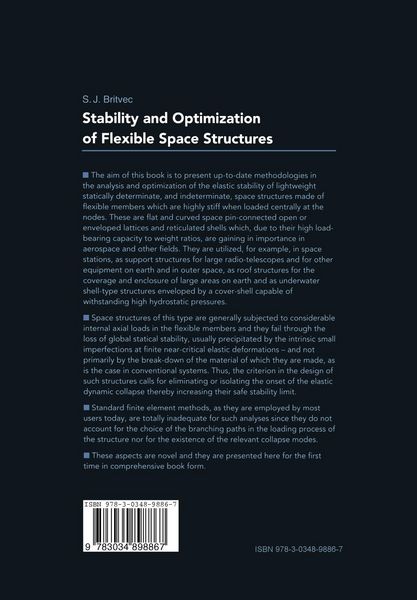
• Produktbild: Stability and Optimization of Flexible Space Structures
  • Produktbild: Stability and Optimization of Flexible Space Structures

Stability and Optimization of Flexible Space Structures

Fr. 137.00

inkl. gesetzl. MwSt., Versandkostenfrei


Beschreibung

Produktdetails

Einband

Taschenbuch

Erscheinungsdatum

28.09.2011

Verlag

Springer Basel

Seitenzahl

280

Maße (L/B/H)

24.4/17/1.8 cm

Gewicht

548 g

Auflage

Softcover reprint of the original 1st ed. 1995

Sprache

Englisch

ISBN

978-3-0348-9886-7

Beschreibung

Produktdetails

Einband

Taschenbuch

Erscheinungsdatum

28.09.2011

Verlag

Springer Basel

Seitenzahl

280

Maße (L/B/H)

24.4/17/1.8 cm

Gewicht

548 g

Auflage

Softcover reprint of the original 1st ed. 1995

Sprache

Englisch

ISBN

978-3-0348-9886-7

Herstelleradresse

Springer-Verlag GmbH
Tiergartenstr. 17
69121 Heidelberg
DE

Email: GPSR Kontakt

Noch keine Bewertungen vorhanden

Verfassen Sie die erste Bewertung zu diesem Artikel

Helfen Sie anderen Kundinnen und Kunden durch Ihre Meinung.

Kundinnen und Kunden meinen

Bewertungen (0)

  • Produktbild: Stability and Optimization of Flexible Space Structures
  • Produktbild: Stability and Optimization of Flexible Space Structures
  • 1 The Post-Buckling Analysis of Pin-Connected Slender Prismatic Members.- 1.1 The Post-Buckling Behavior of Single Pin-Ended Elastic Members—General Law of Pin-Jointed Members.- 1.2 Elastic Buckling of Pin-Jointed Plane Isostatic Trusses Composed of Flexible Bars.- 1.3 Thermal Buckling of Axially Constrained Compressive Pin-Jointed Slender Members.- 1.4 Thermal Post-Buckling of Flexible Elastic Members in Statically Indeterminate Pin-Jointed Lattices—An Illustration of the Basic Theory.- 2 The Post-Buckling Equilibrium of Isostatic Hinge-Connected Space Structures Composed of Slender Members.- 2.1 General Force-Displacement Equilibrium Paths for Perfect Members.- 2.2 Geometrical Compatibility Conditions in Space.- 2.3 Initial Kinematic Relations.- 2.4 Kinematic Relations in Post-Buckling.- 2.5 Initial Equilibrium States.- 2.6 Unsupported Structures—Initial Kinematic and Equilibrium Conditions.- 2.7 Equilibrium in Post-Buckling.- 2.8 Alternative Derivation of the Post-Buckling Equilibrium Equations.- 2.9 Alternative Derivation of the Post-Buckling Equilibrium Equations—Matrix Formulation of the General Law.- 2.10 Alternative Derivation of the Post-Buckling Equilibrium Equations—Matrix Formulation of the Equilibrium Equations on the Distorted Geometry.- 2.11 The Post-Buckling Equilibrium States.- 2.12 Reduction of the General Equilibrium Equations and Their Solution.- 2.13 Some Applications of the Theory to Simple Space Structures Made of Flexible Elastic Members.- CASE A.- CASE B.- CASE C.- CASE D.- 2.14 Influence of Initial Imperfections on the Post-Buckling Equilibrium Paths of Pin-Connected Lattices Composed of Flexible Members.- Perfect Systems as a Special Case.- Imperfect or Perturbed Systems.- 2.15 Stability Analysis of Equilibrium States.- 2.16 Some Applications of the Stability Theory to Practical Space Lattices and Structures.- CASE E1.- CASE E2.- CASE F1.- CASE F2.- 3 Static and Dynamic Buckling of Complex Hyperstatic Pin-Connected Elastic Systems.- 3.1 Introduction—Post-Buckling of Hyperstatic Lattices.- 3.2 Initial Equilibrium Equations—Kinematic Admissibility Conditions at the Ultimate Critical State.- 3.3 Simplified Kinematic Admissibility Conditions for the Buckled Hyperstatic Lattice.- 3.4 Matrix Formulation of the General Law for Prismatic Pin-Jointed Members in a Hyperstatic Lattice.- 3.5 Matrix Formulation of the General Post-Buckling Equilibrium Equations for Hyperstatic Pin-Jointed Lattices.- 3.6 Reduction of the General Equilibrium Equations of the Hyperstatic Lattice and Their Solution.- Example: Model Reticulated Shell.- 3.7 Direct Evaluation of the Most Degrading Buckling Mode in Equilibrium Using the Total Potential Energy Hypersurfaces.- 3.8 Comparison of the Numerical Results Characterizing the Post-Buckling Equilibrium of Three Model Reticulated Shells for Underwater Applications.- (i) The Unoptimized Model Shell (Model No. 1).- (ii) The First Optimized Model Shell (Model No. 2).- (iii) The Second Optimized Model Shell (Model No. 3).- 3.9 The Most Degrading Post-Buckling Modes for the Three Model Reticulated Shells Intended for Underwater Applications.- 3.10 Minimization Methods in the Direct Evaluation of the Most Degrading Buckling Modes.- 3.11 Numerical Evaluation of the Most Degrading Dynamic and Static Buckling Modes and the Structural Stability Optimization Strategies in Hyperstatic Pin-Jointed Elastic Systems.- Model No. 1.- Model No. 2.- Model No. 3.- Some Optimization Strategies in Hyperstatic Pin-Jointed or Quasi Pin-jointed Elastic Systems.- 3.12 Structural and Material Features of Practical Optimizable Elastic Systems Pin-Jointed by Special Connectors—The BRISHELL Systems.- The Figure Source Index.