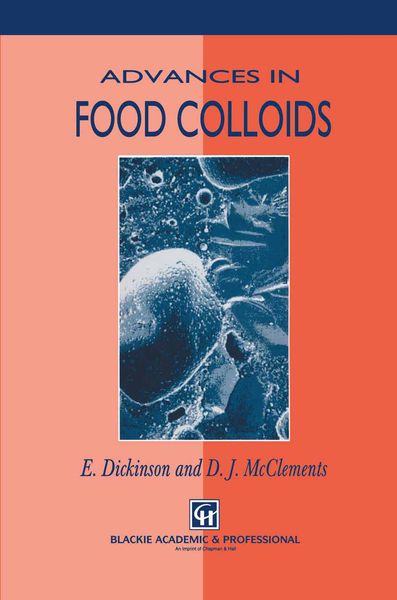
Advances in Food Colloids
-
- Hardcover
- Taschenbuch ausgewählt
-
Sprache:Englisch
Fr. 191.00
inkl. gesetzl. MwSt.,
Beschreibung
Produktdetails
Einband
Taschenbuch
Erscheinungsdatum
17.09.2011
Verlag
Springer UsSeitenzahl
334
Maße (L/B/H)
23.5/15.5/1.9 cm
Gewicht
532 g
Auflage
Softcover reprint of the original 1st ed. 1996
Sprache
Englisch
ISBN
978-1-4612-8519-9
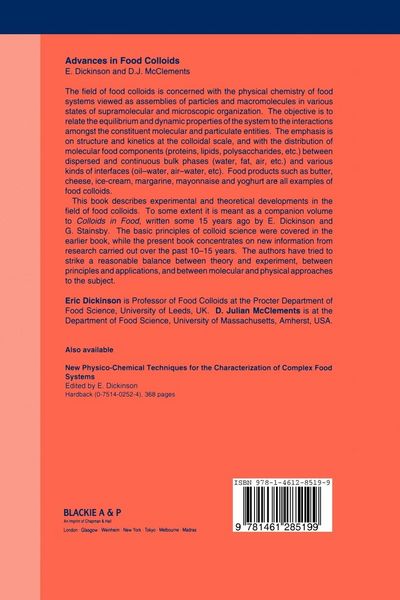
The field of food colloids is concerned with the physical chemistry of food systems viewed as assemblies of particles and macromolecules in various states of supramolecular and microscopic organization. The objective is to relate the equilibrium and dynamic properties of the system to the inter actions amongst the constituent molecular and particulate entities. The emphasis is on structure and kinetics at the colloidal scale, and with the distribution of molecular food components (proteins, lipids, poly saccharides, etc.) between dispersed and continuous bulk phases (water, fat, air, etc.) and various kinds of interfaces (oil-water, air-water, etc.). Food products such as butter, cheese, ice-cream, margarine, mayonnaise of food colloids. and yoghurt are all examples This book describes some recent experimental and theoretical develop ments in the field of food colloids. By way of background, we start with a brief survey of the current consumer trends which may point the way towards future research opportunities in the field. Chapter 1 also attempts to illustrate the way in which advances in instrumental methods and experimental investigations of well-defined mixed protein-surfactant systems are offering new insights into the structure of protein adsorbed layers and the competitive adsorption of proteins in oil-in-water emulsion systems.
Noch keine Bewertungen vorhanden
Verfassen Sie die erste Bewertung zu diesem Artikel
Helfen Sie anderen Kundinnen und Kunden durch Ihre Meinung.