
• Produktbild: Earthquake-Resistant Design with Rubber
  • Produktbild: Earthquake-Resistant Design with Rubber
  • Produktbild: Earthquake-Resistant Design with Rubber

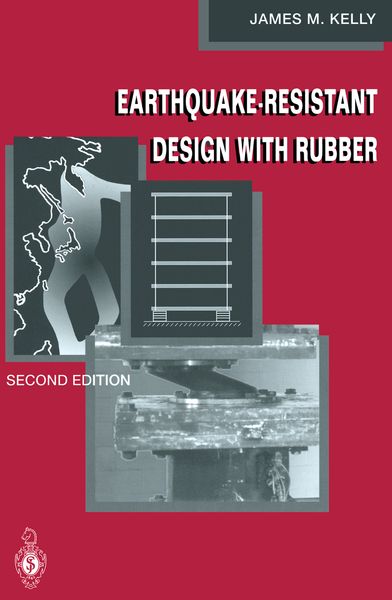
Earthquake-Resistant Design with Rubber

Fr. 137.00

inkl. gesetzl. MwSt., Versandkostenfrei


Beschreibung

Produktdetails

Einband

Taschenbuch

Erscheinungsdatum

22.09.2011

Verlag

Springer London

Seitenzahl

243

Maße (L/B/H)

23.5/15.5/1.5 cm

Gewicht

415 g

Auflage

Second Edition 1997

Sprache

Englisch

ISBN

978-1-4471-1247-1

Beschreibung

Produktdetails

Einband

Taschenbuch

Erscheinungsdatum

22.09.2011

Verlag

Springer London

Seitenzahl

243

Maße (L/B/H)

23.5/15.5/1.5 cm

Gewicht

415 g

Auflage

Second Edition 1997

Sprache

Englisch

ISBN

978-1-4471-1247-1

Herstelleradresse

Springer-Verlag KG
Sachsenplatz 4-6
1201 Wien
AT

Email: ProductSafety@springernature.com

Kundinnen und Kunden meinen

0 Bewertungen

Informationen zu Bewertungen

Zur Abgabe einer Bewertung ist eine Anmeldung im Konto notwendig. Die Authentizität der Bewertungen wird von uns nicht überprüft. Wir behalten uns vor, Bewertungstexte, die unseren Richtlinien widersprechen, entsprechend zu kürzen oder zu löschen.

Die Bewertungen sind nach Format, Anzahl Sterne und Datum sortiert.

Verfassen Sie die erste Bewertung zu diesem Artikel

Helfen Sie anderen Kund*innen durch Ihre Meinung

Kundinnen und Kunden meinen

0 Bewertungen filtern

  • Produktbild: Earthquake-Resistant Design with Rubber
  • Produktbild: Earthquake-Resistant Design with Rubber
  • Produktbild: Earthquake-Resistant Design with Rubber
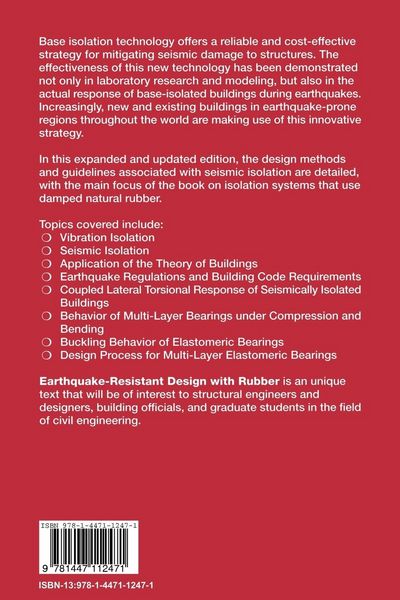
  • 1 Seismic Isolation for Earthquake-Resistant Design.- 1.1 Introduction.- 2 Vibration Isolation.- 2.1 Introduction.- 2.2 Theory of Vibration Isolation.- 2.3 Frictional Vibration Isolators.- 3 Seismic Isolation.- 3.1 Review of Fixed-Base Structural Analysis.- 3.2 Linear Theory of Base Isolation.- 3.3 Isolation of Very Flexible Structures.- 4 Extension of Theory to Buildings.- 4.1 M-Degree-of-Freedom Equations of Motion.- 4.2 Modal Analysis of M-DOF System.- 4.3 Estimates of Displacements and Forces for M-DOF System.- 5 Earthquake Regulations for Seismically Isolated Structures.- 5.1 Introduction.- 5.2 1994 Uniform Building Code.- 5.3 Design Methods.- 5.4 Static Analysis.- 5.5 Dynamic Analysis.- 5.6 Computer Programs for Analysis of Seismically Isolated Structures.- 5.7 Other Requirements for Nonstructural Components.- 5.8 Review.- 5.9 Design Requirements for Isolators.- 5.10 Base-Isolated Structures under Extreme Earthquake Loading.- 6 Coupled Lateral-Torsional Response of Seismically Isolated Buildings.- 6.1 Introduction.- 6.2 Case I: Three Close Frequencies.- 6.3 Case II: Equal Lateral Frequencies, Distinct Torsional Frequency.- 7 Behavior of M?ltilayered Bearings Under Compression and Bending.- 7.1 Introduction.- 7.2 Shear Stresses Produced by Compression.- 7.3 Bending Stiffness of a Single Pad.- 7.4 Pure Compression of Single Pads with Large Shape Factors.- 7.5 Compression Stiffness for Circular Pads with Large Shape Factors.- 7.6 Compression Stiffness for Square Pads with Large Shape Factors.- 7.7 Bending Stiffness of Single Pads with Large Shape Factors.- 8 Buckling Behavior of Elastomeric Bearings.- 8.1 Stability Analysis of Bearings.- 8.2 Stability of Annular Bearings.- 8.3 Influence of Vertical Load on Horizontal Stiffness.- 8.4 Downward Displacement of the Top of a Bearing.- 8.5 A Simple Mechanical Model for Bearing Buckling.- 8.6 Postbuckling Behavior.- 8.7 Influence of Compressive Load on Bearing Damping Properties.- 8.8 Rollout Stability.- 9 Design Process for Multilayered Elastomeric Bearings.- 9.1 Preliminary Bearing Design Process.- 9.2 Experimental Studies of Elastomeric Isolator Performance.- 9.3 Compact Design Bearings.- Afterword.- References.- Appendix A.- A.I Base-Isolated Buildings and Projects in the United States.- A.2 Retrofit Base-Isolated Buildings and Projects in the United States.- Appendix B.- B.I N-PAD.- B.2 3D-BASIS.- B.3 SADSAP.- B.4 General Nonlinear Three-Dimensional Analysis Programs.