Video Coding The Second Generation Approach
-
- Hardcover
- Taschenbuch ausgewählt
- eBook
-
Sprache:Englisch
Fr. 239.00
inkl. gesetzl. MwSt.,
Beschreibung
Produktdetails
Einband
Taschenbuch
Erscheinungsdatum
07.10.2011
Herausgeber
Luis Torres + weitereVerlag
Springer UsSeitenzahl
434
Maße (L/B/H)
23.5/15.5/2.5 cm
Auflage
Softcover reprint of the original 1st ed. 1996
Sprache
Englisch
ISBN
978-1-4612-8575-5
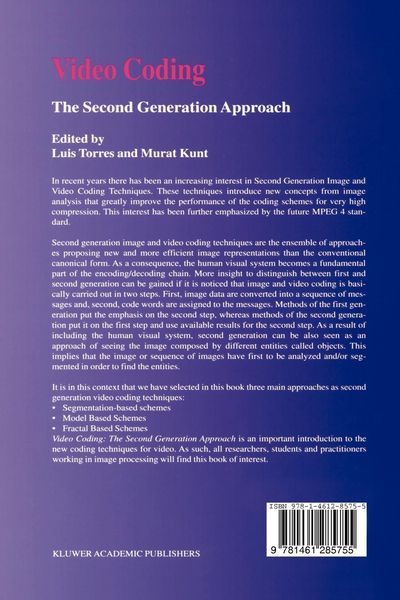
In recent years there has been an increasing interest in Second Generation Image and Video Coding Techniques. These techniques introduce new concepts from image analysis that greatly improve the performance of the coding schemes for very high compression. This interest has been further emphasized by the future MPEG 4 standard. Second generation image and video coding techniques are the ensemble of approaches proposing new and more efficient image representations than the conventional canonical form. As a consequence, the human visual system becomes a fundamental part of the encoding/decoding chain. More insight to distinguish between first and second generation can be gained if it is noticed that image and video coding is basically carried out in two steps. First, image data are converted into a sequence of messages and, second, code words are assigned to the messages. Methods of the first generation put the emphasis on the second step, whereas methods of the second generation put it on the first step and use available results for the second step. As a result of including the human visual system, second generation can be also seen as an approach of seeing the image composed by different entities called objects. This implies that the image or sequence of images have first to be analyzed and/or segmented in order to find the entities. It is in this context that we have selected in this book three main approaches as second generation video coding techniques: Segmentation-based schemes Model Based Schemes Fractal Based Schemes £/LIST£ Video Coding: The Second Generation Approach is an important introduction to the new coding techniques for video. As such, all researchers, students and practitioners working in image processing will find this book of interest.
Noch keine Bewertungen vorhanden
Verfassen Sie die erste Bewertung zu diesem Artikel
Helfen Sie anderen Kundinnen und Kunden durch Ihre Meinung.