
• Produktbild: Vertebrate Flight
  • Produktbild: Vertebrate Flight
Band 27

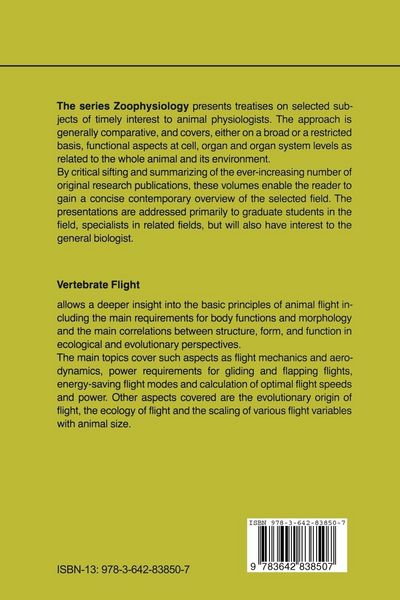
Vertebrate Flight Mechanics, Physiology, Morphology, Ecology and Evolution

Aus der Reihe Zoophysiology

Fr. 201.00

inkl. gesetzl. MwSt., Versandkostenfrei


Beschreibung

Produktdetails

Einband

Taschenbuch

Erscheinungsdatum

08.12.2011

Verlag

Springer Berlin

Seitenzahl

291

Maße (L/B/H)

23.5/15.5/1.7 cm

Gewicht

470 g

Auflage

Softcover reprint of the original 1st ed. 1990

Sprache

Englisch

ISBN

978-3-642-83850-7

Beschreibung

Produktdetails

Einband

Taschenbuch

Erscheinungsdatum

08.12.2011

Verlag

Springer Berlin

Seitenzahl

291

Maße (L/B/H)

23.5/15.5/1.7 cm

Gewicht

470 g

Auflage

Softcover reprint of the original 1st ed. 1990

Sprache

Englisch

ISBN

978-3-642-83850-7

Herstelleradresse

Springer-Verlag KG
Sachsenplatz 4-6
1201 Wien
AT

Email: GPSR Kontakt

Noch keine Bewertungen vorhanden

Verfassen Sie die erste Bewertung zu diesem Artikel

Helfen Sie anderen Kundinnen und Kunden durch Ihre Meinung.

Kundinnen und Kunden meinen

Bewertungen (0)

  • Produktbild: Vertebrate Flight
  • Produktbild: Vertebrate Flight
  • 1. Introduction.- 1.1 Gliders.- 1.2 Active Flyers.- 1.3 Outline of the Book.- 2. Basic Aerodynamics.- 2.1 Introduction.- 2.2 The Flow Around an Aerofoil.- 2.2.1 Bernoulli’s Equation.- 2.2.2 Reynolds Number.- 2.2.3 Boundary Layer.- 2.3 Blade-Element and Momentum Jet Theories.- 2.3.1 Lift and Drag.- 2.3.2 Power Required to Fly.- 2.4 Vortex Theory of Flight.- 2.4.1 Bound, Trailing and Starting Vortices.- 2.4.2 Steady Motion.- 2.4.3 Lifting-Line Theories.- 2.4.4 Quasi-Steady Assumption.- 2.4.5 Unsteady Effects.- 3. Physiology of Flight.- 3.1 Introduction.- 3.2 Energy and Mechanical Efficiency.- 3.3 Metabolic Rates.- 3.4 Oxygen Uptake.- 3.4.1 Respiratory Mechanics.- 3.4.2 Respiratory Gas Exchange.- 3.4.3 Circulation.- 3.4.4 Oxygen Consumption Versus Body Mass.- 3.4.5 Mass Loss.- 3.4.6 Heat Loss and Exchange.- 3.5 Altitudinal Changes.- 3.6 Estimates for Cost of Flight.- 3.6.1 Direct Measurements of O2 Uptake and CO2 Production.- 3.6.2 Mass Loss.- 3.6.3 Doubly Labelled Water Method.- 3.6.4 Radio Telemetry.- 3.7 Flight Duration, Flight Range and Cost of Transport.- 4. Morphological Flight Parameters.- 4.1 Introduction.- 4.2 Lenghts, Areas, Masses.- 4.3 Wing Shape.- 4.4 Weis-Fogh’s and Ellington’s Shape Parameters.- 5. Gliding Flight.- 5.1 Introduction.- 5.2 Gliding Performance.- 5.3 Effects of Change in Wingspan on Gliding Performance.- 5.4 Lifting Line Theory.- 5.5 Flap-Gliding.- 5.6 Stability and Control of Movements.- 5.6.1 Pitch.- 5.6.2 Roll.- 5.6.3 Yaw.- 6. Soaring.- 6.1 Introduction.- 6.2 Soaring Methods.- 6.2.1 Slope Soaring.- 6.2.2 Thermal Soaring.- 6.2.3 Gust, Frontal and Wave Soaring.- 6.2.4 Dynamic Soaring.- 6.3 Soaring Performance and Flight Morphology.- 6.3.1 Circling Performance.- 6.3.2 Cross-Country Soaring.- 6.3.3 Wing Shape in Soaring Birds.- 6.4 Bats and Pterosaurs.- 7. Migration.- 7.1 Introduction.- 7.2 Orientation and Navigation.- 7.3 Flight Range.- 7.4 Cruising Speed and Flight Time.- 7.5 Effect of Wind.- 7.6 Evolution of Soaring Migration.- 7.7 Formation Flight.- 8. Hovering Flight.- 8.1 Introduction.- 8.2 Kinematics of Hovering.- 8.3 The Rankine-Froude Momentum Theory.- 8.4 Blade-Element Theory.- 8.4.1 Profile, Parasite and Inertial Power.- 8.4.2 Weis-Fogh’s Model for Normal Hovering.- 8.4.3 Norberg’s Model for Asymmetrical Hovering.- 8.5 Vortex Theory.- 8.5.1 Ellington’s Hovering Model.- 8.5.2 Rayner’s Hovering Model.- 8.6 Animals with Sustained Hovering.- 8.7 Summary and for Ecologists and Others: Recipes for Power Calculation.- 8.7.1 Induced Power, Normal Hovering.- 8.7.2 Induced Power, Asymmetrical Hovering.- 8.7.3 Profile Power, Normal Hovering.- 8.7.4 Profile Power, Asymmetrical Hovering.- 8.7.5 Inertial Power.- 9. Forward Flight.- 9.1 Introduction.- 9.2 Wing Kinematics.- 9.3 Relative Airspeeds and Forces.- 9.3.1 Downstroke Forces.- 9.3.2 Upstroke Forces.- 9.4 Vorticity Action.- 9.5 Power Requirements for Horizontal Forward Flight.- 9.5.1 Induced Power.- 9.5.2 Profile Power.- 9.5.3 Parasite Power.- 9.5.4 Inertial Power.- 9.5.5 Flapping Flight with Constant Circulation.- 9.5.6 A Method of Calculating Forces with Blade-Element Theory.- 9.5.7 Comparison Between Different Power Models.- 9.6 Take-Off, Climbing and Landing.- 9.6.1 Take-Off and Climbing.- 9.6.2 Landing.- 9.7 Flight Manoeuvres.- 9.7.1 Turning Ability.- 9.7.2 Maximum Roll Acceleration and the Initiation of a Turn.- 9.7.3 Prey Catching and Landing Manoeuvres.- 9.8 Energy-Saving Types of Flight.- 9.8.1 Bounding Flight.- 9.8.2 Undulating Flight.- 9.8.3 Ground Effect.- 9.9 For Ecologists and Others: Recipes for Power Calculation.- 9.9.1 Induced Power.- 9.9.2 Profile Power.- 9.9.3 Parasite Power.- 9.9.4 Power Required for a Climb.- 9.9.5 Power Required for a Descent.- 9.9.6 Power Required for Bounding Flight.- 9.9.7 Power Required for Undulating Flight.- 10. Scaling.- 10.1 Introduction.- 10.2 Geometric Similarity.- 10.3 Estimated Relationships Between Wing Characteristics and Body Mass.- 10.3.1 Wingspan.- 10.3.2 Wing Area.- 10.3.3 Wing Loading.- 10.3.4 Aspect Ratio.- 10.3.5 Flight Speed, Power and Cost of Transport.- 10.3.6 Flight Muscle Masses.- 10.3.7 Wingbeat Frequency.- 10.4 Upper and Lower Size Limits.- 11. Morphological Adaptations for Flight.- 11.1 Introduction.- 11.2 Muscle System.- 11.2.1 Muscle Fibre Structure and Function.- 11.2.2 The Structure of Bird Muscle Fibres.- 11.2.3 The Structure of Bat Muscle Fibres.- 11.2.4 Contraction Rate and Wingbeat Frequency.- 11.2.5 Body Size, Wing Shape and Flight Muscle Fibres — a Summary.- 11.2.6 Flight Muscle Power.- 11.2.7 Flight Muscle Structure.- 11.2.8 Muscle Arrangements.- 11.2.9 The Main Flight Muscles.- 11.3 Skeleton System.- 11.3.1 Trunk Skeleton.- 11.3.2 Pectoral Girdle.- 11.3.3 Wing Skeletal and Membrane Arrangements.- 11.3.4 Were Pterosaurs Quadrupedal or Bipedal?.- 11.4 Feather Structure and Function.- 11.4.1 Main Structure.- 11.4.2 Vane Asymmetry and Feather Curvature.- 11.4.3 Flight Feathers of Archaeopteryx.- 11.4.4 Silent Flight.- 11.5 Wing Adaptations Enhancing Flight Performance.- 11.5.1 Wing Camber.- 11.5.2 Wing Flaps.- 11.5.3 Turbulence Generators.- 11.5.4 Wing Slots.- 11.5.5 Energy-Saving Elastic Systems.- 11.6 Tail and Feet.- 12. Flight and Ecology.- 12.1 Introduction.- 12.2 Predictions on Wing Shape and Flight Behaviour.- 12.3 Wing Design in Birds.- 12.3.1 Continuous Foraging Flights.- 12.3.2 Perching.- 12.3.3 Locomotion Among Vegetation.- 12.3.4 Migratory Species.- 12.3.5 Foraging on Ground or in Water.- 12.4 Wing Shape and Foraging Energetics of Hummingbirds at Different Altitudes.- 12.5 Wing Design of Species in a Pariform Guild.- 12.6 Wing Design in Bats.- 12.7 Wing Design and Echolocation Call Structure in Bats.- 12.8 Evolution of Wing Morphology.- 13. Evolution of Flight.- 13.1 The Major Theories.- 13.1.1 Trees-Down Theory.- 13.1.2 Ground-Up Theory.- 13.2 Transition from Gliding to Flapping Flight, an Aerodynamic Model.- 13.3 The Ground-Running and Jumping Scenario, a Discussion.- 13.4 The Climbing Ability in Proto-Fliers.- 14. Concluding Remarks.- References.