Gutscheinbedingungen

*Gültig bis 20.07.2026 auf alle Bücher. Ausgeschlossen sind Zeitschriften, Prozentbücher und Abos | Einlösbar in allen Buchhandlungen von Orell Füssli, Barth Bücher, Buchladen Rapunzel, Papeterie Köhler, Schuler Orell Füssli, Stauffacher und ZAP unter Vorweisung des Gutscheins, auf www.orellfüssli.ch durch Eingabe des Gutscheincodes. Beim Service „eBooks verschenken“ und bei eBook-Käufen via eReader nicht einlösbar | Mindesteinkaufswert: Fr. 30.- | Nicht mit anderen Rabatten kumulierbar.

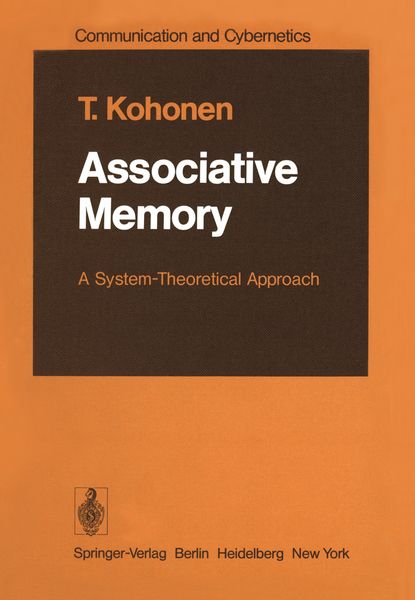
  • Produktbild: Associative Memory
  • Produktbild: Associative Memory
Band 17

Associative Memory A System-Theoretical Approach

Fr. 73.90

inkl. gesetzl. MwSt., Versandkostenfrei


Beschreibung

Produktdetails

Einband

Taschenbuch

Erscheinungsdatum

19.01.2012

Verlag

Springer Berlin

Seitenzahl

178

Maße (L/B/H)

24.4/17/1.1 cm

Auflage

1. Auflage

Sprache

Englisch

ISBN

978-3-642-96386-5

Beschreibung

Produktdetails

Einband

Taschenbuch

Erscheinungsdatum

19.01.2012

Verlag

Springer Berlin

Seitenzahl

178

Maße (L/B/H)

24.4/17/1.1 cm

Auflage

1. Auflage

Sprache

Englisch

ISBN

978-3-642-96386-5

Herstelleradresse

Springer-Verlag GmbH
Heidelberger Platz 3
14197 Berlin
Deutschland
Email: sdc-bookservice@springer.com
Url: www.springer.com
Telephone: +49 30 827870
Fax: +49 30 8214091

Noch keine Bewertungen vorhanden

Verfassen Sie die erste Bewertung zu diesem Artikel

Helfen Sie anderen Kundinnen und Kunden durch Ihre Meinung.

Kundinnen und Kunden meinen

Bewertungen (0)

  • Produktbild: Associative Memory
  • Produktbild: Associative Memory
  • 1. Introduction.- 1.1 On the Physical Embodiment of Associative Information Structures.- 1.1.1 A System-Model Approach to the Associative Memory.- 1.1.2 Relational Structures of Knowledge.- 1.1.3 Acquisition and Retrieval of Knowledge as Structured Sequences.- 1.2 Implementations of Associative Recall.- 1.2.1 Basic Characteristics of Associative Memories.- 1.2.2 The Content-Addressable Memory (CAM).- 1.2.3 Hash-Coding.- 1.2.4 Holographic Associative Memories.- 1.2.5 Nonholographic, Distributed Associative Memories.- 1.3 Mathematical Notations and Methods.- 1.3.1 Vector Space Concepts.- 1.3.2 Matrix Notations.- 1.3.3 Further Properti es of Matrices.- 1.3.4 Matrix Equations.- 1.3.5 Projection Operators.- 1.3.6 Matrix Differential Calculus.- 2. Associative Search Methods.- 2.1 Addressing by the Contents.- 2.1.1 Hash-Coding Principles.- 2.1.2 An Example of Hash-Coding: Multiple-Keyword Search.- 2.1.3 A Processing Language for Associative Data Structures.- 2.2 Content-Addressable Memories.- 2.2.1 Associative Recall by the Partial Match Operation.- 2.2.2 Hardware Implementation of the CAM Structure.- 2.2.3 Parallel Comparison of Magnitudes.- 2.3 Optimal Associative Mappings.- 2.3.1 System Model for an Analog Associative Memory.- 2.3.2 Autoassociative Recall as an Orthogonal Projection.- 2.3.3 The Novelty Filter.- 2.3.4 Autoassociative Encoding.- 2.3.5 Optimal Linear Associative Mappings.- 2.3.6 Optimal Nonlinear Associative Mappings.- 2.3.7 The Problem of Invariant Recognition.- 2.3.8 Relationship Between Associative Mapping, Linear Regression, and Linear Estimation.- 2.4 Relationship of Associative Mappings to Pattern Classification.- 2.4.1 Discriminant Functions.- 2.4.2 Comparison Methods.- 2.4.3 Statistical Formulation of Pattern Classification.- 3. Adaptive Formation of Optimal Associative Mappings.- 3.1 On the Implementation of Conditioned Responses in Simple Physical Systems.- 3.1.1 A Simple Adaptive Linear System.- 3.1.2 On the Physical Realizability of Adaptive Elements.- 3.2 Adaptive Filters Which Compute Orthogonal Projections.- 3.2.1 The Novelty Detector Paradigm.- 3.2.2 Analysis of the Adaptive Linear Unit by Means of Matrix Products.- 3.2.3 An Extremely Fast Adaptive Process Which Generates the Novel ty Filter.- 3.2.4 Adaptation With Forgetting.- 3.3 Recursive Generation of the Optimal Associative Mapping.- 3.3.1 Linear Corrective Algorithms.- 3.3.2 The General Setting for the Computation of M = YX+.- 3.3.3 Recursive Evaluation of the Best Exact Solution (Gradient Projection Method).- 3.3.4 Recursive Evaluation of the Best Approximate Solution (Regression Solution).- 3.3.5 Recursive Solution in the General Case.- 4. On Biological Associative Memory.- 4.1 Physiological Foundations of Memory.- 4.1.1 On the Mechanisms of Memory in Biological Systems.- 4.1.2 Structural Features of Some Neural Networks.- 4.1.3 Functional Features of Neurons.- 4.1.4 Modelling of the Synaptic Plasticity.- 4.1.5 Can the Memory Capacity Ensue from Synaptic Changes?.- 4.2 Computerized Models of Associative Memory in Neural Networks.- 4.2.1 The Associative Network Paradigm.- 4.2.2 The Novelty Filter Paradigm.- 4.2.3 Review of Related Approaches.- References.- Author Index.