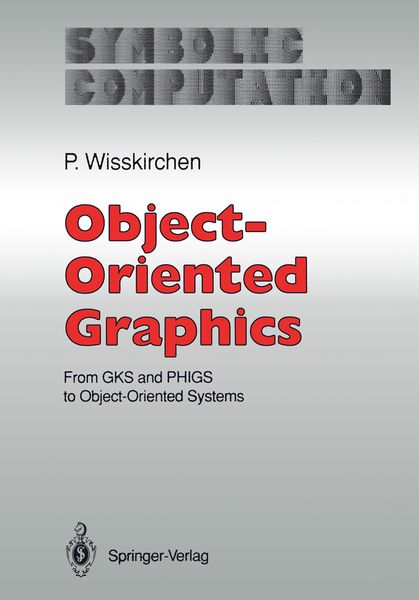
Object-Oriented Graphics From GKS and PHIGS to Object-Oriented Systems
Aus der Reihe
Computer Graphics - Systems and Applications
-
- Taschenbuch ausgewählt
- eBook
-
Sprache:Englisch
Fr. 138.00
inkl. gesetzl. MwSt.,
Beschreibung
Produktdetails
Einband
Taschenbuch
Erscheinungsdatum
25.12.2011
Abbildungen
XIII, 236 p. 15 illus.
Verlag
Springer BerlinSeitenzahl
236
Maße (L/B/H)
24.2/17/1.5 cm
Gewicht
445 g
Sprache
Englisch
ISBN
978-3-642-84249-8
At present, object-oriented programming is emerging from the research labora tories and invading into the field of industrial applications. More and more products have been implemented with the aid of object-oriented programming techniques and tools, usually as extensions of traditional languages in hybrid development systems. Some of the better known examples are OSF-Motif, News, Objective-C on the NeXT computer, the C extension C++, and CLOS an object oriented extension of LISP. All of these developments incorporate interactive graphics. Effective object-oriented systems in combination with a graphics kernel does it mean that the field of computer graphics has now become merely an aspect of the object-oriented world? We do not think so. In spite of interesting individual developments, there are still no sound object-oriented graphics sys tems available. If it is desired to develop a complex graphics application embed ded in a window-oriented system then it is still necessary to work with elemen tary tools. What is to be displayed and interactively modified inside a window must be specified with a set of graphics primitives at a low level, or has to be written with a standardized graphics kernel system such as GKS or PHIGS, i. e. , by kernels specified and implemented in a non-object-oriented style. With the terms GKS and PHIGS we enter the world of international graphics standards. GKS and PHIGS constitute systems, not mere collections of graphics primitives.
Noch keine Bewertungen vorhanden
Verfassen Sie die erste Bewertung zu diesem Artikel
Helfen Sie anderen Kundinnen und Kunden durch Ihre Meinung.