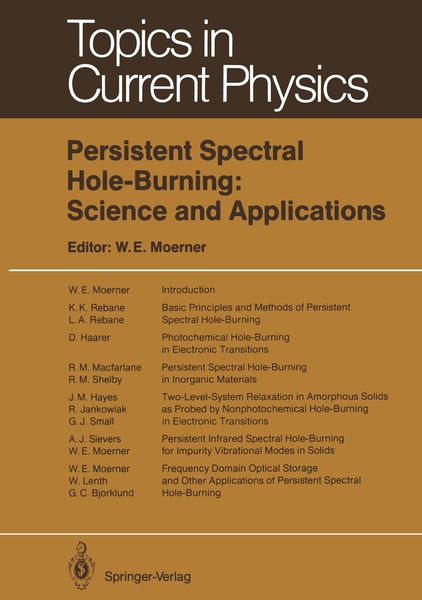
Produktbild: Persistent Spectral Hole-Burning: Science and Applications
Band 44

Persistent Spectral Hole-Burning: Science and Applications

Fr. 72.90

inkl. gesetzl. MwSt., Versandkostenfrei


Beschreibung

Produktdetails

Einband

Taschenbuch

Erscheinungsdatum

19.01.2012

Herausgeber

William E. Moerner

Verlag

Springer Berlin

Seitenzahl

315

Maße (L/B/H)

24.2/17/1.9 cm

Gewicht

577 g

Auflage

Softcover reprint of the original 1st ed. 1988

Sprache

Englisch

ISBN

978-3-642-83292-5

Beschreibung

Produktdetails

Einband

Taschenbuch

Erscheinungsdatum

19.01.2012

Herausgeber

William E. Moerner

Verlag

Springer Berlin

Seitenzahl

315

Maße (L/B/H)

24.2/17/1.9 cm

Gewicht

577 g

Auflage

Softcover reprint of the original 1st ed. 1988

Sprache

Englisch

ISBN

978-3-642-83292-5

Herstelleradresse

Springer-Verlag KG
Sachsenplatz 4-6
1201 Wien
AT

Email: GPSR Kontakt

Noch keine Bewertungen vorhanden

Verfassen Sie die erste Bewertung zu diesem Artikel

Helfen Sie anderen Kundinnen und Kunden durch Ihre Meinung.

Kundinnen und Kunden meinen

Bewertungen (0)

  • Produktbild: Persistent Spectral Hole-Burning: Science and Applications
  • 1. Introduction.- 1.1 Fundamental Requirements for Persistent Spectral Hole-Burning.- 1.2 Significance for Science and Applications.- 1.3 Historical Overview and Survey of Mechanisms.- 1.4 Synopsis of the Book.- References.- 2. Basic Principles and Methods of Persistent Spectral Hole-Burning.- 2.1 Background.- 2.2 Homogeneous Spectrum of an Electron-Vibrational Transition.- 2.2.1 Integrated Intensities of Purely Electronic Lines and Phonon Sidebands, Electron-Phonon Interactions and Temperature Dependence.- 2.2.2 Relative Width (Q-factor) of PEL. Peak Intensities.- 2.2.3 Role of Local Modes.- 2.3 Inhomogeneous Broadening of the Vibronic Spectrum.- 2.3.1 Inhomogeneous Broadening of Purely Electronic Lines Inhomogeneous Distribution Function.- 2.3.2 Selectivity of the Spectral Response of an Inhomogeneous Absorption Band.- 2.3.3 Inhomogeneous Distribution Function Under Monochromatic Laser Excitation. Site-Selection Spectroscopy.- 2.4 Persistent Spectral Hole-Burning.- 2.4.1 Burning of Spectral Holes in the Inhomogeneous Distribution Function.- 2.4.2 Early Observations of Persistent Spectral Hole-Burning.- 2.5 Kinetics of Persistent Spectral Hole-Burning.- 2.6 Spectroscopic Applications.- 2.6.1 Homogeneous Zero-Phonon Line Broadening and Dephasing in Crystals.- 2.6.2 Photochemical Hole-Burning in Glassy Matrices.- 2.6.3 Homogeneous Linewidths of Vibronic Transitions and Relaxation.- 2.6.4 Off-Resonance Hole-Burning and Non-Correlation Effects.- 2.6.5 Hole-Burning in the Spectra of Chlorophyll-like Molecules.- 2.7 Special Methods of Hole-Burning and Detection.- 2.7.1 Detection of Holes by Doppler Scanning.- 2.7.2 Holographic Detection of Spectral Holes.- 2.7.3 Creation of Sharp Antiholes.- 2.8 Hole-Burning Time-and-Space-Domain Holography.- 2.8.1 Hole-Burning by Picosecond Pulses.- 2.8.2 Theory of Time-and-Space-Domain Holographic Recording and Playback.- 2.8.3 Experimental Results and Discussion.- 2.9 Concluding Remarks.- References.- 3. Photochemical Hole-Burning in Electronic Transitions.- 3.1 Photochemical, Photophysical, and Spin Hole-Burning.- 3.1.1 Historic Survey.- 3.1.2 Radiation-Induced Saturation Versus Chemical Depletion.- a) Transient Saturation.- b) Chemical Depletion.- 3.1.3 Photochemical Systems and Mechanisms.- 3.2 Spectroscopic Analysis of Hole-Burning Experiments.- 3.2.1 General Remarks.- 3.2.2 Fast Relaxation Processes and Excited State Dephasing.- a) Lineshape Analysis.- b) Temperature Dependence of the “Homogeneous” Linewidth.- 3.2.3 Spectral Diffusion in Glasses.- a) TLS Parameters and Tunnelling Rates.- b) Spectroscopic Parameters.- 3.3 Field Effects in Hole-Burning Spectroscopy.- 3.3.1 Introduction: The Site Memory Function.- 3.3.2 Electric-Field Effects.- a) Stark Effect for Molecules with Inversion Symmetry.- b) Stark Effect for Molecules Without Inversion Symmetry.- 3.3.3 Strain-Field Effects.- References.- 4. Persistent Spectral Hole-Burning in Inorganic Materials.- 4.1 Introduction.- 4.2 Hole-Burning Mechanisms.- 4.3 Color Centers.- 4.4 Rare Earth Compounds.- 4.4.1 Trivalent Rare Earth Ions in Glasses.- 4.4.2 Divalent Rare Earth Ions in Crystals.- a) CaF2:Sm2+.- b) SrF2:Sm2+.- c) BaClF:Sm2+.- 4.5 Transition Metal Ions.- 4.5.1 LiGa5 O8:Co2+.- 4.5.2 Y3Al5O12:Ti3+.- 4.6 Conclusion.- References.- 5. Two-Level-System Relaxation in Amorphous Solids as Probed by Nonphotochemical Hole-Burning in Electronic Transitions.- 5.1 Background.- 5.2 Survey of NPHB Systems.- 5.2.1 Hydrogen-Bonded Crystals.- 5.2.2 Molecules in Amorphous Polyacene Films.- 5.2.3 Molecules in Organic Glasses.- 5.2.4 Molecules in Polymers.- 5.2.5 Rare-Earth Ions in Glasses and Polymers.- 5.3 Optical Linewidths and Dephasing in Amorphous Solids.- 5.3.1 Single-Impurity Single-TLS System Hamiltonian.- 5.3.2 Optical Dephasing due to Off-Diagonal Modulation.- 5.3.3 Recent Experiments.- 5.3.4 New Theories.- 5.3.5 Comparison of Theories and Experimental Data.- 5.3.6 Hole Widths and TLS Relaxation Processes in Organic Systems.- 5.4 Density of States Functions for TLS.- 5.5 Laser-Induced Hole Filling.- 5.5.1 Rhodamine 640 in Poly(vinylalcohol).- 5.5.2 Nd3+ and Pr3+ in Poly(vinylalcohol).- 5.5.3 A Tentative Model for LIHF.- 5.6 Recent Developments.- 5.7 Concluding Remarks.- References.- 6. Persistent Infrared Spectral Hole-Burning for Impurity Vibrational Modes in Solids.- 6.1 Introduction.- 6.1.1 Matrix-Isolated Molecules in Van der Waals and Ionic Solids.- 6.1.2 Persistent IR Hole-Burning in Vibrational Modes.- 6.2 Molecules in Van der Waals Matrices.- 6.2.1 1,2-Difluorethane (DFE).- a) Diode Laser Measurements.- b) CO2 Laser Measurements.- 6.2.2 Interpretation of Persistence.- 6.2.3 Molecular Aggregates of Methyl Nitrite or Methanol.- 6.3 ReO4? in Alkali Halide Crystals.- 6.3.1 Background and Spectroscopic Information.- 6.3.2 Measurements of Relaxation Times T1 and T2.- 6.3.3 Persistent Spectral Holes for ReO4? in Alkali Halides.- a) Summary of Characteristics.- b) Model for the PIRSH Process.- 6.3.4 Persistent Spectral Pegs.- 6.3.5 Ultrasonic Studies of Multiple Ground State Configurations.- 6.3.6 Conclusions on the ReO4? System.- 6.4 Persistent Spectral Hole-Burning for CN? Molecules in Alkali Halide Crystals.- 6.4.1 Background Information on Matrix-Isolated CN?.- 6.4.2 High-Resolution FTIR Spectroscopy in the CN? Stretch Region.- 6.4.3 Hole-Burning in the CN? Stretch Mode Region.- 6.4.4 A Study of the CN?:Na+ Center Dynamics.- a) Fluorescence.- b) Hole-Burning and ?l Center Geometry.- 6.4.5 Other CN? Complexes.- 6.5 Conclusion.- 6.5.1 Comparison of the Three Types of Vibrational Hole-Burning Systems.- 6.5.2 Systems Which do not Exhibit PIRSH Formation.- a) Derivatives of the CN? Molecule.- b) Spherical-Top Molecules Which Contain Hydrogen.- 6.5.3 Future Prospects.- a) NO2? in Alkali Halides.- b) Disordered Solids.- References.- 7. Frequency Domain Optical Storage and Other Applications of Persistent Spectral Hole-Burning.- 7.1 Introduction.- 7.2 Systems Issues for Frequency Domain Optical Storage.- 7.2.1 General Remarks.- 7.2.2 Engineering Studies.- 7.3 Materials Research for Frequency Domain Optical Storage.- 7.3.1 General Materials Requirements.- 7.3.2 Limitations of Single-Photon Recording Mechanisms.- 7.3.3 Photon-Gated Mechanisms.- 7.3.4 Limitations on Storage Density.- 7.4 Alternative Data-Storage Configurations.- 7.4.1 Time Domain Storage.- 7.4.2 Electric-Field Readout.- 7.4.3 Holographic Readout.- 7.5 Other Applications of Persistent Spectral Hole-Burning.- 7.5.1 General Remarks.- 7.5.2 Laser Pulse Shaping Based on Fourier Synthesis.- 7.5.3 Laser Pulse Shaping Based on Voltage Modulation.- 7.5.4 Frequency Multiplexed Optical Spatial Filters.- 7.6 Summary and Future Prospects.- References.