
Gutscheinbedingungen

*Gültig bis 18.08.2026 auf (fast) alles. Ausgeschlossen sind Smartboxen, Zeitschriften, Tickets, Lebensmittel, Gaming-Elektroartikel, Tinte/Toner, Gutscheine, Geschenkkarten, Blumen und Abos | Einlösbar in allen Buchhandlungen von Orell Füssli, Barth Bücher, Buchladen Rapunzel, Schuler Orell Füssli, Stauffacher und ZAP unter Vorweisung des Gutscheins, auf www.orellfüssli.ch durch Eingabe des Gutscheincodes. Beim Service „eBooks verschenken“ und bei eBook-Käufen via eReader nicht einlösbar | Mindesteinkaufswert: Fr. 100.- | Nicht mit anderen Rabatten kumulierbar.

  • Produktbild: Intrafamily Bargaining and Household Decisions
  • Produktbild: Intrafamily Bargaining and Household Decisions

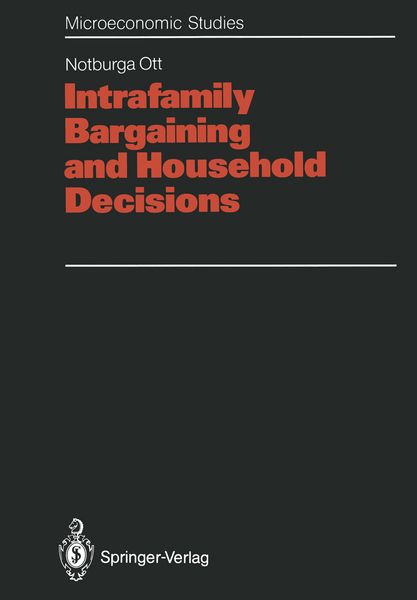
Intrafamily Bargaining and Household Decisions

Aus der Reihe Microeconomic Studies

Fr. 138.00

inkl. gesetzl. MwSt., Versandkostenfrei


Beschreibung

Produktdetails

Einband

Taschenbuch

Erscheinungsdatum

17.02.2012

Abbildungen

VIII, 242 p.

Verlag

Springer Berlin

Seitenzahl

242

Maße (L/B/H)

24.4/17/1.4 cm

Gewicht

442 g

Sprache

Englisch

ISBN

978-3-642-45710-4

Beschreibung

Produktdetails

Einband

Taschenbuch

Erscheinungsdatum

17.02.2012

Abbildungen

VIII, 242 p.

Verlag

Springer Berlin

Seitenzahl

242

Maße (L/B/H)

24.4/17/1.4 cm

Gewicht

442 g

Sprache

Englisch

ISBN

978-3-642-45710-4

Herstelleradresse

Springer-Verlag KG
Sachsenplatz 4-6
1201 Wien
AT

Email: GPSR Kontakt

Noch keine Bewertungen vorhanden

Verfassen Sie die erste Bewertung zu diesem Artikel

Helfen Sie anderen Kundinnen und Kunden durch Ihre Meinung.

Kundinnen und Kunden meinen

Bewertungen (0)

  • Produktbild: Intrafamily Bargaining and Household Decisions
  • Produktbild: Intrafamily Bargaining and Household Decisions
  • 1 Introduction.- 2 Models of the ‘new home economics’.- 2.1 Decisions in an existing family.- 2.2 Family formation and marital stability.- 2.3 Problems and further questions.- 3 Family decisions as a bargaining problem.- 3.1 The family as an organization of exchange.- 3.2 Household decisions as a non-cooperative game.- 3.3 Household decisions as a cooperative game.- 4 A Nash bargaining model for household decisions.- 4.1 Comparison with traditional approaches.- 4.2 Comparative statics.- 5 Time allocation in a static bargaining model with household production.- 5.1 The model.- 5.2 Division of work within the household.- 5.3 Effects of an exogenous change in wages.- 6 A dynamic model with accumulation of human capital.- 6.1 Intrafamily division of work and accumulation of human capital.- 6.2 The dynamic approach.- 6.3 Time allocation depending on individual bargaining power.- 7 Pareto efficiency of family decisions.- 7.1 Binding force of contracts and efficiency.- 7.2 Discrete choices.- 7.3 Fertility as a prisoner’s dilemma.- 8 The binding force of intrafamily contracts.- 8.1 Self-enforcing contracts.- 8.2 Enforcement by institutions.- 8.3 Remarks on policy options.- 9 Introducing uncertainty: the possibility of conflict.- 9.1 Exogenous probability of conflict.- 9.2 Causes of conflict and negotiation strategies.- 9.3 Endogenous probability of conflict.- 10 Empirical tests of the bargaining approach.- 10.1 Tests based on the Slutsky restrictions.- 10.2 Test of Pareto efficiency.- 11 Survey of empirical bargaining models.- 11.1 Household labor supply: a model with fixed bargaining power.- 11.2 Household labor supply: a game theoretic model in a discrete choice setting.- 11.3 The distribution of welfare in the household: measuring the bargaining power.- 11.4 Marriageand divorce: estimates with explicit threat point.- 12 Empirical evidence of the bargaining approach - first findings with German data.- 12.1 Balance of power within marriages.- 12.2 Fertility decision.- 12.3 Divorce behavior.- 13 Concluding remarks.