
• Produktbild: Laser Ablation
  • Produktbild: Laser Ablation
Band 28

Laser Ablation Principles and Applications

Fr. 137.00

inkl. gesetzl. MwSt., Versandkostenfrei


Beschreibung

Produktdetails

Einband

Taschenbuch

Erscheinungsdatum

08.12.2011

Herausgeber

John C. Miller

Verlag

Springer Berlin

Seitenzahl

187

Maße (L/B/H)

23.5/15.5/1.2 cm

Gewicht

318 g

Auflage

Softcover reprint of the original 1st ed. 1994

Sprache

Englisch

ISBN

978-3-642-78722-5

Beschreibung

Portrait

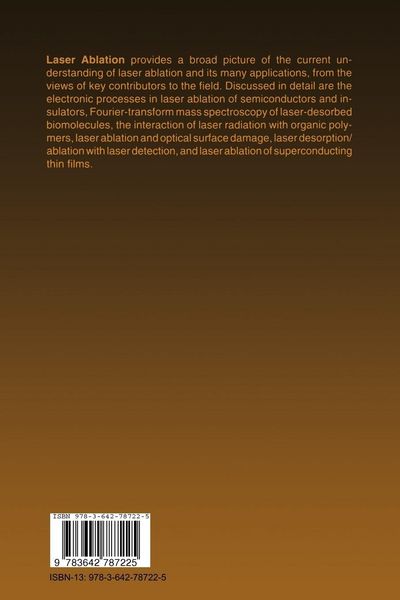
Laser Ablation discusses experiments and models for laser ablation of atoms, ions, molecules and clusters from solid surfaces. Specific topics include laser ablation and thin-film deposition of high-temperature superconductors; laser-induced desoption of adsorbed molecules and of semiconductors; laser ablation of polymers and biological tissues; laser desorption mass spectrometry of biological molecules; fundamental physics of ablation; and such diverse applications as tribological film deposition laser-ablation mass spectrometry in ion traps.

Produktdetails

Einband

Taschenbuch

Erscheinungsdatum

08.12.2011

Herausgeber

John C. Miller

Verlag

Springer Berlin

Seitenzahl

187

Maße (L/B/H)

23.5/15.5/1.2 cm

Gewicht

318 g

Auflage

Softcover reprint of the original 1st ed. 1994

Sprache

Englisch

ISBN

978-3-642-78722-5

Herstelleradresse

Springer-Verlag KG
Sachsenplatz 4-6
1201 Wien
AT

Email: ProductSafety@springernature.com

Kundinnen und Kunden meinen

0 Bewertungen

Informationen zu Bewertungen

Zur Abgabe einer Bewertung ist eine Anmeldung im Konto notwendig. Die Authentizität der Bewertungen wird von uns nicht überprüft. Wir behalten uns vor, Bewertungstexte, die unseren Richtlinien widersprechen, entsprechend zu kürzen oder zu löschen.

Die Bewertungen sind nach Format, Anzahl Sterne und Datum sortiert.

Verfassen Sie die erste Bewertung zu diesem Artikel

Helfen Sie anderen Kund*innen durch Ihre Meinung

Kundinnen und Kunden meinen

0 Bewertungen filtern

  • Produktbild: Laser Ablation
  • Produktbild: Laser Ablation
  • 1. History, Scope, and the Future of Laser Ablation.- 1.1 Introduction.- 1.2 History of Laser Ablation Studies and Applications.- 1.2.1 The Sixties.- 1.2.2 The Seventies.- 1.2.3 The Eighties.- 1.2.4 The Nineties.- References.- 2. Electronic Processes in Laser Ablation of Semiconductors and Insulators.- 2.1 Electronic Mechanisms in Desorption and Ablation.- 2.2 Interaction of Photons with Solids.- 2.2.1 Creation of Electron-Hole Pairs and Excitons.- 2.2.2 Excitation of Electrons and Holes Localized on Defects.- 2.2.3 Collective Effects: Free-Electron Heating and Plasma Effects.- 2.2.4 Density of Electronic Excitation.- 2.3 Electron-Lattice Interactions and the Localized Excited State.- 2.3.1 Interactions Between Free Carriers and Phonons.- 2.3.2 Capture of Charge Carriers at Defect Sites.- 2.3.3 Lattice-Induced Localization of Free Carriers and Excitons.- 2.4 Creation and De-Excitation of the Localized Excited State.- 2.4.1 Non-Radiative De-Excitation.- 2.4.2 Transfer of Electronic to Configurational Energy.- 2.4.3 Other Non-Radiative De-Excitation Channels.- 2.5 Survey of Experimental Results.- 2.5.1 Alkali Halides and Alkaline-Earth Fluorides.- 2.5.2 Oxides.- 2.5.3 Compound Semiconductors.- 2.6 Models of Laser-Induced Desorption.- 2.6.1 Models of Electronic Processes in Laser-Induced Desorption.- 2.6.2 Calculation Techniques.- 2.7 Simulation of Laser Ablation.- 2.7.1 Models of Laser Ablation.- 2.7.2 Model Calculations of Laser Ablation.- 2.8 Summary and Conclusions.- References.- 3. Laser Ablation and Optical Surface Damage.- 3.1 Introductory Remarks.- 3.2 Characteristics of Optical Surface Damage.- 3.3 Possible Causes of Optical Damage.- 3.4 Investigation of Optical Surface Damage Mechanisms.- 3.4.1 Laser Ablation as a Probe of Optical Damage.- 3.4.2 Surface Analytical Techniques.- 3.4.3 Laser Pump-Probe Measurements.- 3.5 Concluding Remarks.- References.- 4. Pulsed-Laser Deposition of High-Temperature Superconducting Thin Films.- 4.1 Advantages of Pulsed-Laser Deposition.- 4.2 Materials Base.- 4.3 Laser-Beam-Target Interaction.- 4.3.1 Target Texturing.- 4.3.2 Particle Deposition.- 4.4 Dynamics of the Laser-Produced Plume.- 4.5 Evaporant-Substrate Interaction.- 4.6 Frontiers of High-Temperature Superconducting Thin-Film Research.- 4.6.1 Epitaxial Multilayers.- 4.6.2 Work on Ultrathin Films.- 4.6.3 Control of Phase and Crystallinity in Thin-Film Form.- 4.7 Scaling-up to Larger Areas.- 4.8 Future Directions.- 4.8.1 Component Development.- 4.8.2 System Issues.- 4.9 Summary.- References.- 5. Interaction of Laser Radiation with Organic Polymers.- 5.1 History.- 5.2 Characteristics of UV-Laser Ablation.- 5.3 Chemical Physics of the Ablation Process.- 5.3.1 Ablation Products.- 5.3.2 Time Profile of Ablation.- a) Polyimide.- b) Polymethyl Methacrylate.- 5.4 Theories of Ultraviolet-Laser Ablation.- 5.5 Contemporary Trends in UV-Laser Ablation.- References.- 6. Laser Ablation and Laser Desorption Techniques with Fourier-Transform Mass Spectrometry (FTMS).- 6.1 Principles of FTMS Operation.- 6.1.1 Ion Formation.- 6.1.2 Ion Trapping.- 6.1.3 Ion Detection.- 6.1.4 Ion Structural Techniques.- 6.2 Laser-Ablation FTMS for Clusters.- 6.2.1 Cluster Formation.- 6.2.2 Accurate Mass and High-Resolution Measurements.- 6.2.3 Ion-Molecule Reactions.- 6.2.4 Collision-Activated Dissociation.- 6.3 Laser-Desorption FTMS for Biomolecules.- 6.3.1 Development of Matrix-Assisted Laser Desorption.- 6.3.2 Interfacing MALDI with FTMS.- 6.3.3 Ion-Trapping Considerations for MALDI-FTMS.- 6.3.4 Combining Separation Methods with MALDI-FTMS.- 6.4 Future Directions.- 6.5 Conclusions.- References.- 7. Diagnostic Studies of Laser Ablation for Chemical Analysis.- 7.1 Laser Ablation in Vacuum.- 7.1.1 Instrumentation.- 7.1.2 Physical Processes for Laser Ablation In Vacuo.- 7.1.3 Examples.- 7.2 Laser Ablation in an Atmosphere.- 7.2.1 Physical Processes Unique to Ablation in an Atmosphere.- 7.2.2 Diagnostics for Laser Ablation in an Atmosphere.- a) Blast-Wave Diagnostics.- b) Optical Diagnostics for Monitoring Plasma Formation.- c) Density, Temperature, and Velocity Diagnostics.- d) Ablated Material Velocity Determination.- References.