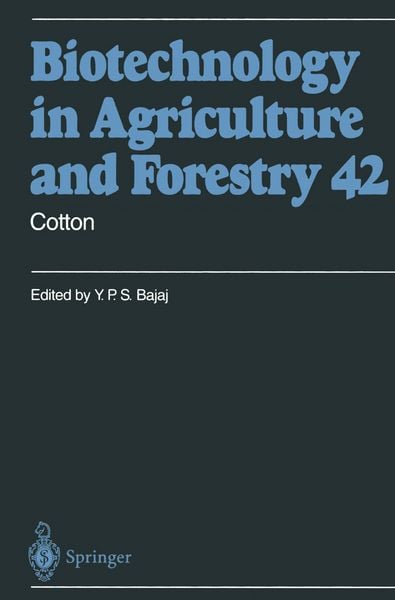
• Produktbild: Cotton
  • Produktbild: Cotton
Band 42

Cotton

Fr. 137.00

inkl. gesetzl. MwSt., Versandkostenfrei


Beschreibung

Produktdetails

Einband

Taschenbuch

Erscheinungsdatum

19.01.2012

Abbildungen

XVII, 367 p. 2 illus. in color.

Herausgeber

Y.P.S. Bajaj

Verlag

Springer Berlin

Seitenzahl

367

Maße (L/B/H)

23.5/15.5/2.2 cm

Gewicht

593 g

Auflage

Softcover reprint of the original 1st ed. 1998

Sprache

Englisch

ISBN

978-3-642-80375-8

Beschreibung

Produktdetails

Einband

Taschenbuch

Erscheinungsdatum

19.01.2012

Abbildungen

XVII, 367 p. 2 illus. in color.

Herausgeber

Y.P.S. Bajaj

Verlag

Springer Berlin

Seitenzahl

367

Maße (L/B/H)

23.5/15.5/2.2 cm

Gewicht

593 g

Auflage

Softcover reprint of the original 1st ed. 1998

Sprache

Englisch

ISBN

978-3-642-80375-8

Herstelleradresse

Springer-Verlag GmbH
Tiergartenstr. 17
69121 Heidelberg
DE

Email: GPSR Kontakt

Noch keine Bewertungen vorhanden

Verfassen Sie die erste Bewertung zu diesem Artikel

Helfen Sie anderen Kundinnen und Kunden durch Ihre Meinung.

Kundinnen und Kunden meinen

Bewertungen (0)

  • Produktbild: Cotton
  • Produktbild: Cotton
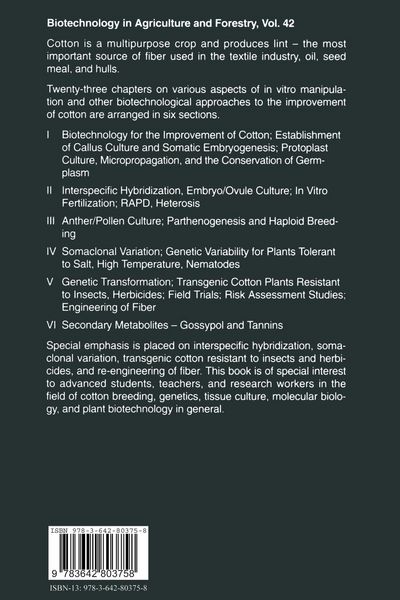
  • Section I Biotechnology for the Improvement of Cotton; Establishment of Callus Culture and Somatic Embryogenesis; Protoplast Culture; Micropropagation and the Conservation of Germplasm.- I.1 Biotechnology for the Improvement of Cotton.- I.2 Establishment of Callus Culture, Somatic Embryogenesis, and the Regeneration of Cotton Plants.- I.3 Regeneration of Plants from Cotton Protoplasts.- I.4 Micropropagation and the Conservation of Germplasm of Cotton.- Section II Interspecific Hybridization, Embryo/Ovule Culture; In Vitro Fertilization; RAPD; Heterosis.- II.1 Interspecific Hybridization in Cotton Through Embryo Rescue and Culture.- II.2 In Vitro Fertilization in Cotton.- II.3 In Vitro Culture of Cotton Ovules.- II.4 Use of Random Amplified Polymorphic DNA (RAPD) Markers to Assist Wide Hybridization in Cotton.- II.5 Heterosis in Cotton.- Section III Anther/Pollen Culture; Parthenogenesis and Haploid Breeding.- III.1 Anther Culture Studies and Pollen Embryogenesis in Cotton.- III.2 In Vitro Culture of Isolated Pollen of Cotton.- III.3 Parthenogenesis and Haploid Breeding in Gossypium hirsutum.- Section IV Somaclonal Variation/Genetic Variability; Plants Tolerant to Salt and Water Stress, High Temperature, and Nematodes (for plants resistant to insects and herbicides see Chaps. V.2,3 this Volume).- IV.1 Somaclonal Variation in Cotton.- IV.2 Salt and Water Stress-Tolerant Cotton.- IV.3 In Vitro Regeneration of High Temperature-Resistant Cotton Plants.- IV.4 Nematode Resistance in Cotton.- Section V Genetic Transformation; Transgenic Cotton Resistant to Insects and Herbicides; Field Trials; Risk Assessment Studies; Gentic Engineering of Fiber.- V.I Genetic Transformation of Cotton Through Particle Bombardment.- V.2 Insect-Resistant Transgenic Cotton.- V.3 Transgenic Cotton Resistant to the Herbicide 2,4-D.- V.4 Effect of Transgenic Cotton Expressing the Bacillus thuringiensis var. kurstaki Endotoxin on Soil Microorganisms - Risk Assessment Studies.- V.5 Genetic Engineering of Cotton Fiber.- Section VI Secondary Metabolites — Gossypol and Tannins.- VI.1 Gossypol — A Unique Biologically Active Compound from the Cotton Plant.- VI.2 Tannins in Cotton.