• Produktbild: Models of Neural Networks I
  • Produktbild: Models of Neural Networks I

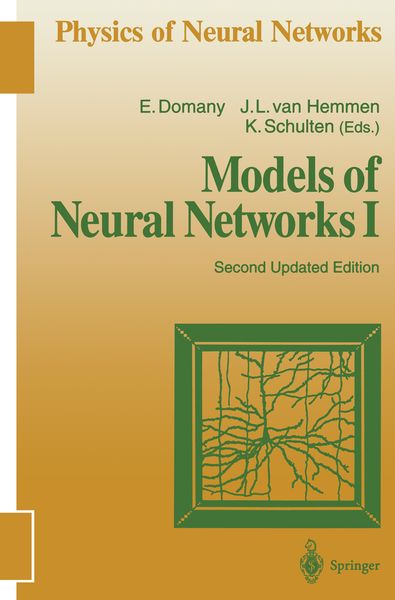
Models of Neural Networks I

Fr. 72.90

inkl. gesetzl. MwSt., Versandkostenfrei


Beschreibung

Produktdetails

Einband

Taschenbuch

Erscheinungsdatum

19.01.2012

Herausgeber

Eytan Domany + weitere

Verlag

Springer Berlin

Seitenzahl

355

Maße (L/B/H)

23.5/15.5/2.1 cm

Gewicht

575 g

Auflage

Second Edition 1995

Sprache

Englisch

ISBN

978-3-642-79816-0

Beschreibung

Produktdetails

Einband

Taschenbuch

Erscheinungsdatum

19.01.2012

Herausgeber

Verlag

Springer Berlin

Seitenzahl

355

Maße (L/B/H)

23.5/15.5/2.1 cm

Gewicht

575 g

Auflage

Second Edition 1995

Sprache

Englisch

ISBN

978-3-642-79816-0

Herstelleradresse

Springer-Verlag KG
Sachsenplatz 4-6
1201 Wien
AT

Email: GPSR Kontakt

Noch keine Bewertungen vorhanden

Verfassen Sie die erste Bewertung zu diesem Artikel

Helfen Sie anderen Kundinnen und Kunden durch Ihre Meinung.

Kundinnen und Kunden meinen

Bewertungen (0)

  • Produktbild: Models of Neural Networks I
  • Produktbild: Models of Neural Networks I
  • 1. Collective Phenomena in Neural Networks.- 1.1 Introduction and Overview.- 1.1.1 Collective Phenomena in a Historical Perspective.- 1.1.2 The Role of Dynamics.- 1.1.3 Universality, Locality, and Learning.- 1.1.4 Outline of this Paper.- 1.2 Prerequisites.- 1.2.1 Large Deviations: A Case Study.- 1.2.2 Large Deviations: General Principles.- 1.2.3 A Mathematical Detour.- 1.2.4 Sublattice Magnetizations.- 1.2.5 The Replica Method.- 1.3 The Hopfield Model.- 1.3.1 The Hopfield Model with Finitely Many Patterns.- 1.3.2 Stability.- 1.3.3 The Hopfield Model with Extensively Many (Weighted) Patterns.- 1.3.4 The Phase Diagram of the Hopfield Model.- 1.3.5 Discussion.- 1.3.6 Parallel Dynamics (the Little Model).- 1.3.7 Continuous-Time Dynamics and Graded-Response Neurons.- 1.4 Nonlinear Neural Networks.- 1.4.1 Arbitrary Synaptic Kernel and Finitely Many Patterns.- 1.4.2 Spectral Theory.- 1.4.3 Extensively Many Patterns.- 1.5 Learning, Unlearning, and Forgetting.- 1.5.1 Introduction.- 1.5.2 The Pseudoinverse Learning Rule.- 1.5.3 The Perceptron Convergence Theorem.- 1.5.4 Hebbian Learning.- 1.5.5 Intermezzo.- 1.5.6 Hebbian Unlearning.- 1.5.7 Forgetting.- 1.6 Hierarchically Structured Information.- 1.6.1 Structured Information, Markov Chains, and Martingales.- 1.6.2 Signal-to-Noise-Ratio Analysis.- 1.6.3 Equivalence to the Hopfield Model.- 1.6.4 Weighted Hierarchies.- 1.6.5 Low-Activity Patterns.- 1.6.6 Discussion.- 1.7 Outlook.- References.- 2. Information from Structure: A Sketch of Neuroanatomy.- 2.1 Development of the Brain.- 2.2 Neuroanatomy Related to Information Handling in the Brain.- 2.3 The Idea of Electronic Circuitry.- 2.4 The Projection from the Compound Eye onto the First Ganglion (Lamina) of the Fly.- 2.5 Statistical Wiring.- 2.6 Symmetry of Neural Nets.- 2.7 The Cerebellum.- 2.8 Variations in Size of the Elements.- 2.9 The Cerebral Cortex.- 2.10 Inborn Knowledge.- References.- 3. Storage Capacity and Learning in Ising-Spin Neural Networks.- 3.1 Introduction.- 3.1.1 The Model.- 3.1.2 Content-addressable Memory.- 3.1.3 The Hopfield Model.- 3.1.4 The Spin-glass Analogy.- 3.1.5 Finite Temperature.- 3.2 Content-addressability: A Dynamics Problem.- 3.2.1 Numerical Tests.- 3.3 Learning.- 3.3.1 Learning Perfect Storage.- 3.3.2 Enforcing Content-addressability.- 3.3.3 Optimal Learning.- 3.3.4 Training with Noise.- 3.3.5 Storing Correlated Patterns.- 3.4 Discussion.- References.- 4. Dynamics of Learning.- 4.1 Introduction.- 4.2 Definition of Supervised Learning.- 4.3 Adaline Learning.- 4.4 Perceptron Learning.- 4.5 Binary Synapses.- 4.6 Basins of Attraction.- 4.7 Forgetting.- 4.8 Outlook.- References.- 5. Hierarchical Organization of Memory.- 5.1 Introduction.- 5.2 Models: The Problem.- 5.3 A Toy Problem: Patterns with Low Activity.- 5.4 Models with Hierarchically Structured Information.- 5.5 Extensions.- 5.6 The Enhancement of Storage Capacity: Multineuron Interactions.- 5.7 Conclusion.- References.- 6. Asymmetrically Diluted Neural Networks.- 6.1 Introduction.- 6.2 Solvability and Retrieval Properties.- 6.3 Exact Solution with Dynamic Functionals.- 6.4 Extensions and Related Work.- Appendix A.- Appendix B.- Appendix C.- References.- 7. Temporal Association.- 7.1 Introduction.- 7.2 Fast Synaptic Plasticity.- 7.2.1 Synaptic Plasticity in Hopfield-Type Networks.- 7.2.2 Sequence Generation by Selection.- 7.3 Noise-Driven Sequences of Biased Patterns.- 7.4 Stabilizing Sequences by Delays.- 7.4.1 Transition Mechanism and Persistence Times.- 7.4.2 Analytic Description of the Dynamics.- 7.4.3 Extreme Dilution of Synapses.- 7.5 Applications: Sequence Recognition, Counting, and the Generation of Complex Sequences.- 7.5.1 Sequence Recognition and Counting.- 7.5.2 Complex Sequences.- 7.6 Hebbian Learning with Delays.- 7.7 Epilogue.- References.- 8. Self-organizing Maps and Adaptive Filters.- 8.1 Introduction.- 8.2 Self-organizing Maps and Optimal Representation of Data.- 8.3 Learning Dynamics in the Vicinity of a Stationary State.- 8.4 Relation to Brain Modeling.- 8.5 Formation of a “Somatotopic Map”.- 8.6 Adaptive Orientation and Spatial Frequency Filters.- 8.7 Conclusion.- References.- 9. Layered Neural Networks.- 9.1 Introduction.- 9.2 Dynamics of Feed-Forward Networks.- 9.2.1 General Overview.- 9.2.2 The Model: Its Definition and Solution by Gaussian Transforms.- 9.2.3 Generalization for Other Couplings.- 9.3 Unsupervised Learning in Layered Networks.- 9.3.1 Hebbian Learning and the Development of Orientation-Sensitive Cells and Columns.- 9.3.2 Information-Theoretic Principles Guiding the Development of the Perceptual System.- 9.3.3 Iterated Hebbian Learning in a Layered Network.- 9.4 Supervised Learning in Layered Networks.- 9.5 Summary and Discussion.- References.- Elizabeth Gardner-An Appreciation.