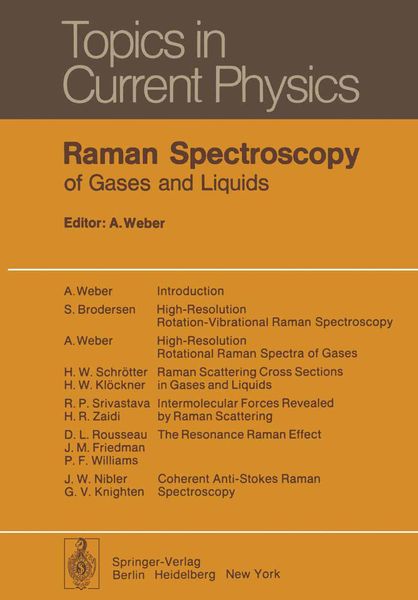
Produktbild: Raman Spectroscopy of Gases and Liquids
Band 11

Raman Spectroscopy of Gases and Liquids

Fr. 137.00

inkl. gesetzl. MwSt., Versandkostenfrei


Beschreibung

Produktdetails

Einband

Taschenbuch

Erscheinungsdatum

13.12.2011

Herausgeber

A. Weber

Verlag

Springer Berlin

Seitenzahl

320

Maße (L/B/H)

24.4/17/1.9 cm

Gewicht

576 g

Auflage

Softcover reprint of the original 1st ed. 1979

Sprache

Englisch

ISBN

978-3-642-81281-1

Beschreibung

Produktdetails

Einband

Taschenbuch

Erscheinungsdatum

13.12.2011

Herausgeber

A. Weber

Verlag

Springer Berlin

Seitenzahl

320

Maße (L/B/H)

24.4/17/1.9 cm

Gewicht

576 g

Auflage

Softcover reprint of the original 1st ed. 1979

Sprache

Englisch

ISBN

978-3-642-81281-1

Herstelleradresse

Springer-Verlag KG
Sachsenplatz 4-6
1201 Wien
AT

Email: ProductSafety@springernature.com

Kundinnen und Kunden meinen

0 Bewertungen

Informationen zu Bewertungen

Zur Abgabe einer Bewertung ist eine Anmeldung im Konto notwendig. Die Authentizität der Bewertungen wird von uns nicht überprüft. Wir behalten uns vor, Bewertungstexte, die unseren Richtlinien widersprechen, entsprechend zu kürzen oder zu löschen.

Die Bewertungen sind nach Format, Anzahl Sterne und Datum sortiert.

Verfassen Sie die erste Bewertung zu diesem Artikel

Helfen Sie anderen Kund*innen durch Ihre Meinung

Kundinnen und Kunden meinen

0 Bewertungen filtern

  • Produktbild: Raman Spectroscopy of Gases and Liquids
  • 1. Introduction.- References.- 2. High-Resolution Rotation-Vibrational Raman Spectroscopy.- 2.1 Theory.- 2.1.1 Intensity Expressions.- 2.1.2 Selection Rules.- 2.1.3 The Vibrational Matrix Element.- 2.1.4 Linear Molecules.- 2.1.5 Symmetric Top Molecules.- 2.1.6 Asymmetric Top Molecules.- 2.1.7 Spherical Top Molecules.- 2.1.8 Comparison with the Theory of Infrared Spectra.- 2.2 Experimental Technique.- 2.2.1 General Features of Instrumentation and Technique.- 2.2.2 Details of Present Instruments.- 2.2.3 Comparison to Infrared Experimental Techniques.- 2.3 Results.- 2.3.1 General Remarks.- 2.3.2 Linear Molecules.- 2.3.3 C3v Molecules.- 2.3.4 Other Symmetric Top Molecules.- 2.3.5 Asymmetric Top Molecules.- 2.3.6 Spherical Top Molecules.- 2.3.7 Conclusion.- References.- 3. High-Resolution Rotational Raman Spectra of Gases.- 3.1 Instrumentation and Techniques.- 3.1.1 The Raman Source Unit.- a) The Laser System.- b) The Scattering Cell.- c) The Illuminating Optics.- d) The Transfer Optics.- 3.1.2 Filters.- 3.1.3 The Spectrograph.- 3.1.4 Recording Materials.- 3.1.5 Wavelength Standards.- 3.1.6 Determination of Raman Shifts.- 3.1.7 Photoelectric Spectrometers.- 3.1.8 Interferometric Techniques.- 3.2 Observed Rotational Spectra.- 3.2.1 Diatomic Molecules.- 3.2.2 Linear Polyatomic Molecules.- 3.2.3 Symmetric Top Molecules.- 3.2.4 Asymmetric Top Molecules.- 3.2.5 “Forbidden” Pure Rotational Spectra.- a) Spherical Top Molecules — Td Symmetry.- b) Symmetric Top Molecules — C3V Symmetry.- 3.3 Summary.- References.- 4. Raman Scattering Cross Sections in Gases and Liquids.- 4.1 Raman Scattering Cross Sections in Gases.- 4.1.1 Theoretical Considerations.- 4.1.2 Determination of the Absolute Scattering Cross Section of Nitrogen.- 4.1.3 Measurement of Relative Scattering Cross Sections.- a) Experimental Procedure.- b) Results.- c) Influence of the Resonance Raman Effect.- 4.2 Raman Scattering Cross Sections in Liquids.- 4.2.1 Internal Field Effect and Intermolecular Interactions.- 4.2.2 Absolute Scattering Cross Sections.- 4.2.3 Relative Scattering Coefficients.- 4.3 Ratio of the Raman Scattering Cross Section in the Liquid and in the Gaseous State.- 4.4 Conclusion.- References.- 5. Intermolecular Forces Revealed by Raman Scattering.- 5.1 Introductory Remarks.- 5.2 Spectral Function for Raman Scattering.- 5.3 Impact Theory.- 5.4 Isolated Lines.- 5.4.1 Calculation of Line Widths and Shifts.- a) Non-Perturbative Approaches.- b) Perturbative Approaches.- c) Line Shift.- 5.4.2 Comparison of Theory with Experiment and Information Obtained about Intermolecular Potentials.- 5.5 Overlapping Lines and Band Shapes.- 5.6 Statistical Theories.- 5.7 Liquids.- 5.8 Conclusion.- References.- 6. The Resonance Raman Effect.- 6.1 Resonance Raman Scattering.- 6.2 Diatomic Molecules.- 6.2.1 Discrete Resonance Raman Scattering.- 6.2.2 Continuum Resonance Raman Scattering.- 6.2.3 Perturbed Diatomic Molecules.- 6.3 Polyatomic Molecules.- 6.4 Porphyrin Compounds.- 6.4.1 Porphyrin Absorption Spectrum.- 6.4.2 Helpful Diagrams.- 6.4.3 Scattering from Q0, Q1, and B.- 6.4.4 Anomalous Polarization.- 6.4.5 Interference Effects.- 6.4.6 Non-Adiabatic Effects.- 6.4.7 Influence of Jahn-Teller Distortion.- 6.5 Concluding Remarks.- References.- 7. Coherent Anti-Stokes Raman Spectroscopy.- 7.1 Theory.- 7.1.1 Maxwell’s Equations for Macroscopic Samples.- 7.1.2 Symmetry Properties of ?(3)258.- 7.1.3 CARS Amplitudes.- 7.1.4 Raman Amplitudes.- 7.1.5 Microscopic Third-Order Susceptibilities.- 7.2 Comparison of CARS and Raman Spectroscopy.- 7.2.1 Signal Strengths.- 7.2.2 Lineshapes and Maxima.- 7.2.3 Selection Rules.- 7.2.4 Orientation Averaging and Polarization Behavior.- 7.3 Experimental Aspects of CARS.- 7.4 Survey of CARS Experimental Results.- 7.4.1 Solids.- 7.4.2 Liquids.- 7.4.3 Gases.- a) Combustion and Gas Diagnostics.- b) Plasma Diagnostics.- c) Photochemical, Kinetic and Excited State Studies.- d) High-Resolution Spectroscopy.- 7.4.4 Solutions.- 7.4.5 Background Suppression in CARS.- 7.5 Summary.- References.- Additional References with Titles.