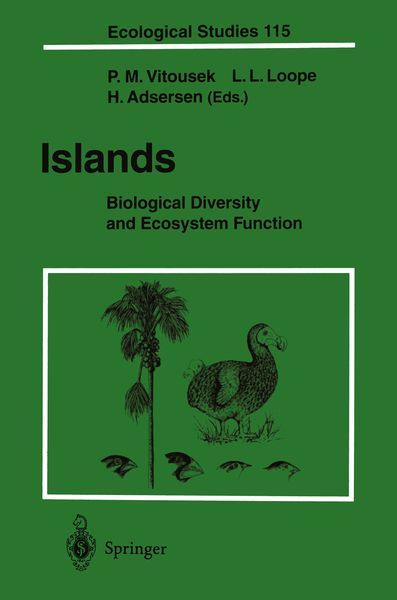
Produktbild: Islands
Band 115

Islands Biological Diversity and Ecosystem Function

Aus der Reihe Ecological Studies

Fr. 137.00

inkl. gesetzl. MwSt., Versandkostenfrei


Beschreibung

Produktdetails

Einband

Taschenbuch

Erscheinungsdatum

30.12.2011

Illustriert von

K. Madsen

Herausgeber

Peter Vitousek + weitere

Verlag

Springer Berlin

Seitenzahl

238

Maße (L/B/H)

23.5/15.5/1.5 cm

Gewicht

406 g

Auflage

Softcover reprint of the original 1st ed. 1995

Sprache

Englisch

ISBN

978-3-642-78965-6

Beschreibung

Produktdetails

Einband

Taschenbuch

Erscheinungsdatum

30.12.2011

Illustriert von

K. Madsen

Herausgeber

Verlag

Springer Berlin

Seitenzahl

238

Maße (L/B/H)

23.5/15.5/1.5 cm

Gewicht

406 g

Auflage

Softcover reprint of the original 1st ed. 1995

Sprache

Englisch

ISBN

978-3-642-78965-6

Herstelleradresse

Springer-Verlag KG
Sachsenplatz 4-6
1201 Wien
AT

Email: ProductSafety@springernature.com

Kundinnen und Kunden meinen

0 Bewertungen

Informationen zu Bewertungen

Zur Abgabe einer Bewertung ist eine Anmeldung im Konto notwendig. Die Authentizität der Bewertungen wird von uns nicht überprüft. Wir behalten uns vor, Bewertungstexte, die unseren Richtlinien widersprechen, entsprechend zu kürzen oder zu löschen.

Die Bewertungen sind nach Format, Anzahl Sterne und Datum sortiert.

Verfassen Sie die erste Bewertung zu diesem Artikel

Helfen Sie anderen Kund*innen durch Ihre Meinung

Kundinnen und Kunden meinen

0 Bewertungen filtern

  • Produktbild: Islands
  • 1 Introduction — Why Focus on Islands?.- Section A: Patterns and Levels of Diversity.- 2 Research on Islands: Classic, Recent, and Prospective Approaches.- 2.1 Introduction.- 2.2 Classic Approaches.- 2.2.1 The Dodo Approach.- 2.2.2 The Finch Approach.- 2.2.3 The Island Biogeography Approach.- 2.3 Recent Approaches.- 2.3.1 The Spider Approach.- 2.3.2 The Biodiversity Approach.- 2.3.2.1 Endemism.- 2.3.2.2 Isolation.- 2.3.2.3 Distribution Pattern and Biodiversity.- 2.3.2.4 “Dodos” and Biodiversity.- 2.3.2.5 “Finches” and Biodiversity.- 2.3.2.6 “Spiders” and Biodiversity.- 2.3.2.7 Conservation and Biodiversity.- 2.3.3 The Ecosystem Functions Approach.- 2.3.4 The Conservation Approach.- 2.4 Recapitulation.- 2.4.1 Islands as Model Ecosystems.- 2.4.2 Isolates that are Not Islands.- 2.5 Prospective Approaches.- References.- 3 Evolution, Speciation, and the Genetic Structure of Island Populations.- 3.1 Introduction.- 3.2 The Biota of the Hawaiian Islands.- 3.3 Geological Features of the Hawaiian Islands.- 3.4 Natural Selection Versus Sexual Selection.- 3.5 Classical Sexual Selection Theory.- 3.6 The Differential Selection Model.- 3.7 Small Populations and Founder Event Speciation.- 3.8 The Biology of Small Populations.- 3.9 Population Bottlenecks and the Genetic Variability Paradox.- 3.10 The Role of Natural Hybridization.- 3.11 The Role of Sexual Selection in Conservation Biology.- 3.12 Conclusions.- References.- 4 Patterns of Diversity in Island Plants.- 4.1 Introduction.- 4.2 Disharmony and Endemism.- 4.3 Adaptive Radiation.- 4.4 Morphological Features of Island Plants.- 4.4.1 Island Woodiness.- 4.4.2 Loss of Dispersibility.- 4.4.3 Changes in Reproductive Biology.- 4.5 Selected Examples of Adaptive Radiation in Hawaii and the Galápagos Islands.- 4.5.1 The Hawaiian Silversword Alliance.- 4.5.2 Lipochaeta in Hawaii.- 4.5.3 Lobelioideae in Hawaii.- 4.5.4 Scalesia in the Galápagos.- 4.5.5 Macraea in the Galápagos.- 4.5.6 Lecocarpus in the Galápagos.- References.- 5 Vertebrate Patterns on Islands.- 5.1 Introduction.- 5.2 Islands and Biodiversity.- 5.3 Islands as Microcosms.- References.- 6 Patterns of Diversity in Island Soil Fauna: Detecting Functional Redundancy.- 6.1 Introduction.- 6.2 The Role of Soil Fauna in Ecosystem Processes.- 6.3 Taxonomic Impediments.- 6.4 Patterns of Diversity for Island Soil Fauna in Hawaii.- 6.4.1 Age Gradient.- 6.4.2 Elevational Gradient.- 6.4.3 Disturbance Gradients.- 6.5 Conclusion.- References.- 7 Ecosystem and Landscape Diversity: Islands as Model Systems.- 7.1 Introduction.- 7.2 Ecosystem Diversity on Islands.- 7.3 The State Factors and Their Interactions.- 7.3.1 Climate.- 7.3.2 Organisms.- 7.3.3 Relief.- 7.3.4 Parent Material.- 7.3.5 Time.- 7.3.6 Interactions.- 7.4 Ecosystem Diversity and Ecosystem Function.- References.- Section B: Threats to Diversity on Islands.- 8 Prehistoric Extinctions and Ecological Changes on Oceanic Islands.- 8.1 Introduction.- 8.2 Diversity.- 8.3 Prehuman Extinctions.- 8.4 Prehuman Biological Invasions.- 8.5 Anthropogenic Deletions.- 8.6 Vertebrate Feeding Guilds.- 8.7 Future Directions.- References.- 9 Biological Invasions as Agents of Change on Islands Versus Mainlands.- 9.1 Introduction.- 9.2 Are Islands Inherently More Subject to Invasion?.- 9.3 Effects of Introduced Species.- 9.3.1 Species-Level Effects.- 9.3.2 Ecosystem-Level Effects.- 9.4 Ecosystem Function and Species Loss as a Result of Invasion.- 9.5 Conclusions.- References.- 10 Climate Change and Island Biological Diversity.- 10.1 Introduction.- 10.2 Quaternary Climates of Islands: What Do We Know?.- 10.2.1 Quaternary Environments of Oceans.- 10.2.2 Pertinent Information on Quaternary Environments of the African and South American Tropics.- 10.2.3 Hawaiian Islands.- 10.2.3.1 Present-Day conditions.- 10.2.3.2 What Do We Know About Quaternary Paleoenvironments in Hawaii?.- 10.2.4 Galápagos Islands.- 10.2.5 Easter Island and Other Sites in the Southern Pacific.- 10.3 Biological Effects of Warming on Islands.- 10.4 Conclusions: Prognosis for Potential Effects of Global Warming on Island Biological Diversity.- References.- Section C: Diversity and Ecosystem Function.- 11 Ecosystem-Level Consequences of Species Additions and Deletions on Islands.- 11.1 Introduction.- 11.2 Linking Biodiversity to Ecosystem Processes.- 11.3 Additions and Deletions on Islands.- 11.3.1 Functional Properties of Island Species.- 11.3.1.1 Land Crabs and Snails on Christmas Island.- 11.3.1.2 Manuring, Moths, and Mice on Marion Island.- 11.3.1.3 Moose on Isle Royale.- 11.4 Predicting Consequences of Additions and Deletions.- 11.4.1 Probabilistic Rules.- 11.4.2 Problems with Probabilistic Rules.- 11.5 Island-Mainland Comparisons.- 11.6 Functional “Redundancy”.- References.- 12 Biological Diversity and the Maintenance of Mutualisms.- 12.1 Ecological Interactions.- 12.2 Representative Examples of Mutualisms.- 12.2.1 Ant-Plant Relationships.- 12.2.2 Ants and Other Invertebrates.- 12.2.3 Figs and Insect Pollinators.- 12.2.4 Bat Pollination Systems.- 12.3 Chatham Islands: Ecosystem Disruption and Mutualisms.- 12.3.1 Sophora microphylla Pollination.- 12.3.2 Rhopalostylis Seed Dispersal.- 12.4 Seabirds and Soil — Commensalisms or Indirect Mutualisms.- 12.5 The Survival of Mutualisms on Islands.- 12.6 Management Under a Monoculture Scenario.- References.- 13 Biological Diversity and Disturbance Regimes in Island Ecosystems.- 13.1 Introduction.- 13.2 Disturbance Regimes and Biodiversity Patterns Across the Pacific Islands.- 13.2.1 Disturbance Regimes.- 13.2.2 Biodiversity Patterns.- 13.2.3 The Concept of Biological Diversity.- 13.3 Disturbance Regimes and Biodiversity as Factors in Ecosystem Development.- 13.3.1 Factors in Ecosystem and Vegetation Development.- 13.3.2 Case Examples.- 13.4 Disturbance Regime and Stand Demography.- 13.4.1 Disturbance as a Multivariate Regime.- 13.4.2 Developmental Stages in Stand Demography.- 13.4.3 Interaction Between Scale Variables and the Ecological Community.- 13.5 Tree Mortality Patterns as Mediated by Biodiversity and Disturbance Regime.- 13.6 Summary and Conclusion.- References.- 14 Effects of Diversity on Productivity: Quantitative Distributions of Traits.- 14.1 Introduction.- 14.2 Simple Distributions of Traits.- 14.3 Distributions of Two or More Traits.- 14.4 Complementarity and Tradeoffs Among Traits.- 14.5 Biodiversity and the Usefulness of Production.- 14.6 Conclusions.- References.- Section D: Conservation Implications.- 15 Insular Lessons for Global Biodiversity Conservation with Particular Reference to Alien Invasions.- 15.1 Introduction.- 15.2 Insular Lessons for Conservation.- 15.2.1 Island Biogeographic Theory.- 15.2.2 Susceptability of Insular Biotas to Alien Invasions.- 15.2.3 Additions of Species.- 15.2.4 The Loss of “Key” Species.- 15.2.5 Changing Disturbance Regimes Favour Alien Invasions.- 15.2.6 Alien-Dominated Ecosystems Are Unstable in the Long-Term.- 15.3 Conclusion.- References.- 16 Saint Helena: Sustainable Development and Conservation of a Highly Degraded Island Ecosystem.- 16.1 Introduction: Small Islands and Sustainable Development.- 16.2 Geology and Climate of St Helena.- 16.3 The Original Ecology of St Helena.- 16.4 Mechanisms of Environmental Degradation.- 16.4.1 Extinctions and Habitat Loss.- 16.5 Species Recovery and Habitat Restoration on St Helena.- 16.5.1 Sustainable Environment and Development Strategy for St Helena.- 16.6 Conclusions.- References.- Section E: Where Can We Go from Here?.- 17 Biodiversity and Ecosystem Function: Using Natural Attributes of Islands.- 17.1 Introduction.- 17.2 Using Island Gradients.- 17.3 Diversity, Disturbance, and Stability.- 17.4 Continental Islands: Terrestrial and Aquatic.- 17.5 Summary.- References.- 18 Experimental Studies on Islands.- 18.1 Introduction.- 18.2 Advantages of Islands.- 18.3 Examples.- 18.3.1 Within-Ecosystem Processes.- 18.3.2 Larger-Scale Phenomena.- 18.4 Conclusions.- Reference.